
 How Much Are They Worth?
Celebrity fortunes, explained
How Much Are They Worth?
Celebrity fortunes, explained









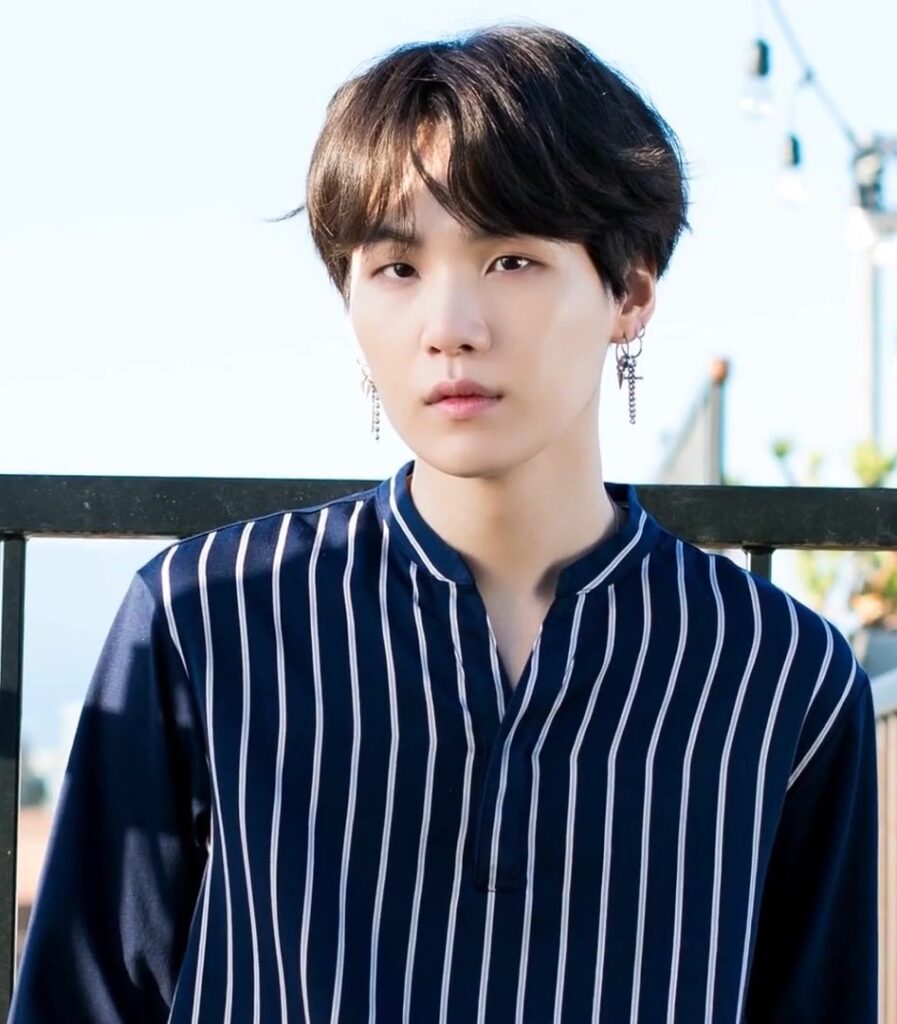
How did Suga (Min Yoon-gi) build this fortune?
The answer unfolds through the career, earnings, deals and assets behind the headline estimate.
Before the fame
The background and early turning points that shaped Suga (Min Yoon-gi)’s route to prominence.
Min Yoon-gi, known professionally as Suga and, in his solo work, as Agust D, was born on 9 March 1993 in Daegu, South Korea, the younger of two sons. He began writing lyrics and teaching himself music production on a home computer at around 13, and by his mid-teens was working part-time at a local recording studio, arranging and composing tracks for other acts before he had ever performed under his own name. At 17 he left Daegu for Seoul to pursue music professionally, a decision he has described as a considerable gamble at the time, according to Wikipedia. His stage name Suga is generally attributed to the “shooting guard” position he played in school basketball, while his solo alias Agust D combines “DT,” an abbreviation of his hometown “Daegu Town,” with “Suga” spelled backwards.
Suga signed with Big Hit Entertainment (now HYBE) as a producer-trainee and spent roughly three years training before debuting in June 2013 as a member of BTS on the music programme M Countdown, performing “No More Dream” from the group’s first album, 2 Cool 4 Skool. Unlike many idol trainees, he was recruited chiefly for his production and songwriting ability rather than performance alone, and he registered his first professional production credit, the protest track “518-062” with the hip-hop crew D-Town, in 2010, before BTS existed. That grounding meant he was writing and producing BTS material from the group’s earliest releases onward, building a catalogue of composer and lyricist credits, now numbering more than 160 registered works with the Korea Music Copyright Association, that would later underpin both his BTS earnings and a prolific outside production career writing for acts including Suran, IU, Halsey and Psy.
The breakthrough years
The career decisions and defining moments that turned recognition into sustained earning power.
BTS’s global breakout through the mid-to-late 2010s gave Suga a platform, but his own breakthrough as a distinct artist came from stepping outside the group. He released his debut mixtape, Agust D, as a free download in August 2016, using it to address depression and social anxiety with a directness rare in K-pop, and followed it with D-2 in May 2020, which entered the UK Albums Chart and reached number 11 on the Billboard 200, then the highest placement for a Korean solo act. That trajectory culminated in April 2023 with D-Day, his first full studio album released under the Agust D name, which debuted at number 2 on the Billboard 200, tying the record for the highest chart entry ever achieved by a Korean solo artist, matched only by bandmate Jimin weeks earlier, according to Korea.net, the official website of the Republic of Korea.

What the work can earn
Reported pay, contracts, royalties and performance income reveal how the fortune was funded.
As part of BTS, Suga has received five Grammy Award nominations across three ceremonies, including Best Pop Duo/Group Performance for “Dynamite” (2021) and “Butter” (2022), Best Music Video for “Yet to Come” (2023), and a share in the Album of the Year nomination for Coldplay’s Music of the Spheres, on which BTS featured, per Grammy.com. His D-Day World Tour, staged across the United States and Asia between April and August 2023, played 28 shows to more than 320,000 fans and grossed 57.2 million dollars, making it the highest-grossing concert tour ever undertaken by a K-pop soloist, and the accompanying concert film, Suga: Agust D Tour “D-Day” the Movie, went on to become the highest-grossing concert film released in the United States and worldwide in 2024, as reported by Wikipedia’s entry on the D-Day Tour.
Suga’s standing extends well beyond chart placements. In July 2021, South Korea’s then-President Moon Jae-in appointed all seven BTS members Special Presidential Envoys for Future Generations and Culture, and that September the group appeared before the 76th United Nations General Assembly in New York to deliver a speech on youth issues, climate action and COVID-19 recovery, a session covered live around the world, as reported by ABC News Australia. In 2018 the group had already received the South Korean government’s Hwagwan Order of Cultural Merit for their role in spreading Korean culture internationally. Within the music industry specifically, Suga built a separate reputation as a producer capable of moving between K-pop, R&B and hip-hop, work that earned him the informal nickname “the hand of Midas” among Korean commentators for the commercial success of the tracks he touches.
The business beyond the main career
Endorsements, ownership interests and investments can keep compounding long after the initial breakthrough.
Suga was named a global brand ambassador for the Italian fashion house Valentino in January 2023, joining its “DI.VAs” roster of cultural figures and fronting campaigns including the Maison Valentino Essentials line, a partnership Valentino said reflected his authenticity and creative independence, as reported by WWD. Three months later, in April 2023, the NBA named him a global ambassador for the league, a role that has since included appearances at NBA games in the United States and Asia and a co-branded apparel capsule with Mitchell & Ness released under the SUGAxNBA label, according to the NBA’s official press release. He has also lent his voice to Samsung’s “Over the Horizon” ringtone, re-composing the brand’s signature theme in 2021.
Suga’s business interests are built less around founded companies than around equity and royalty streams tied directly to his creative output. When HYBE went public in October 2020, chairman Bang Si-hyuk gifted the seven BTS members a combined 478,695 common shares, 68,385 shares each, ahead of the listing. Unlike several bandmates who later sold down portions of their stakes, Suga is reported to have retained his full allocation, which was valued at roughly 21.4 billion won, or approximately 14.8 million US dollars, as of December 2025, according to Outlook Respawn. Beyond that stake, he continues to draw ongoing songwriting and production royalties through the Korea Music Copyright Association from his back catalogue, which spans BTS releases, his own solo work and outside productions for other artists.

Notable luxury item
A reported property or major asset offers a tangible glimpse of the wealth behind the public estimate.
In August 2018, Suga purchased a property in the Hannam Riverhill complex in Seoul’s UN Village, an enclave favoured by conglomerate executives and entertainment figures, paying the full 3.4 billion won price, then equivalent to roughly 3 million US dollars, in cash rather than financing the purchase, according to SBS Star. The purchase mirrored a pattern among his BTS bandmates of buying Seoul real estate outright rather than taking on mortgage debt. His HYBE shareholding, detailed above, functions as a second major asset class alongside that property, giving him a wealth base split between real estate and listed equity rather than one concentrated in either.
Suga (Min Yoon-gi)’s estimated net worth
Public estimates vary because private contracts, investments, taxes and liabilities are not fully disclosed.
How this estimate is calculated
This estimate draws on Suga’s documented and reported financial position rather than any single published figure. His retained HYBE shareholding of 68,385 shares was worth an estimated 21.4 billion won, close to 14.8 million US dollars, as of December 2025. His 2023 D-Day World Tour grossed 57.2 million dollars across 28 shows, on top of income from a discography that includes a number 2 Billboard 200 debut album, two charting mixtapes, and more than 160 registered songwriting and production credits generating ongoing royalties. He additionally holds a Seoul property bought outright for 3.4 billion won in 2018, plus fees from ambassador roles with Valentino and the NBA. Taken together, these confirmed components support a net worth broadly in the range used below. Celebrity Net Worth, used here only as a secondary reference point, puts the figure higher, at 50 million dollars, but that estimate is not itemised against his disclosed HYBE stake or property records, so this estimate leans towards the more conservative range directly supported by his documented assets and income streams.
The working supports a range of $30 million to $40 million. The figure we publish is its midpoint.
Suga has given consistently and often quietly to causes tied to children’s welfare and disaster relief, typically timing large single donations to his birthday each March. Recorded gifts include roughly 100 million won to the Korea Pediatric Cancer Foundation in 2019, a similar sum to Hope Bridge Korea Disaster Relief Association for Daegu’s COVID-19 response in 2020, and further 100-million-won donations to child cancer care at Keimyung University Dongsan Hospital in 2021 and to wildfire and earthquake relief efforts in 2022, 2023 and 2025. By far his largest single act of giving came in June 2025, days after completing his military service, when he donated 5 billion won, around 3.6 million US dollars, to Seoul’s Severance Hospital to establish the Min Yoon-gi Center for autism treatment, having spent his final months of service volunteering there as a music instructor for children with autism spectrum disorder, per The Korea Herald. The gift prompted more than 200 million won in additional public donations to the hospital within a single day of the news breaking.
In August 2024, Suga fell while riding an electric scooter near his home in Hannam-dong, Seoul, prompting a police breath test that put him well over South Korea’s legal alcohol limit for personal mobility devices, which are treated under the same drink-driving laws as cars. He was formally indicted and, in a summary judgment issued by the Seoul Western District Court on 30 September 2024, fined 15 million won, around 11,500 US dollars, and had his licence to operate such devices revoked, according to the South China Morning Post. Suga issued a public apology at the time, describing his conduct as “careless and wrong,” and South Korea’s Military Manpower Administration, which he was then serving under as a social service agent, stated the incident concerned his personal time and did not affect his enlisted duties. The episode drew sustained domestic media coverage but did not lead to further legal or professional consequences beyond the fine.