
 How Much Are They Worth?
Celebrity fortunes, explained
How Much Are They Worth?
Celebrity fortunes, explained


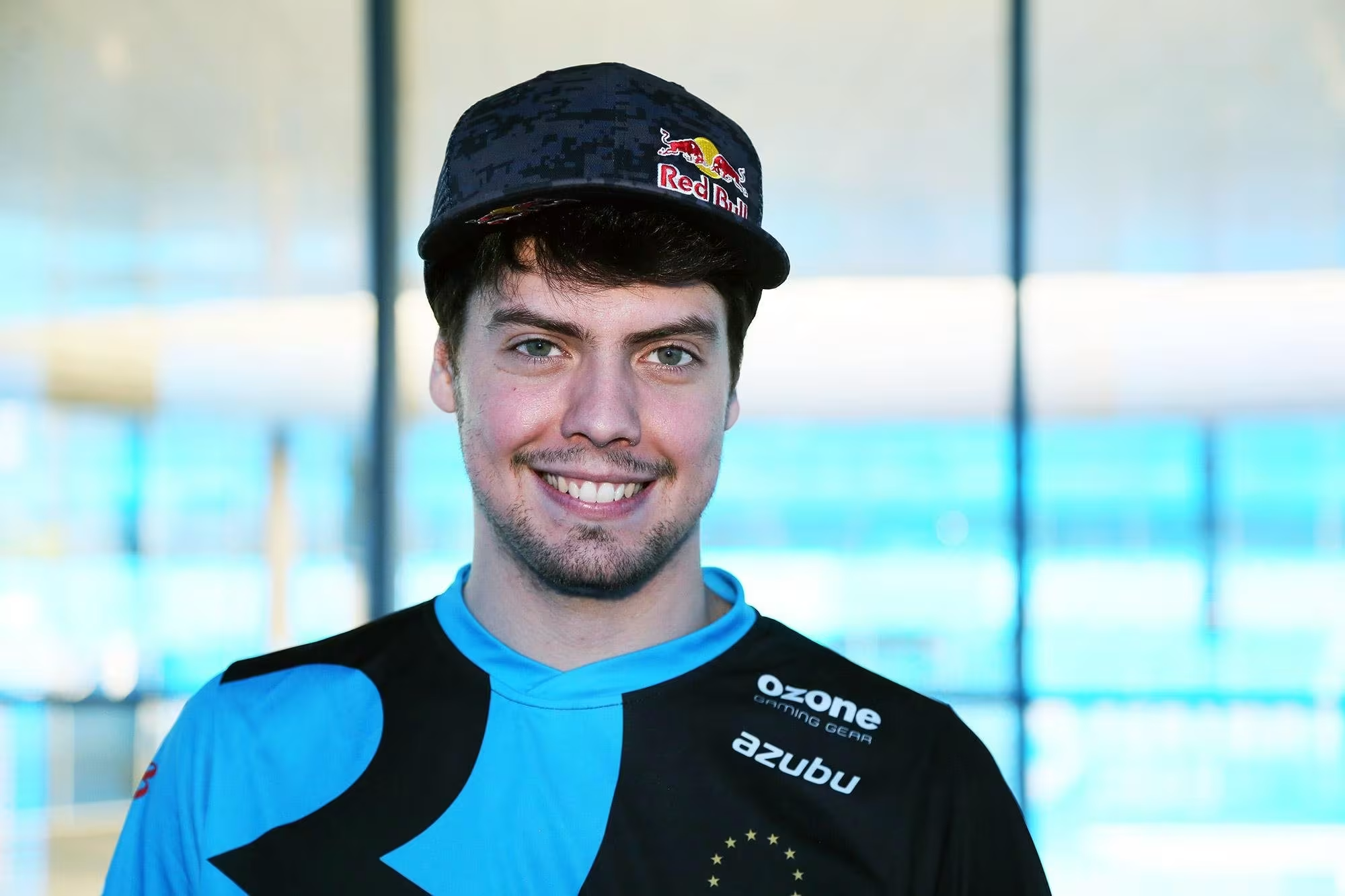




Disguised Toast (Jeremy Wang)
Net worth revealed after 6 slides
Begin the countdown ↓How did Disguised Toast (Jeremy Wang) build this fortune?
The answer unfolds through the career, earnings, deals and assets behind the headline estimate.
Before the fame
The background and early turning points that shaped Disguised Toast (Jeremy Wang)’s route to prominence.
Jeremy Wang was born on November 25, 1991, in Taipei, Taiwan. His family relocated to Penang, Malaysia before his first birthday, then later moved to Kingston, Ontario, Canada, after his older brother enrolled at a university there (Wikipedia).
Wang went on to study at the University of Waterloo, initially majoring in computer science before switching to mathematics, and graduated with a BSc in 2013. Before he streamed full time, he worked as an app developer for a string of large employers, including Mercedes-Benz, the NFL, the Royal Bank of Canada, and Zynga — a conventional corporate-tech resume that predates his entire online career (Wikipedia).
Wang’s online career started in 2015, when he began posting YouTube videos and infographics breaking down unusual card interactions in the digital card game Hearthstone. He streamed for years wearing a toast-shaped cardboard mask, a bit tied to his username — itself a reference to a Hearthstone card’s voice line, “this guy’s toast” — until he accidentally revealed his face on stream in October 2016 (Wikipedia).
His competitive Hearthstone career was short and uneven: he competed at the PAX East ONOG Major in March 2017 but was disqualified after oversleeping through his match, and he received a 72-hour competitive ban in June 2017 for showcasing an in-game exploit on stream (Wikipedia; Liquipedia). In October 2017, he joined OfflineTV, the Los Angeles-based content-creator collective, which became the platform for his shift away from a single-game competitor and toward the broad, personality-driven variety streaming that now defines his career.
The turning point came in summer 2019, when his Teamfight Tactics and Legends of Runeterra streams broke out and he briefly became the second most-watched streamer on Twitch — the moment that took him from “Hearthstone YouTuber” to one of the platform’s biggest all-around names (Wikipedia).
The breakthrough years
The career decisions and defining moments that turned recognition into sustained earning power.
That 2019 breakout directly led to Wang’s highest-profile platform move: in November 2019, he signed an exclusive streaming deal with Facebook Gaming, becoming one of the first major English-speaking creators to leave Twitch for the platform. The exact contract value was never disclosed, but Wang later said Twitch’s competing offer at the time was “insultingly low” and roughly 30 times smaller than what Facebook put on the table (CNN Business; Dot Esports).
His time on Facebook Gaming (2020-2021) coincided with the Among Us boom, which added more than two million YouTube subscribers and roughly 400 million views, and included collaborations with PewDiePie, Pokimane, and Logic, plus a widely covered Among Us stream with U.S. Representatives Alexandria Ocasio-Cortez and Ilhan Omar promoting voter turnout in October 2020 (Wikipedia).
Wang left Facebook Gaming in November 2021 and returned to Twitch a week later, signing a new deal that he candidly described on stream as underwhelming: “I took a trash-ass deal. No offense Twitch, but your offer was trash and we both know it. I took it though” — explaining he came back for his community, not the money (Dexerto). He was named to Forbes’ 30 Under 30 (Games) list in 2021. In January 2023, he founded his own esports organization, DSG, discussed in detail below, and in December 2023 he was named Esports Personality of the Year at the Esports Awards in Las Vegas (Esports.gg). As of 2026, he has 2.9 million Twitch followers and 3.77 million YouTube subscribers with more than 1.59 billion lifetime views (Wikipedia).

What the work can earn
Reported pay, contracts, royalties and performance income reveal how the fortune was funded.
There is no verified, publicly disclosed figure for Wang’s personal annual income. His revenue is spread across several channels — Twitch subscriptions and ad revenue, YouTube ad revenue across a channel with 1.59 billion total views, brand sponsorships, merchandise, and historically some tournament prize money — none of which he has broken out individually. Third-party stream-tracking sites publish wildly inconsistent estimates, ranging from roughly $600,000 to $840,000 a year on the high end down to figures well under $500,000 on the low end; these are automated, unverified scrapes of subscriber and viewership counts, not disclosed income, and should be read as directional at best.
What is more concretely documented is a major, ongoing outflow that most of those earnings estimators do not account for: since January 2023, Wang has personally funded his esports organization, DSG, at a reported cost of roughly $500,000 to $1 million a year, with no outside sponsors or investors covering the gap (Esports.gg; Dexerto). That spending meaningfully offsets whatever he brings in from streaming and content in a given year.
Wang’s competitive tournament winnings are one of the more precisely documented parts of his finances, if a modest one: tracking site Esports Earnings credits him with $61,250 in total prize money across 17 tournaments in multiple games between 2017 and 2022, including $13,250 from Hearthstone events, $16,200 from Fortnite, $11,250 from a Hearthstone Battlegrounds event, $4,800 from Teamfight Tactics, and smaller amounts from League of Legends, Apex Legends, Fall Guys, and Rust. His single largest prize was $9,075 for a second-place finish at a 2018 Fortnite Summer Skirmish event (Esports Earnings).
Far larger than any tournament winnings are his two major streaming-platform contracts. The November 2019 exclusive deal with Facebook Gaming was never disclosed in dollar terms, but Wang has said it dwarfed Twitch’s competing offer several times over (Dot Esports). By contrast, his November 2021 return to Twitch was, by his own description, a comparatively weak deal that he accepted for community reasons rather than money (Dexerto). Neither contract’s value has ever been made public, so no verified total exists for either deal.

The business beyond the main career
Endorsements, ownership interests and investments can keep compounding long after the initial breakthrough.
Over his streaming career, Wang has been reported to carry brand partnerships including NCSoft (Lineage 2: Revolution), Stunlock Studios (Battlerite), Respawn Entertainment (Apex Legends), HTC (Vive VR), HyperX gaming peripherals, Amazon, and Nexon (MapleStory 2), among others (Sportskeeda). These figures are not independently verified by financial disclosures and should be treated as reported rather than confirmed.
At the organizational level, DSG’s most notable brand partnership came in May 2024, when Chipotle Mexican Grill signed on as the founding partner of DSG’s entry into Tekken 8 esports, backing the roster around player Phi “PhiDX” Lam ahead of Evo 2024 (Esports Insider). Wang has also spoken publicly about how difficult it has been to attract corporate sponsorship for DSG more broadly, saying brands are “scared of esports because they invested millions into it and they didn’t get any significant return” (Tubefilter).
A note on sourcing before this section: this profile was originally briefed around the idea that Wang co-founded OTK (One True King), the Austin-based creator organization. Direct research turned up no evidence supporting that — OTK was founded in October 2020 by streamers Asmongold, Mizkif, Esfand, Rich Campbell, and Tips Out, and Wang does not appear in its member or founder lists (Wikipedia). His actual, well-documented affiliations are membership in OfflineTV since October 2017, and — far more significant to his finances — founding and personally bankrolling his own esports organization. This section covers what is actually documented rather than repeating an unverified premise.
Wang founded DSG (styled “Disguised”) on January 8, 2023, launching with a men’s Valorant roster in the North American Challengers League, followed weeks later by an all-female roster competing in the VCT Game Changers circuit (Wikipedia). The organization has no outside investors or corporate sponsors funding its core operations — by design, according to Wang, who has said the goal was to offer players “fair, flexible terms” rather than the more restrictive contracts common at other orgs (Tubefilter). Its budget reportedly grew from an initial estimate of $250,000-$300,000 to roughly $500,000 a year, with total 2023 operating costs reported at close to $1 million, all funded out of Wang’s own pocket (Esports.gg; Dexerto). In June 2023, Wang launched a Patreon to help offset those costs, which brought in roughly $2,780 a month from about 638 supporters shortly after launch — a small fraction of the organization’s annual spend (Dexerto).
DSG has since expanded into League of Legends (winning its debut NACL summer split in 2023), Apex Legends, Teamfight Tactics, and Tekken 8 and other fighting games (backed by the 2024 Chipotle partnership), and launched a North American Overwatch roster in January 2026. It also withdrew from VALORANT Challengers Southeast Asia and disbanded that roster in January 2025 (Wikipedia). Because DSG has never raised outside capital, there is no third-party funding round or valuation to point to the way there would be for a venture-backed esports company — which means, unlike a founder holding equity in a company like 100 Thieves or TSM, Wang’s exposure to DSG functions as an ongoing personal expense rather than an appreciating or independently priced asset.

Notable luxury item
A reported property or major asset offers a tangible glimpse of the wealth behind the public estimate.
No reliable public record of Wang purchasing a home, its price, or other major personal assets was located. For years he lived in OfflineTV’s shared Los Angeles house alongside other members of the collective — a group living arrangement and business asset of the OfflineTV brand rather than a personal property purchase by Wang. Absent a verified deed, listing, or on-record disclosure of a purchase price, this profile does not assign a value to any real estate or major asset Wang may personally own.
Disguised Toast (Jeremy Wang)’s estimated net worth
Public estimates vary because private contracts, investments, taxes and liabilities are not fully disclosed.
How this estimate is calculated
That is a genuinely wide range, and it needs to be, because almost none of the inputs are independently verified. Wang’s two largest streaming contracts — the 2019 Facebook Gaming deal and the 2021 Twitch re-signing — were both undisclosed in dollar terms; his tournament winnings are modest and precisely tracked at $61,250; his YouTube and Twitch ad/subscription income has never been broken out; and third-party earnings estimators for his channels disagree with each other by a factor of two or more. Automated aggregator sites put his net worth anywhere from roughly $1.6 million to $5 million, and none of them publish a methodology beyond estimating ad rates off public subscriber and view counts — treat those figures as rough cross-checks, not verified totals. No dedicated Celebrity Net Worth (celebritynetworth.com) profile for Wang specifically could be located at the time of writing, so that commonly cited aggregator is not cited here as a secondary source.
The other major factor pulling in the opposite direction from most streamer net-worth estimates is DSG. Since January 2023, Wang has personally funded the organization at a reported cost of roughly $500,000 to $1 million a year, with no outside investors sharing that burden and no resale value or third-party valuation to offset it — unlike a founder whose esports org is a growing, VC-backed paper asset, DSG’s ledger for Wang looks more like an ongoing subtraction from his personal wealth than an addition to it. Several years of that spending, layered on top of undisclosed but presumably substantial platform-deal income earlier in his career, is roughly how this profile arrives at a mid-single-digit-million range rather than either the low end or high end of what aggregator sites separately claim.
In short: Wang’s net worth cannot be stated with real precision, and any source claiming an exact figure — to the dollar — is not working from disclosed data. The range above reflects that honestly rather than manufacturing false confidence.
| Year | Milestone |
|---|---|
| 2013 | Graduates University of Waterloo with a BSc in Mathematics; works as an app developer (NFL, RBC, Mercedes-Benz, Zynga) before streaming full time |
| 2015 | Begins posting Hearthstone strategy videos and infographics on YouTube |
| 2017 | Wins Red Bull Team Brawl: Spring 2017 ($1,500); joins OfflineTV in October |
| 2018 | Takes second place at a Fortnite Summer Skirmish event for $9,075, his largest single tournament prize |
| 2019 | Breaks out as a Teamfight Tactics streamer; signs an exclusive multi-year deal with Facebook Gaming in November, reportedly far above Twitch’s competing offer |
| 2020-2021 | Among Us content adds 2M+ YouTube subscribers and roughly 400 million views |
| 2021 | Named to Forbes 30 Under 30 (Games); leaves Facebook Gaming and re-signs with Twitch in November on a deal he later called underwhelming |
| 2023 | Founds DSG esports organization in January, funding it personally at a reported cost approaching $1 million for the year; launches Patreon in June to help offset costs; named Esports Personality of the Year at the Esports Awards |
| 2024 | DSG partners with Chipotle to enter Tekken 8 esports; roster expands into fighting games alongside existing Valorant, League of Legends, and Apex Legends teams |
| 2025 | DSG withdraws from VALORANT Challengers Southeast Asia and disbands that roster |
| 2026 | DSG launches a North American Overwatch roster in January; Wang’s channels reach roughly 2.9M Twitch followers and 3.77M YouTube subscribers with 1.59B+ lifetime views |
Wang’s financial profile sits apart from other streamer-founders in a specific way: he owns an esports organization that is a cost center, not an appreciating asset. That puts him in a very different position from a founder like Matthew “Nadeshot” Haag, whose 100 Thieves raised outside venture capital across multiple rounds and was last valued at roughly $460 million in 2021 — a large, if illiquid and hard-to-price, paper asset. DSG has taken no outside funding, so there is no comparable valuation to attach to Wang’s ownership; if anything, DSG functions as a recurring six-figure annual expense he covers personally, closer to an expensive hobby than an equity stake.
Against other former OfflineTV members and Twitch variety streamers of similar scale and tenure — names like Sykkuno, Pokimane, or Valkyrae, who built comparable subscriber and viewership bases through platform deals, YouTube, and brand work without personally bankrolling a seven-figure esports operation — Wang’s net worth is likely lower than it would otherwise be, precisely because a meaningful share of his content-creation income has been redirected into DSG’s operating costs rather than saved or invested.
Sources and references
- Wikipedia — Disguised Toast
- Wikipedia — Disguised (esports)
- Wikipedia — One True King
- CNN Business — Facebook nabs Disguised Toast from Twitch to compete in the video game streaming wars
- Dot Esports — Disguised Toast says Twitch offered him 30 times less than Facebook Gaming in 2019
- Dexerto — Disguised Toast explains why he took “trash” Twitch deal after leaving Facebook Gaming
- Esports.gg — How Disguised Toast started his $500,000 VALORANT team
- Tubefilter — Disguised Toast is asking a big question: “Is it actually possible for esports to be profitable?”
- Dexerto — Disguised Toast launches Patreon as DSG team will cost $1m in 2023
- Esports Insider — Disguised partners with Chipotle to enter Tekken 8
- Esports Earnings — Jeremy “DisguisedToast” Wang — Player Earnings
- Liquipedia — Disguised Toast (Hearthstone Wiki)
- Esports.gg — Esports Awards 2023 winners list
- Sportskeeda — How much is Disguised Toast’s Total Net Worth? (secondary source, cited for reported endorsement list only)