 How Much Are They Worth?
Celebrity fortunes, explained
How Much Are They Worth?
Celebrity fortunes, explained










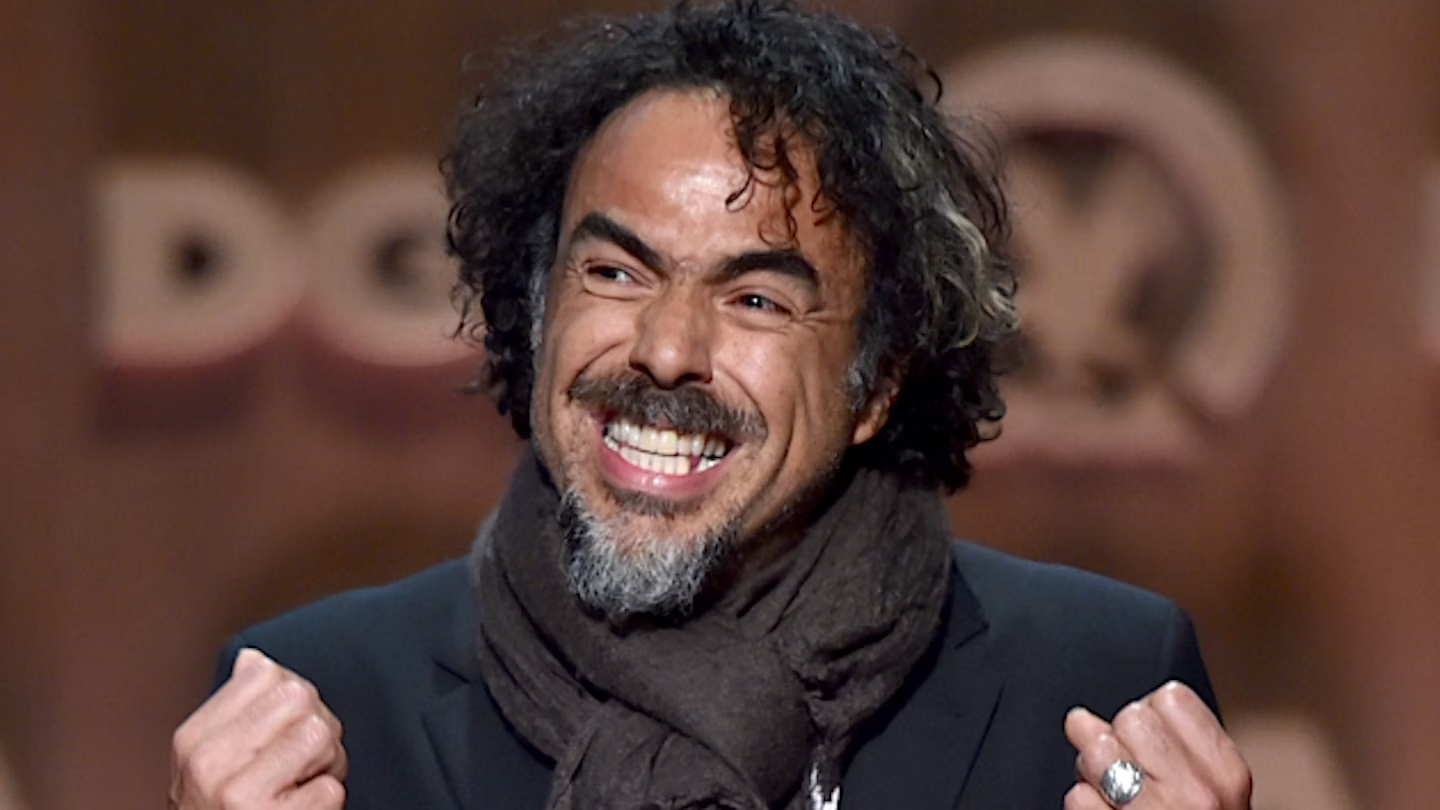
How did Alejandro G. Iñárritu build this fortune?
The answer unfolds through the career, earnings, deals and assets behind the headline estimate.
Before the fame
The background and early turning points that shaped Alejandro G. Iñárritu’s route to prominence.
Alejandro González Iñárritu was born on August 15, 1963, in Mexico City, the youngest of seven children of Héctor González Gama, a banker who went bankrupt when Iñárritu was five, and his mother Luz María. His maternal grandfather was a Mexican Supreme Court justice, and the Iñárritu surname traces to Basque heritage, a lineage confirmed on the PBS series Finding Your Roots, according to his Wikipedia biography. He was expelled from high school in his mid-teens and, at 16 and again at 18, worked as a sailor on cargo ships, crossing the Mississippi River and travelling through Europe and Africa, journeys he has credited with shaping the settings of his later films.
Iñárritu is married to Maria Eladia Hagerman, an editor and graphic designer, and the couple have two adult children. He has spoken publicly about living with ADHD and has said in Mexican press that success for him has little to do with money or popularity, according to an Infobae report on his views on wealth.
After returning to Mexico City, Iñárritu studied communications at Universidad Iberoamericana and in 1984 became a radio host at WFM, then Mexico’s leading rock and eclectic music station, where he built playlists into narrative arcs and interviewed major artists, per his Wikipedia profile. He went on to become one of Televisa’s youngest producers and, between 1987 and 1989, composed the scores for six Mexican feature films.
In 1991 he co-founded the production company Zeta Film with Raúl Olvera, directing commercials and short films while studying under theater director Ludwik Margules and Los Angeles acting coach Judith Weston. It was during this period that he began his creative partnership with screenwriter Guillermo Arriaga, a collaboration that would produce his first three features, as detailed in the Britannica entry on Iñárritu.
The breakthrough years
The career decisions and defining moments that turned recognition into sustained earning power.
Iñárritu’s directorial debut, Amores Perros, premiered at Cannes in 2000, won the Critics’ Week Grand Prize, and earned an Academy Award nomination for Best Foreign Language Film. Made on a reported budget of around $2 million, it went on to gross roughly $20 million worldwide, an early demonstration that his films did not depend on large budgets to succeed, according to the Infobae piece on his career and finances.
He followed it with 21 Grams (2003), which won Sean Penn the Volpi Cup for Best Actor at Venice, and then Babel (2006), the closer of his informal “Death Trilogy” with Arriaga. At Cannes 2006, Iñárritu won the festival’s Best Director award, becoming the first Mexican-born director to do so, and Babel went on to receive seven Academy Award nominations including Best Picture and Best Director, per his Wikipedia filmography.

What the work can earn
Reported pay, contracts, royalties and performance income reveal how the fortune was funded.
Birdman (2014) won three Academy Awards, Best Picture, Best Director, and Best Original Screenplay, making Iñárritu the first Mexican filmmaker to direct a Best Picture winner. The following year, The Revenant earned him a second consecutive Best Director Oscar, making him only the third director in Academy history to win the category back to back and the first to do it in 65 years, following John Ford and Joseph L. Mankiewicz, according to his Wikipedia biography.
Across his career he has won five Academy Awards, three BAFTAs, and four Golden Globes, and he remains the only director to win the Directors Guild of America Award for Outstanding Directing in two consecutive years. Javier Bardem’s Best Actor win at Cannes for Biutiful (2010) and Leonardo DiCaprio’s Best Actor Oscar for The Revenant both came under his direction.
In 2017, Iñárritu premiered Carne y Arena, a virtual reality installation depicting the migrant experience at the U.S.-Mexico border, the first VR work ever shown at the Cannes Film Festival before it toured to LACMA, the Prada Foundation in Milan, and Washington, D.C. The Academy of Motion Picture Arts and Sciences honored it with a Special Achievement Award, its first such award in more than 20 years, per his Wikipedia entry.
His public profile took on a new dimension in 2026 with Digger, his long-gestating collaboration with Tom Cruise. The two had wanted to work together since Cruise became an early admirer of Amores Perros in 2000, but the project only came together after Iñárritu approached him with the concept roughly seven years earlier, according to The Credits’ report on the Cruise-Iñárritu partnership.

The business beyond the main career
Endorsements, ownership interests and investments can keep compounding long after the initial breakthrough.
Iñárritu has not built a personal-endorsement business in the way some celebrities have, but he has directed a series of high-profile branded films. In 2002 he directed “Powder Keg” starring Clive Owen for BMW’s The Hire series, winning a Cannes Gold Lion, and in 2010 he directed Nike’s “Write the Future” campaign for the FIFA World Cup, which won the Grand Prix at the Cannes Lions advertising festival, according to his Wikipedia biography.
In 2012 he directed Procter & Gamble’s “Best Job” Olympics commercial, which won a Primetime Emmy and a DGA Award, and later that year Facebook released his brand film “The Things That Connect Us” to mark the platform reaching one billion users. As with the underlying BMW, Nike, P&G, and Facebook contracts, no public figures exist for what Iñárritu was paid for this commercial work, so it is not counted as a specific dollar amount in this estimate.
In May 2007, Iñárritu joined fellow Mexican directors Alfonso Cuarón and Guillermo del Toro to found the production company Cha Cha Cha, entering a five-picture financing agreement with Universal Pictures worth a reported $100 million, with Focus Features handling international sales, as described in a Rotten Tomatoes editorial on the company’s formation. The filmmakers said the venture was meant as “a safe haven” to keep making the work they loved while nurturing other directors.
More recently, Bardo, False Chronicle of a Handful of Truths (2022) was distributed by Netflix and marked his first Mexican production since Amores Perros. His current project, Digger, starring Tom Cruise, is being produced by Warner Bros. Pictures and Legendary Pictures for an October 2026 release; Warner Bros. has put the official budget at $125 million, though a studio insider told World of Reel the real figure is “pushing $200 million.”

Notable luxury item
A reported property or major asset offers a tangible glimpse of the wealth behind the public estimate.
Unlike many of his Hollywood peers, Iñárritu has not been the subject of public real estate reporting on a personal mansion, ranch, or trophy property; he is understood to live in Los Angeles, but no purchase price, address, or sale has been documented in mainstream coverage reviewed for this estimate. The one specific, recurring asset-related expense that has been reported is his mother’s living arrangement.
Iñárritu covers the cost of a private senior-care residence for his mother, Luz María, in Mexico City, reported at roughly 60,000 Mexican pesos a month, providing her an individual apartment, prepared meals, 24-hour medical care, and security staff, according to TVNotas’ report on the arrangement. He has said the decision followed security concerns in Mexico, including a past armed robbery and his father’s kidnapping.
Alejandro G. Iñárritu’s estimated net worth
Public estimates vary because private contracts, investments, taxes and liabilities are not fully disclosed.
How this estimate is calculated
This estimate starts from four decades of directing income: a modestly budgeted independent debut in Amores Perros that outperformed its cost, a run of studio and awards-season films from Babel through The Revenant that carried significant studio backing, a Netflix-distributed production in Bardo, and an equity position in Cha Cha Cha, the production company he co-founded with Cuarón and del Toro under a $100 million Universal financing deal. It also factors in commercial-directing fees from major brand films for BMW, Nike, Procter & Gamble, and Facebook, none of which have publicly disclosed values, and his upcoming payday from Digger, a $125 million-to-$200 million Warner Bros. and Legendary production due in October 2026 whose compensation terms are not public.
Against that income, the model treats his mother’s approximately 60,000-peso monthly care costs as a modest recurring personal expense, and does not add any real estate value given the absence of public reporting on personal property. Celebrity Net Worth, used here only as a secondary cross-check rather than a primary source, currently estimates his fortune in a broadly similar range.
In June 2020, Iñárritu joined Guillermo del Toro, Alfonso Cuarón, and Salma Hayek to launch Sifonóforo, an emergency fund backed by more than 40 Mexican production companies to support technical and manual film workers left without income during the pandemic, offering roughly 20,000 pesos per approved applicant, according to El Informador’s coverage of the fund’s launch.
Publicly, Iñárritu has cultivated an image built on artistic seriousness rather than celebrity lifestyle, telling Mexican press that success is “living life as you want to” and has “little to do with money, approval, and popularity,” per the same Infobae report. That framing has generally held up against a career spent on art-house and awards-season films rather than commercial franchises.
In 2009, Iñárritu was among a group of filmmakers who signed a petition supporting director Roman Polanski after his detention in Switzerland on a decades-old sexual abuse case, arguing that arresting filmmakers en route to festivals threatened the ability of festivals to screen work freely, a stance documented in his Wikipedia biography.
More recently, Bardo (2022) drew polarizing reviews, with some critics calling it self-indulgent and bloated with symbolism. Iñárritu pushed back publicly, saying he detected “a kind of racist undercurrent” in some of the criticism, suggesting his Mexican identity colored how the film’s ambition was received. The remark itself became a point of debate among critics and commentators covering the film’s reception.