 How Much Are They Worth?
Celebrity fortunes, explained
How Much Are They Worth?
Celebrity fortunes, explained


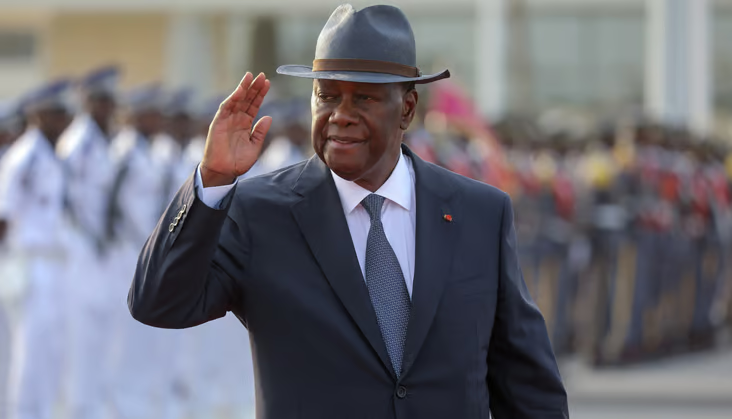
How did Alassane Ouattara build this fortune?
The answer unfolds through the career, earnings, deals and assets behind the headline estimate.
Before the fame
The background and early turning points that shaped Alassane Ouattara’s route to prominence.
Alassane Dramane Ouattara was born in Dimbokro in 1942 and trained as an economist. He studied in the United States, completing degrees at Drexel and the University of Pennsylvania. His international education and technocratic career distinguished him from politicians who rose principally through local party machinery. The International Monetary Fund’s biographical record for Ouattara documents his academic background and progression through central banking, international finance and government. He is married to Dominique Ouattara. Her companies and charitable activities are legally distinct: marriage alone does not make every spouse-associated company, foundation or asset jointly owned by the president.
Ouattara joined the IMF as an economist and later worked at the Central Bank of West African States, commonly known as BCEAO. He became vice-governor, returned to the IMF as director of its African Department and then served as governor of BCEAO. That sequence gave him unusually deep experience in monetary policy and regional finance. In Côte d’Ivoire he chaired an economic-recovery committee and became prime minister under President Félix Houphouët-Boigny from 1990 to 1993. His early career generated professional income and pension rights, but the salary history and retained savings needed for a precise personal valuation are not publicly itemised.
The breakthrough years
The career decisions and defining moments that turned recognition into sustained earning power.
After his premiership, Ouattara served as an IMF deputy managing director from 1994 to 1999. The Fund’s resolution marking his departure as deputy managing director describes decades of institutional service. He then pursued Ivorian politics through the Rally of the Republicans. Disputes over nationality and eligibility blocked or complicated earlier presidential ambitions. His decisive breakthrough came in the 2010 election, whose contested result produced a deadly political crisis when incumbent Laurent Gbagbo refused to concede. Ouattara ultimately assumed office in 2011. That transition made him head of state, but control of presidential institutions did not confer private ownership of them.

What the work can earn
Reported pay, contracts, royalties and performance income reveal how the fortune was funded.
Ouattara’s supporters emphasise restored growth, infrastructure construction and renewed investor confidence after years of division and conflict. Côte d’Ivoire strengthened its place as a major cocoa producer and regional commercial hub while Abidjan saw extensive transport and building projects. Following a 2017 meeting, an IMF statement credited progress under the country’s economic programme. A later IMF review of Côte d’Ivoire’s reform momentum noted improved macroeconomic balances while urging broader inclusion and governance improvements. National growth and public infrastructure are achievements of government and society, not additions to Ouattara’s personal portfolio.
Ouattara’s reputation as a trained economist and former senior IMF official has made economic management central to his international image. He has received state honours and maintained relationships with regional leaders and multilateral institutions. His own policy writing before the presidency included arguments for reform, openness and poverty reduction. In a 1998 IMF address on rapid African growth, he discussed the institutional and policy conditions needed for development. Such speeches show expertise and standing, not an endorsement fee or a saleable asset. Recognition can enhance influence, but it cannot be responsibly translated into private wealth without contractual evidence.

The business beyond the main career
Endorsements, ownership interests and investments can keep compounding long after the initial breakthrough.
There is no reliable public record of Ouattara maintaining a celebrity-style portfolio of paid product endorsements. Campaign advertising and party support belong to electoral organisations, donors and vendors rather than automatically becoming candidate income. State visits, conference appearances and speeches given as president are official functions, not private sponsorships. His professional authority may command attention, but a hypothetical speaking fee after public office cannot be counted before it is earned and disclosed. For these reasons, the estimate adds no speculative endorsement value. Any future paid board, advisory or speaking role would need to be evaluated from an exact contract or credible disclosure, not assumed from his prominence.
Ouattara’s documented career is dominated by central banking, multilateral institutions and public office rather than founding and selling private companies. Dominique Ouattara has had a separate business career, but her holdings cannot simply be assigned to her husband, particularly when title, marital-property treatment and beneficial ownership are not established in an accessible record. Likewise, companies winning public contracts or investing under his administration are not presidential assets. This estimate therefore does not create a fictional founder’s stake. It allows for investments and savings that a highly paid international economist might reasonably accumulate, while applying caution because his current securities, liabilities and ownership interests are not set out in a public audited balance sheet.

Notable luxury item
A reported property or major asset offers a tangible glimpse of the wealth behind the public estimate.
Presidential residences, official vehicles, aircraft access, security and government offices belong to the Ivorian state. Major bridges, roads, towers and public works constructed during Ouattara’s tenure are likewise public or corporate assets. Online wealth claims often blur those categories or attribute spouse-linked holdings without title evidence. A sound estimate requires proof of beneficial ownership, outstanding debt and whether an asset is personal, joint, corporate or charitable. No sufficiently complete, current public filing answers all those questions. Accordingly, this profile limits the asset base to plausible accumulated professional earnings, pensions and investments, and it excludes state resources, party property, the Children of Africa Foundation and property associated only through marriage or political proximity.
Alassane Ouattara’s estimated net worth
Public estimates vary because private contracts, investments, taxes and liabilities are not fully disclosed.
How this estimate is calculated
The method starts with Ouattara’s unusually long high-level professional record: economist, central banker, prime minister, IMF deputy managing director and president. It allows for salary, pension accumulation, savings and conventional investment returns across those roles. It then discounts for tax, living costs, campaign and household expenditure, possible liabilities and the absence of a current audited asset declaration. It excludes public works, official residences, government transport, party funds, charitable assets and any enterprise known only through his spouse or associates. The IMF archive of Ouattara’s 1999 reform address confirms the depth of his professional experience, but experience is an input to earning capacity rather than proof of a bank balance. The resulting range remains editorial and deliberately cautious.
Alassane Ouattara’s estimated net worth is $15 million to $30 million. The range reflects decades in senior international finance and public leadership, including roles capable of supporting substantial savings and pension benefits. It does not include Ivorian state property, public infrastructure, political-party resources, charitable funds or assets attributed solely through his wife. Because no comprehensive public audit establishes his current holdings and liabilities, the estimate should not be presented as a declared fact.
Dominique Ouattara founded the Children of Africa Foundation, which supports health, education and vulnerable children. Its resources are dedicated to charitable purposes and should not be treated as the couple’s spendable wealth. Alassane Ouattara’s public image combines the technocrat who presided over fast growth with the dominant politician whose longevity raises succession questions. The Le Monde analysis of his fourth-term victory describes both economic modernisation and criticism over political consolidation. Philanthropic visibility can improve reputation, but donations to an independent foundation do not evidence personal ownership.
Ouattara’s eligibility, the violence surrounding the 2010 election and his later pursuit of additional terms have all attracted scrutiny. He argued that a new constitution reset the term count, while opponents considered the interpretation an evasion of limits. Major rivals were excluded from the 2025 contest, and rights groups criticised arrests and restrictions before the vote. The Guardian’s report on the 2025 election result records the overwhelming official victory alongside those concerns. These controversies affect political legitimacy and reputation but do not prove a particular private fortune. Unsupported claims of corruption or concealed assets are not treated as established facts in this calculation.