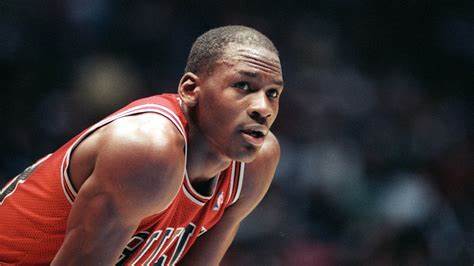
How did Michael Jordan build this fortune?
The answer unfolds through the career, earnings, deals and assets behind the headline estimate.
Before the fame
The background and early turning points that shaped Michael Jordan’s route to prominence.
Jordan entered the NBA in 1984 after starring at North Carolina and spent most of fifteen seasons with Chicago, winning six championships before a later Washington return. The salary record is unusually clear. Spotrac lists $93,877,500 of career cash earnings. That includes extraordinary final Bulls seasons but remains a small fraction of the later fortune after tax, agent costs and decades of spending.
Nike changed the scale before Jordan won his first title. His original five-year contract paid $500,000 annually plus royalties, and first-year Air Jordan sales rapidly exceeded Nike’s initial expectations. Forbes’ transaction analysis reports $2.4 billion of career off-court earnings before tax and a recent annual Nike royalty cheque near $260 million, alongside the documented $94 million playing total.
The breakthrough years
The career decisions and defining moments that turned recognition into sustained earning power.
On court, Jordan’s six Finals victories, five MVP awards and global visibility made that royalty stream durable after retirement. The financial milestone is not simply that Jordan Brand sells products; it is that his agreement participates in sales rather than ending with a fixed endorsement fee. Forbes reported $6.6 billion of Jordan Brand annual wholesale revenue in the period preceding the Hornets sale. Nike owns the brand, so HMW counts royalty cash flow—not the entire brand’s enterprise value—as Jordan’s asset.
What the work can earn
Reported pay, contracts, royalties and performance income reveal how the fortune was funded.
The Hornets produced the largest realised capital event. Jordan paid approximately $275 million for control in 2010. ESPN reported that the 2023 transaction valued the team at roughly $3 billion, while the Hornets’ official announcement confirms he retained a minority share. The valuation is not identical to Jordan’s proceeds because other investors, debt, taxes and the retained piece affect the cash calculation.
Nike remains the most important recurring commercial relationship. Hanes, Gatorade, Upper Deck and licensing work add further income, but their private contracts should not be stacked at invented rates. Forbes’ current profile says Nike now pays nearly $300 million annually and records roughly $2.4 billion of cumulative pretax corporate-partner earnings. HMW taxes those receipts and avoids double-counting them with the earlier Forbes career total.
The business beyond the main career
Endorsements, ownership interests and investments can keep compounding long after the initial breakthrough.
Jordan has continued investing after basketball. He co-founded 23XI Racing with Denny Hamlin; the team’s history documents its 2021 launch, later expansion to three cars and a new facility. He is also a Cincoro Tequila co-founder, and AfroTech reported the 2024 addition of new athlete-investors. Neither company disclosed a financing valuation that would support an aggressive mark.
Other investments include sports-focused venture capital and earlier public-company relationships. Reuters reported Jordan’s participation in Courtside Ventures’ fourth fund, which was targeting $100 million, but did not disclose his commitment. HMW therefore values a diversified private portfolio broadly and does not mistake the fund’s target size for Jordan’s personal stake. The same rule applies to restaurants, dealerships and licensing vehicles.
Notable luxury item
A reported property or major asset offers a tangible glimpse of the wealth behind the public estimate.
Real estate is material but small beside royalties and the Hornets. Jordan’s customised Highland Park estate finally sold for $9.5 million in December 2024 after more than twelve years on the market, according to CBS Chicago. The original $29 million asking price was never realised, and construction, renovations, property tax and carrying costs mean sale price is not profit. HMW adds no fictional premium for the famous gate or basketball court.
Michael Jordan’s estimated net worth
Public estimates vary because private contracts, investments, taxes and liabilities are not fully disclosed.
How this estimate is calculated
HMW begins with the after-tax remainder of $93.9 million in NBA pay and Forbes’ approximately $2.4 billion pretax endorsement history, allowing continuing Nike royalties through August 2026 without capitalising them forever. It adds net Hornets-sale proceeds after minority ownership, basis, transaction costs and tax, retains a discounted Hornets stake, and assigns restrained values to 23XI, Cincoro, venture holdings and property. Published billionaire tracking is used as a reasonableness check, not copied without reconciling the cash flows.
HMW models the sale from Jordan’s ownership history rather than crediting him with the full $3 billion. It recognises his original investment, the minority stake sold in 2019, transaction costs and federal capital-gains tax, then preserves a conservative value for the post-sale minority interest. That approach produces a smaller after-tax contribution than the headline while still recognising the enormous appreciation between 2010 and 2023.
The estimate has unusually strong anchors but remains an estimate. NBA salary, the Hornets valuation and property closing are specific; royalty terms, tax planning, debt, the retained Hornets percentage and private-company cap tables are not. Jordan also pledged substantial philanthropy, which reduces assets available personally. Litigation and operating risk at 23XI prevent HMW from treating a racing charter or facility as guaranteed liquid value.

JavaScript is off, so all sections are displayed together.