 How Much Are They Worth?
Celebrity fortunes, explained
How Much Are They Worth?
Celebrity fortunes, explained









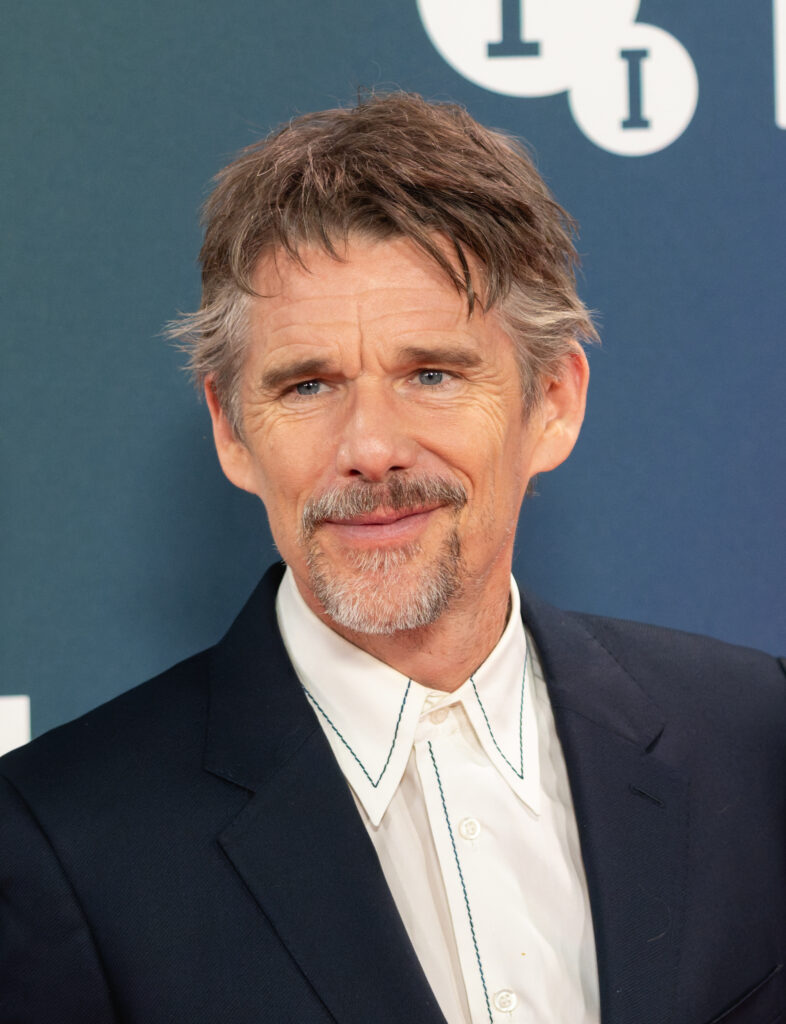
How did Ethan Hawke build this fortune?
The answer unfolds through the career, earnings, deals and assets behind the headline estimate.
Before the fame
The background and early turning points that shaped Ethan Hawke’s route to prominence.
Ethan Green Hawke was born on 6 November 1970 in Austin, Texas, according to the Golden Globes. His parents were teenagers when he was born and separated soon after; he moved with his mother to New York and later New Jersey, where he attended the Hun School of Princeton.
He began acting as a child and briefly studied at Carnegie Mellon University and New York University before work took over. The decision to leave formal training early set the tone for a career built on learning in public, moving between film sets, theatre rehearsal rooms and, later, his own writing desk.
His film debut came at 14 in Joe Dante’s Explorers in 1985, alongside River Phoenix. The breakthrough was Peter Weir’s Dead Poets Society in 1989, opposite Robin Williams, which the Golden Globes lists first among his key credits.
Through the 1990s he became a defining face of his generation in Reality Bites in 1994, and began his long partnership with Richard Linklater in Before Sunrise in 1995, followed by Gattaca, Great Expectations and Snow Falling on Cedars.
The breakthrough years
The career decisions and defining moments that turned recognition into sustained earning power.
Training Day in 2001, opposite Denzel Washington, brought his first Academy Award nomination, for Best Supporting Actor. He then co-wrote Before Sunset in 2004 and Before Midnight in 2013 with Linklater and Julie Delpy, both of which earned screenplay nominations.
Boyhood, filmed over twelve years and released in 2014, added a fourth nomination. When Blue Moon brought a fifth in 2026, his first in the lead actor category, The Hollywood Reporter and ABC7 New York both marked it as the fifth of his career.

What the work can earn
Reported pay, contracts, royalties and performance income reveal how the fortune was funded.
In Blue Moon he played the lyricist Lorenz Hart in his ninth film with Linklater. He was nominated for Best Actor at the 2026 Oscars, where Michael B. Jordan won for Sinners, according to The Hollywood Reporter. He also received a 2026 Golden Globe nomination for the role, and an earlier one for The Good Lord Bird, the 2020 limited series he co-created and in which he played the abolitionist John Brown, as recorded by the Golden Globes.
He is also a novelist, with The Hottest State, Ash Wednesday and A Bright Ray of Darkness, and a director whose credits include the Blaze Foley biopic Blaze, the Paul Newman and Joanne Woodward documentary The Last Movie Stars and the Flannery O’Connor film Wildcat.
Beyond the Oscars, his performance as a troubled minister in Paul Schrader’s First Reformed in 2017 won several major critics’ prizes. On the stage he has worked steadily, with a Tony nomination for The Coast of Utopia.
His franchise work broadened his audience: he played the villain Arthur Harrow in Marvel’s Moon Knight in 2022 and a masked killer in The Black Phone, which CNBC reported had passed $150 million at the global box office on a production budget of $16 million; Box Office Mojo now records $161,440,742 worldwide.

The business beyond the main career
Endorsements, ownership interests and investments can keep compounding long after the initial breakthrough.
Hawke has not been a major commercial endorser, and no significant long-term brand ambassadorship has been reported for him. His work outside acting tends to be publishing and directing rather than advertising.
This makes his income unusually dependent on film, television and book work, with back-end deals like the one described by The Hollywood Reporter doing the job that endorsement contracts do for other stars.
Hawke’s most interesting financial decisions have been deals rather than companies. With his friend Jason Blum, with whom he started a theatre company in his twenties, he made low-budget horror films on a profit-sharing model. The Hollywood Reporter reported that on The Purge, which cost $3 million and opened to $34 million, he took almost no money up front in exchange for a slice of the profits, with sources putting his total in the mid-seven figures.
The partnership continued with Sinister, The Black Phone and Black Phone 2, which Variety reported opened to $26.5 million in October 2025. He also produces his own projects, often with his wife Ryan Hawke, who produced Blaze and Wildcat with him. Those smaller films are unlikely to be large earners, but owning a stake in his own work gives him more control over where his time goes than a conventional fee-for-service career would.

Notable luxury item
A reported property or major asset offers a tangible glimpse of the wealth behind the public estimate.
His best-documented property is a townhouse at 353 West 21st Street in Chelsea, New York. NBC News reported that he bought it in 2005 for $3 million and listed it in 2013 for $6.25 million, describing a two-family home of about 3,500 square feet with a garden and terrace.
Other holdings have not been itemised in reliable reporting, and this estimate does not assign values to property beyond that documented sale listing.
Ethan Hawke’s estimated net worth
Public estimates vary because private contracts, investments, taxes and liabilities are not fully disclosed.
How this estimate is calculated
Three figures about Hawke’s own money are on the record. NBC News reported that he bought a two-family townhouse at 353 West 21st Street in Chelsea in 2005 for $3 million and listed it in 2013 for $6.25 million. The Hollywood Reporter reported that on The Purge, which cost $3 million and opened to $34 million, he took almost no money up front in exchange for a slice of the profits, with sources putting his total in the mid-seven figures. No ordinary fee of his, for a film, a series or a play, has ever been published.
The working extends those two points across a career. An actor with four decades of lead roles, a Marvel series and a stake in a horror franchise might gross somewhere between $70 million and $100 million, of which perhaps 40 per cent survives representation and combined federal and New York tax, leaving roughly $28 million to $41 million. Adding net property equity of perhaps $3 million to $5 million, implied by the NBC News figures, gives the range below. The career gross is assumed; the townhouse and the reported scale of the Purge pay-out are not.
The profit-participation deal is what keeps the range wide. A back-end share pays out over years against a studio’s own accounting of what a film earned, and neither the percentage nor the statements are ever made public, so an actor who takes that trade repeatedly, as Hawke has done with Blumhouse since 2013, has career earnings that cannot be reconstructed precisely from outside. Add a divorce settled privately, a townhouse whose final sale price was never reported, and book advances publishers do not announce, and the townhouse purchase and the Purge back-end are the only firm ground underneath the figure below.
Confidence: Partly documented – a verified townhouse purchase and a trade-reported mid-seven-figure profit share give the range two real anchors, but every film and television fee behind it is assumed rather than disclosed.
Hawke has no personal foundation of note and his charitable activity has been low-key, mostly benefit performances and support for theatre and arts organisations in New York.
His public image is that of a working artist moving between blockbuster, independent film, stage, fiction and directing, a reputation his long Linklater collaboration and his Blumhouse deals, as reported by The Hollywood Reporter, have both reinforced.
Hawke has not faced significant legal disputes. The most intense scrutiny came with the end of his marriage to Uma Thurman, with whom he has two children, which drew heavy tabloid attention in the early 2000s; he married Ryan Shawhughes in 2008, as NBC News noted in its report on the townhouse.
He has occasionally drawn criticism for blunt remarks about blockbuster cinema, which he has since tempered while working with Marvel himself.