
 How Much Are They Worth?
Celebrity fortunes, explained
How Much Are They Worth?
Celebrity fortunes, explained




How did Yayoi Kusama build this fortune?
The answer unfolds through the career, earnings, deals and assets behind the headline estimate.
Before the fame
The background and early turning points that shaped Yayoi Kusama’s route to prominence.
Yayoi Kusama is a Japanese artist whose polka dots, pumpkins, Infinity Net paintings and mirrored environments have achieved exceptional museum and commercial reach. Born in Matsumoto in 1929, she works from a Tokyo studio and has lived voluntarily in a nearby psychiatric hospital since the 1970s. Her wealth cannot be read directly from auction headlines because resale proceeds normally go to the owner selling the work, not to the artist. Tate’s Yayoi Kusama artist profile provides a museum-backed account of her career and recurring themes.
Kusama made art against her family’s wishes and corresponded with Georgia O’Keeffe before moving to New York in 1958. There she developed the large monochrome Infinity Net canvases, staged happenings and created environments that challenged the male-dominated art scene. Financial success did not immediately follow influence, and she returned to Japan in 1973. The Museum of Modern Art’s Yayoi Kusama collection page documents works from her formative New York period. Those works now command high resale prices, but their later appreciation was not paid retroactively to Kusama.
The breakthrough years
The career decisions and defining moments that turned recognition into sustained earning power.
International reassessment accelerated when Kusama represented Japan at the 1993 Venice Biennale. Subsequent museum exhibitions and immersive Infinity Mirror Rooms introduced her work to audiences far beyond traditional painting collectors. The Art Newspaper’s report on Kusama’s museum attendance documents the extraordinary public demand for her exhibitions. Attendance strengthens licensing, editions and primary-market pricing, but museums’ ticket receipts do not belong to the artist unless a contract specifically allocates them.

What the work can earn
Reported pay, contracts, royalties and performance income reveal how the fortune was funded.
Kusama’s retrospectives have appeared at institutions including Tate Modern, the Whitney Museum and the Hirshhorn. Her Tokyo museum opened in 2017, and major outdoor sculptures have become permanent public landmarks. In 2022, her 1959 painting Untitled (Nets) sold for $10.5 million at Phillips, setting an auction record for the artist. Phillips’ lot record for Untitled (Nets) provides the exact resale result. That price indicates market strength but is not counted as Kusama’s personal income.
Kusama’s direct income comes from primary sales through her galleries, new editions and sculpture, licensing, books, merchandise and institutional arrangements. She is represented by Ota Fine Arts, David Zwirner and Victoria Miro in different markets. David Zwirner’s official Kusama artist page records exhibitions and represented work. Galleries ordinarily retain a negotiated share of primary sales, while studio production, fabrication, shipping and tax further reduce the artist’s receipts.

The business beyond the main career
Endorsements, ownership interests and investments can keep compounding long after the initial breakthrough.
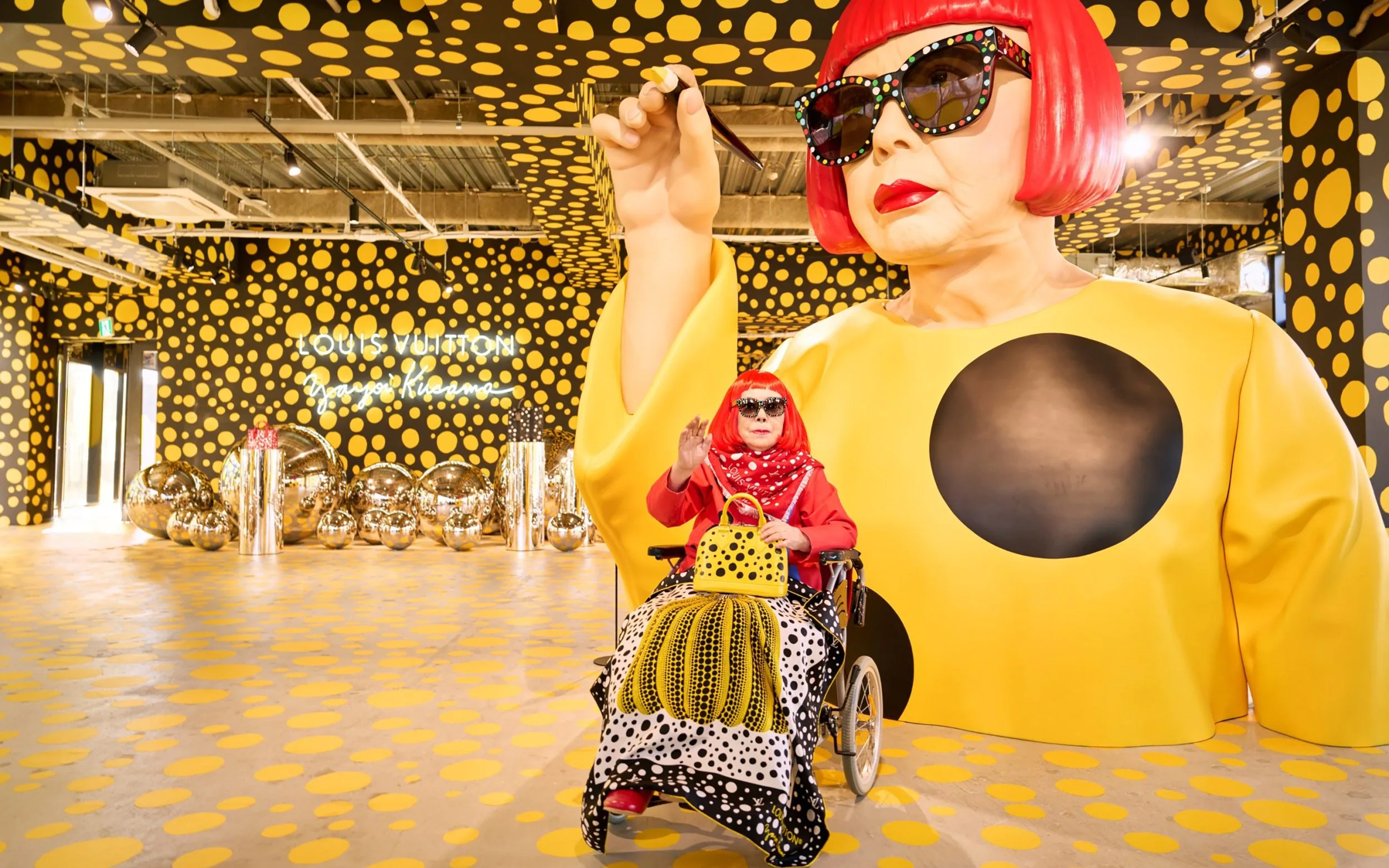
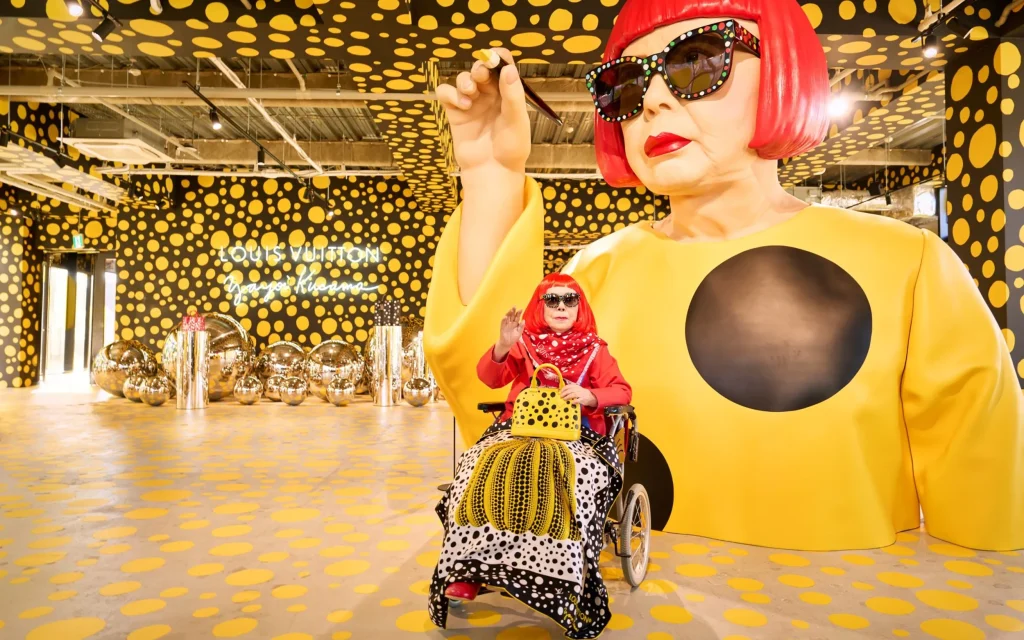
The Louis Vuitton collaborations of 2012 and 2023 placed Kusama’s dots and figures on luxury products worldwide. She has also licensed museum merchandise and published fiction, poetry and autobiography. Louis Vuitton’s official Kusama collaboration page verifies the global luxury partnership. Its retail sales cannot be attributed to her; only an undisclosed royalty or fee belongs in the model, after advisers, studio expenses and tax.
Kusama’s studio oversees production and intellectual property, while the Yayoi Kusama Foundation operates the museum and supports preservation and research. The Yayoi Kusama Museum’s official museum overview describes its purpose. Foundation or museum assets are not presumed to be personally distributable. The estimate instead recognises private rights in the artist’s catalogue, name and authorised editions only where ongoing commercial exploitation plausibly benefits her or her studio.

Notable luxury item
A reported property or major asset offers a tangible glimpse of the wealth behind the public estimate.
Her holdings may include unsold artworks, cash, royalties and intellectual property, but the inventory and ownership entities are private. Artist-held works require a large discount: releasing too many could weaken prices, and insurance, storage, gallery commission and tax stand between appraisal and spendable proceeds. Kusama’s modest institutional living arrangement also makes lifestyle-based estimates especially unhelpful. Victoria Miro’s Kusama profile confirms her continuing studio practice and representation, not the quantity or value of retained inventory.
Yayoi Kusama’s estimated net worth
Public estimates vary because private contracts, investments, taxes and liabilities are not fully disclosed.
How this estimate is calculated
The model estimates $90 million to $150 million in attributable lifetime primary-market, edition, licensing and publishing receipts, far below aggregate resale turnover. After gallery shares, fabrication, studio payroll, tax, donations and personal spending, approximately $30 million to $60 million may have been retained. It adds $20 million to $45 million for conservatively valued artist-held inventory, intellectual property, cash and investments, then deducts $10 million to $25 million for illiquidity, foundation separation, future tax and overlap. The resulting range is roughly $45 million to $80 million, supporting a midpoint that reflects an extraordinary market without assigning her collectors’ resale proceeds.
Kusama’s visual language works across paintings, sculpture, rooms, fashion and accessible merchandise. In 2023 she was reported as the top-selling contemporary artist at major auctions, with nearly $81 million of secondary-market sales. Barron’s report on Kusama’s 2023 auction market supports that total. The number measures transactions among collectors and auction houses; it matters to primary pricing and reputation, but adding it to her wealth would be a fundamental art-market error.
The market record, gallery representation and luxury collaboration prove substantial earning power. They do not reveal primary-sale splits, expenses, donations, foundation transfers or Japanese tax. Auction totals are explicitly excluded from income except as evidence for pricing newly sold work. No private company accounts or verified personal property schedule is available. This estimate therefore uses decades of primary production and licensing, discounted for late-career market growth and for the possibility that important works are held by institutions or separate entities. It also avoids applying today’s record prices to works sold cheaply during earlier decades. Currency conversion and long-term care planning introduce additional uncertainty.