
 How Much Are They Worth?
Celebrity fortunes, explained
How Much Are They Worth?
Celebrity fortunes, explained










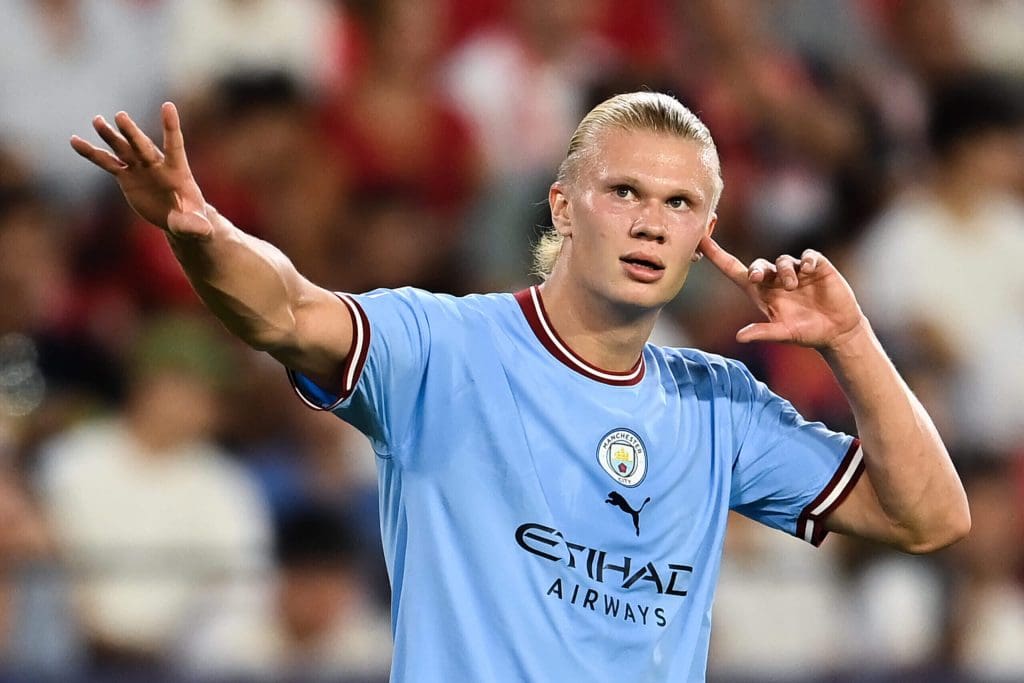
How did Erling Haaland build this fortune?
The answer unfolds through the career, earnings, deals and assets behind the headline estimate.
Before the fame
The background and early turning points that shaped Erling Haaland’s route to prominence.
Erling Braut Haaland was born in Leeds, England, in 2000 while his father, Alf-Inge Haaland, was playing in English football, but he grew up in Bryne, Norway. That combination of a professional-football household and a Norwegian sporting upbringing helped make elite performance feel normal from an early age. Haaland developed at Bryne before progressing through Molde, Red Bull Salzburg and Borussia Dortmund. His scoring record accelerated at every level rather than arriving through one isolated breakthrough.
His public identity is unusually focused. Where many modern stars build a broad entertainment persona, Haaland’s brand revolves around physical preparation, direct humour and goals. That clarity matters commercially: sponsors can associate him with speed, strength and a recognisable number-nine image without needing to manufacture a separate off-field character.
Haaland made his senior start with Bryne and moved to Molde, where regular first-team football exposed him to a higher competitive level while he was still a teenager. Salzburg then provided the platform that turned a highly rated Scandinavian prospect into a global football story. His Champions League debut against Genk brought a first-half hat-trick, and he scored in each of his first five appearances in the competition.
That early European run showed why clubs viewed him differently from a typical young striker. He combined repeatable movement in the penalty area with the pace to threaten space behind a defence. UEFA’s detailed Champions League record analysis documents how quickly he passed successive scoring milestones. The importance for his eventual wealth was not only the number of goals, but that they arrived in the competition watched most closely by Europe’s richest clubs.
The breakthrough years
The career decisions and defining moments that turned recognition into sustained earning power.
Borussia Dortmund signed Haaland during the 2019/20 season, and his Bundesliga debut produced a hat-trick from the bench. He became the focal point of Dortmund’s attack and maintained a scoring rate rarely seen from a player of his age. The Bundesliga’s review of his Dortmund period records 62 league goals in 67 appearances, an output that established him as a finished elite striker rather than a prospect being priced primarily on potential.
Manchester City completed his transfer in 2022 after activating the contractual release mechanism in his Dortmund agreement. The BBC’s report on the completed move noted his 86 goals in 89 Dortmund appearances. Joining the reigning English champions gave Haaland a global weekly audience, a team designed to create chances and a commercial stage capable of multiplying both salary and sponsorship income.

What the work can earn
Reported pay, contracts, royalties and performance income reveal how the fortune was funded.
Haaland’s first Manchester City season delivered the treble: the Premier League, FA Cup and UEFA Champions League. He scored 52 times in 53 games across all competitions and set a Premier League single-season record with 36 league goals. Those performances earned him the 2022/23 UEFA Men’s Player of the Year award, with UEFA’s award announcement placing him ahead of Lionel Messi and Kevin De Bruyne in the vote.
His achievements continued beyond that debut campaign. The Premier League confirmed that he won a third Golden Boot after leading the 2025/26 scoring table, following earlier wins in his first two English seasons. The league’s 2025/26 Golden Boot report put him within one award of the competition record. He has also become Norway’s leading scorer; the Norwegian Football Federation’s senior-team statistics place him comfortably at the top of the national scoring list.
Haaland’s recognition extends well beyond Manchester City supporters. His distinctive running style, towering frame, long hair and meditation celebration have made him immediately identifiable in highlight clips and advertising. He belongs to the small group of active footballers who can draw interest from audiences who do not routinely follow his club.
Performance sustains that visibility. The Premier League reported that he became the fastest player to reach 100 combined goals and assists in the competition, doing so in fewer matches than Alan Shearer. Its account of the 100-involvement milestone illustrates why his public profile is not dependent on a single record season. For a valuation, persistent recognition matters because it supports repeat endorsement renewals and gives his personal brand value outside the term of any one playing contract.

The business beyond the main career
Endorsements, ownership interests and investments can keep compounding long after the initial breakthrough.
Nike announced Haaland as one of the central athletes in its next generation of football stars in 2023. The company’s official Haaland partnership announcement emphasised his scoring, fitness and status as a modern number nine. The arrangement is commercially important because footwear contracts can run across many seasons and remain independent of club employment.
His wider sponsor portfolio has included technology, gaming, fashion, watches, hospitality and consumer brands. Forbes’ Haaland earnings profile lists partners including Nike, Beats by Dre, Breitling, Electronic Arts, Marriott International, Midea, Supercell, Unilever and Visa. These are reported commercial relationships, not companies that Haaland personally owns. Their value is counted as income only after allowing for taxes, representation fees and the possibility that individual agreements start or end.
Haaland’s disclosed business activity is smaller than that of veteran stars who have built restaurant groups, media companies or large investment portfolios. That should not be mistaken for an absence of commercial planning. His partnerships increasingly include equity or long-term brand-building elements rather than only conventional appearance fees. Forbes reported that his relationship with Scandinavian luggage company Db included an ownership stake, giving him exposure to the company’s performance rather than a fee alone.
There is not enough public evidence to assign Haaland ownership of businesses promoted by his family, representatives or commercial partners. Club assets, sponsor companies and intellectual property owned through other entities are also not automatically his personal property. The estimate therefore treats verified playing and endorsement income as the principal wealth engines and gives only cautious credit to disclosed investments.

Notable luxury item
A reported property or major asset offers a tangible glimpse of the wealth behind the public estimate.
Media coverage frequently connects Haaland with luxury homes and performance cars, but observed use is not always proof of ownership. Vehicles may be leased, financed, supplied for promotional purposes or owned through another entity. Likewise, a family residence or property used by a partner should not automatically be placed on his personal balance sheet.
This estimate therefore does not total every car or residence ever associated with him. It assumes that a player with several seasons of elite earnings is likely to hold substantial cash, investments and personal property, while applying a conservative discount for unclear title and debt. Manchester City’s long-term contractual commitment, confirmed by the Premier League’s contract announcement, improves future earning visibility but does not mean the whole future contract is a present-day asset.
Erling Haaland’s estimated net worth
Public estimates vary because private contracts, investments, taxes and liabilities are not fully disclosed.
How this estimate is calculated
The assessment begins with reported annual football income and sponsorship earnings, then considers the seasons Haaland has already spent at Salzburg, Dortmund and Manchester City. Forbes ranked him among football’s highest earners and estimated that his recent annual income was split between a dominant playing component and a substantial off-field component. Those figures represent gross earnings, not retained wealth.
From that base, the calculation deducts a broad allowance for income tax, agent and management fees, professional expenses, lifestyle spending and the fact that not every bonus is guaranteed. It then adds a cautious allowance for accumulated investments and clearly disclosed equity interests. Future wages through 2034 are excluded because they have not yet been earned, while club, sponsor, family and partner-owned assets are excluded entirely. The resulting range is deliberately narrower than simply adding headline contract values.
As of August 2026, Erling Haaland’s estimated net worth is $110 million to $140 million. The midpoint estimate is approximately $125 million.
This is an editorial assessment rather than an audited financial statement. It reflects several years of elite football income, a major endorsement portfolio and probable investment growth, balanced against tax, fees, spending and uncertainty over privately held assets. Forbes estimated $80 million in earnings over the preceding twelve months, but annual gross income is not the same as net worth. The estimate does not capitalise his entire Manchester City contract, count sponsor property as his own or assume that every reported luxury asset is personally owned outright.
Haaland’s public image is built more around discipline and playful confidence than around a highly publicised personal foundation. He has participated in club and sponsor-led community activity, but charitable resources controlled by Manchester City, Nike or any other organisation remain institutional assets, not part of his personal fortune.
His appeal is also helped by a relatively direct communication style. Short interviews, celebrations and humorous social posts travel easily across languages, which is valuable for an athlete from a smaller home market. At the same time, the absence of extensive public charitable disclosure means philanthropy is treated as part of reputation rather than used to make assumptions about the size of his private donations.
Haaland has faced the ordinary scrutiny attached to a superstar striker: criticism during quiet runs, debate about his involvement outside the penalty area and intense attention to body language. None of that provides evidence of a material personal liability. Reporting around Manchester City’s regulatory disputes concerns the club and should not be converted into a personal debt or asset adjustment for Haaland without a direct legal or contractual consequence.
Contract reporting also illustrates the need for caution. Manchester City publicly confirmed an exceptionally long agreement through 2034, while precise salary and bonus figures largely come from media estimates rather than published payroll records. FIFA’s summary of the long-term deal confirms its duration but not every financial term. The calculation therefore relies on reputable earnings estimates rather than treating repeated press figures as audited facts.