 How Much Are They Worth?
Celebrity fortunes, explained


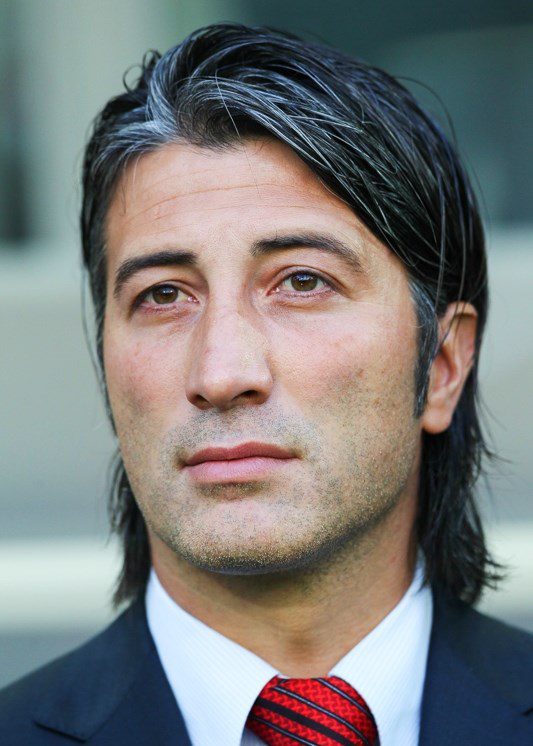
How did Murat Yakin build this fortune?
The answer unfolds through the career, earnings, deals and assets behind the headline estimate.
Murat Yakin before the fame
The background and early turning points that shaped Murat Yakin’s route to prominence.
Murat Yakin was born on 15 September 1974 in Basel to Turkish parents, in the city whose club he would later captain and manage. His younger brother Hakan, born in 1977, also played for Switzerland, and in the early 2000s the two were in the same Basel side.
He came through at Grasshopper, not his home club, joining the Zurich side in 1992 as a teenage centre back.
Yakin made 101 league appearances for Grasshopper between 1992 and 1997, scoring seventeen goals from defence and winning the Swiss title there. A single Bundesliga season of twenty-three games at VfB Stuttgart followed in 1997, then two years at Fenerbahce in Istanbul from 1998.
He came home in 2000, took in a brief spell at 1. FC Kaiserslautern, and settled at Basel from 2001 until his retirement in 2006. Across his club career he played 273 league matches and scored 48 goals. For Switzerland he won 49 caps and scored four times between 1994 and 2004, with Euro 2004 his only major finals as a player.
Murat Yakin’s breakthrough years
The career decisions and defining moments that turned recognition into sustained earning power.
His breakthrough as a coach came at Thun, whom he took to the Swiss Challenge League title in 2009-10, and then at Basel, where two seasons from 2012 brought two Swiss Super League championships. That record is what took him abroad, and it produced the one playing-side figure in his career that was actually reported: Spartak Moscow announced him in June 2014 on a long-term deal that The Moscow Times put at a reported 1.6 million euros a year.
Set that against what the rest of the career paid, which is where our estimate comes in. Fourteen seasons as a player across Switzerland, Germany and Turkey, on wages that ran from roughly 180,000 Swiss francs a season at Grasshopper in the early 1990s to about 700,000 a season as Basel’s captain between 2001 and 2006, come to something around 8.3 million francs gross. Twenty years of management add more. Thun and Luzern at 200,000 to 300,000 a season, Basel at around 700,000, fourteen months at Spartak on the reported Russian salary, five seasons at Schaffhausen, Grasshopper and Sion at perhaps 350,000, and five years with the national team make roughly 10.6 million francs. Together that is about 19 million Swiss francs in gross career earnings, around $23 million, across thirty-four years in the game.

What Murat Yakin’s work can earn
Reported pay, contracts, royalties and performance income reveal how the fortune was funded.
Yakin was appointed Switzerland manager on 9 August 2021, succeeding Vladimir Petkovic, as SWI swissinfo.ch reported at the time. He took the side to the round of sixteen at the 2022 World Cup and to the quarter-finals of Euro 2024, where they beat the holders Italy 2-0 and then lost to England on penalties after a 1-1 draw.
The high point came in 2026. Switzerland drew 0-0 with Colombia in the round of sixteen in Vancouver and won the shoot-out 4-3, with Gregor Kobel saving and Ruben Vargas converting the decisive kick, according to Citizen Digital. That took them to a first World Cup quarter-final since 1954, where Argentina won 3-1 after extra time in Kansas City on 11 July; Dan Ndoye equalised on 67 minutes before Julian Alvarez and Lautaro Martinez settled it, the Honolulu Star-Advertiser reported. His national-team record to 6 October 2026 stands at 69 matches, 32 won, 23 drawn and 14 lost, on 11v11’s match record and the association’s own tally.
What a national-team coach earns in recognition is job security, and in Switzerland that has swung sharply. Yakin was publicly doubted in his first eighteen months, then delivered a Euro quarter-final; blue News reported afterwards that the Swiss Football Association was extending his contract and that of his assistant Giorgio Contini, with the term to be set out at a press conference.
The 2026 run hardened that standing. A quarter-final was Switzerland’s deepest World Cup since the tournament they hosted in 1954, and the route ran through Colombia and then the defending champions rather than a kind draw.
Murat Yakin’s business beyond the main career
Endorsements, ownership interests and investments can keep compounding long after the initial breakthrough.
Commercially he operates in a small market: Switzerland’s football economy is a fraction of Germany’s, and the endorsement money available to a Swiss coach runs through association partners and regional brands, not global contracts.
Our estimate here is modest deliberately so: appearance fees, association-partner obligations in the national-team contract, and domestic advertising at perhaps 100,000 to 200,000 francs a year since 2021: around 750,000 francs over five years, a rounding item next to the salary.
Yakin’s working life was built on fixed-term employment, not equity. Nine club jobs and a national-team post in twenty years is a career of contracts, and the asset underneath is the UEFA Pro Licence and the record attached to his name.
That shapes how the money behaves. A coach on a two-year deal carries termination risk a shareholder does not, and the compensation is that a dismissal usually pays out: he left Luzern, Grasshopper and Sion inside a season or two each, and Swiss practice means those exits were settled, not simply ended.
Murat Yakin’s notable luxury item
A reported property or major asset offers a tangible glimpse of the wealth behind the public estimate.
One category of his personal property entered the public record in an unusual way. Court reporting by Blick in May 2024 established that Yakin owned a collection of watches, six of which were seized in a Basel criminal case; he had handed them over about four years earlier to be sold on, and told the court he had not had them back.
Beyond that, the assets consistent with his earnings are ordinary for a long-standing Swiss resident: property in the Basel region, BVG pension provision across both careers, and whatever the years in Germany, Turkey and Russia left in separate schemes.
Murat Yakin’s estimated net worth
Public estimates vary because private contracts, investments, taxes and liabilities are not fully disclosed.
How this estimate is calculated
Two reported numbers anchor this. The Moscow Times gave his Spartak Moscow salary as a reported 1.6 million euros a year in 2014, and Blick put his national-team pay at an estimated 750,000 francs a year before the post-Euro 2024 extension, with the association’s own ceiling around 1.2 million. Everything else is our estimate, built as seasons multiplied by a wage for that league and era.
From the 19 million francs of gross career earnings set out above, Swiss federal, cantonal and communal income tax on a top earner in Basel takes roughly 35 to 40 per cent, with the German, Turkish and Russian spells taxed where they were earned. That leaves roughly 11 to 12 million francs retained before thirty years of living costs. Against it sits a Basel-region property position, two pension pots and the watch collection the court papers evidence.
The working supports a range of $8 million to $16 million, and the figure below is its midpoint. The input that would move it most is the extension the Swiss Football Association announced after Euro 2024: its term and its value sit at the centre of the last five years of the calculation, and a Swiss report pinning either one down would tighten everything downstream of it. The fourteen playing seasons are the second soft spot, because they ran across three tax jurisdictions in the years before salary reporting became routine.
Confidence: Partly documented — built on one reported club salary and a Swiss press estimate of his national-team pay, with the playing wages carried as our estimate.
His public image is bound up with the brothers’ story. Murat and Hakan were raised in Basel by Turkish parents of modest means and both reached the national team, a recognisable pair in a country where the migrant-background footballer became the norm.
As a coach he stayed close to the domestic game, working at Frauenfeld, Schaffhausen and Grasshopper’s reserve set-up on his way up rather than short-cutting through a big club.
The one legal matter touching him is the Basel case above, and the distinction the court itself drew is the point: Blick reported on 26 May 2024 that Yakin appeared as an injured party rather than as a joint plaintiff, that he applied for the return of the six seized watches, and that no charge was directed at him. He also told the court he had never given or lent the main defendant money.
The other scrutiny has been sporting, not financial. His selections were loudly questioned in Swiss media before Euro 2024, and he had declined an extension offered ahead of that tournament, preferring to be judged on the results.