
 How Much Are They Worth?
Celebrity fortunes, explained









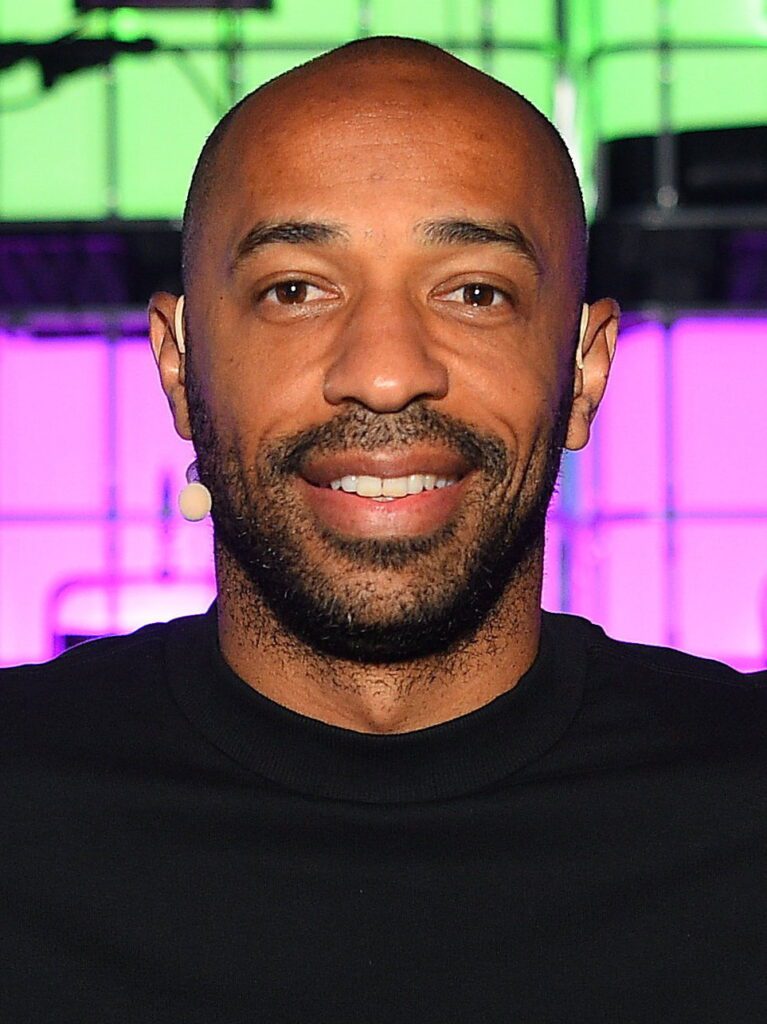
How did Thierry Henry build this fortune?
The answer unfolds through the career, earnings, deals and assets behind the headline estimate.
Thierry Henry before the fame
The background and early turning points that shaped Thierry Henry’s route to prominence.
Thierry Daniel Henry was born on 17 August 1977 in Les Ulis, a new town south of Paris. He was spotted playing locally and taken into Clairefontaine, the French national academy, before Monaco signed him at thirteen.
He started as a winger, which explains the player he became: the pace and the left-footed finish from the inside-right channel were a winger’s tools used from centre forward.
Arsene Wenger gave him his Monaco debut in 1994, and in five seasons there he made 105 league appearances and scored twenty goals, winning Ligue 1 in 1996-97. He was a World Cup winner at twenty-one, scoring three times in France’s 1998 campaign, on FIFA’s record of the tournament, and added a European Championship in 2000.
Juventus bought him in January 1999 for a reported 10.5 million pounds and played him on the flank. It did not work: sixteen league games, three goals, out again by August. The fee went to Monaco; none of it was his.
Thierry Henry’s breakthrough years
The career decisions and defining moments that turned recognition into sustained earning power.
Arsenal paid Juventus a reported 11 million pounds in August 1999, reuniting him with Wenger, and the eight seasons that followed are the career. He made 254 league appearances, scored 174 league goals and 228 in all competitions to become the club’s leading scorer, captained the side for two years, won the Premier League in 2001-02 and with the unbeaten 2003-04 team, took four Golden Boots and two European Golden Shoes, and was Ballon d’Or runner-up in 2003. Barcelona bought him in 2007 and he won the treble in his second season.
What the playing paid, spell by spell, is part reported and part our estimate. The Irish Times reported in June 2007, citing France Football, that Barcelona would pay about 10 million euros a year, roughly 40 per cent above his London salary; his agent denied it at the time, and a figure nearer 6.8 million has also circulated. Working back from the lower of the two, Arsenal paid roughly 1.5 million pounds a year for three seasons, 3.9 million for the next four and 6.5 million in the final year after the 2006 renewal: about 27 million pounds across the spell. Monaco’s five seasons near 700,000 euros and the Juventus half-season add about 4.75 million euros; three Barcelona seasons at the lower rate add about 20 million.
America is the best-documented part. the MLS Players Association’s salary guide had him on a 5 million dollar base and 5.6 million guaranteed in 2012, the highest in the league, and a 3.75 million base rising to 4.35 million with bonuses in 2013; four and a half New York seasons come to about 20 million dollars. Converted at period rates, the playing career comes to roughly 95 million dollars in gross wages across twenty seasons. The 10.5 million pound, 11 million pound and 24 million euro transfer fees are excluded, because each was paid by one club to another, and the 125 million euro release clause in his Barcelona contract was a price on him, not a payment to him.

What Thierry Henry’s work can earn
Reported pay, contracts, royalties and performance income reveal how the fortune was funded.
For France he played 123 times and scored 51 goals between 1997 and 2010, leaving as his country’s record scorer, with a World Cup, a European Championship and the 2003 Confederations Cup won and the 2006 final lost. He took three FWA Footballer of the Year awards, two PFA Players’ Player awards and five French Player of the Year titles.
In coaching the standout is the Olympics. He took charge of the France Under-21 and Olympic side in August 2023 and led it to silver at the Paris Games, then resigned days after the final citing personal reasons, his contract still running to June 2025, as TSN and theScore reported.
Punditry became the second career. He joined Sky Sports after retiring in December 2014 and stayed more than three years, then became a studio analyst on CBS Sports’ Champions League coverage, whose panel became an unlikely television success.
Fox Sports then named him a lead analyst for the 2026 World Cup, alongside Zlatan Ibrahimovic and Alexi Lalas, and he debuted on its coverage of the final draw in December 2025 — working the tournament in North America fifteen years after he moved to New York to play.

Thierry Henry’s business beyond the main career
Endorsements, ownership interests and investments can keep compounding long after the initial breakthrough.
Henry was among Europe’s most advertised footballers in the 2000s. Nike signed him early and used him constantly, Renault built the “va-va-voom” campaign around him, and Pepsi, Reebok and Gillette followed, the last from 2007 in a campaign shared with Roger Federer and Tiger Woods. Beats used him in 2014.
The current deal is betting: Gambling Insider reported him appointed a Betway global ambassador ahead of the 2026 World Cup. Our estimate for the endorsement career is about 40 million dollars gross, weighted to 2002-2010 at perhaps 3 to 5 million a year, tapering to 1 to 2 million since.
His ventures are inside football, not beside it: Arsenal’s youth sides from 2015, two spells as a Belgium assistant either side of a short stint at Monaco, which Sky Sports reported in October 2018 and which ended that January, and a season and a bit at CF Montreal.
The media work is a series of broadcast contracts, not a company, so this income reads as salary. Our estimate for coaching across Belgium, Monaco, Montreal and France is about 9 million dollars gross, and for punditry roughly 1 million a year since 2014, about 12 million to date.

Thierry Henry’s notable luxury item
A reported property or major asset offers a tangible glimpse of the wealth behind the public estimate.
His property followed the jobs: north London through the Arsenal years, then Barcelona, then New York, and London again since, where his children are and the reason he left Montreal in 2021.
The asset base consistent with those earnings is conventional: residential property in two or three expensive cities, investment and pension holdings across four tax jurisdictions, and the image-rights structures top footballers of that era used to keep commercial income separate from wages.
Thierry Henry’s estimated net worth
Public estimates vary because private contracts, investments, taxes and liabilities are not fully disclosed.
How this estimate is calculated
Two published figures do the anchoring: the MLS players’ union salary guide, and the France Football number the Irish Times carried in 2007. Transfer fees only date and scale the moves; they are never income. Everything else is seasons multiplied by a wage.
Gross lifetime income on this working is about 95 million dollars in playing wages, 9 million in coaching, 12 million in punditry and roughly 40 million in endorsements, so over 155 million dollars before tax. UK income tax at 40 and then 50 per cent through the Arsenal years, Spain’s expatriate regime for part of Barcelona, US and New York tax on the MLS contract and French tax on the rest give a blended rate near 40 per cent, with agency and management taking a further 5 to 8 per cent. That leaves roughly 85 to 90 million dollars retained, before two decades of investment return and the cost of a 2007 divorce settlement.
The working supports a range of 90 million to 150 million dollars, and we publish the midpoint. The Arsenal block is the weakest link: eight seasons of English wages reconstructed backwards from one 2007 report about a Barcelona offer his own agent denied. The endorsement total could be wrong in either direction, and a confirmed figure for the Nike relationship alone would reset a quarter of this calculation.
Confidence: Partly documented — anchored in the published MLS salary guide and one reported Barcelona figure, with the Arsenal wages and the endorsement income carried as our estimate.
His best-known campaigning work is Stand Up Speak Up, the anti-racism initiative he fronted with Nike in 2005, whose black and white wristbands sold across Europe for grassroots projects.
In 2021 he left social media over the racist abuse and misinformation the platforms carried, saying he would stay off until they were policed as rigorously as copyright, and he has argued the same on air since.
The handball against the Republic of Ireland in the 2009 World Cup play-off is the incident that follows him. He admitted it afterwards and said a replay would be fairest; FIFA declined and the result stood.
His Monaco record is the other recurring criticism: four wins, five draws and eleven defeats from twenty games before the club ended the appointment in January 2019. The Betway role has also drawn comment from gambling-advertising campaigners.