 How Much Are They Worth?
Celebrity fortunes, explained
How Much Are They Worth?
Celebrity fortunes, explained






How did Alan Chikin Chow build this fortune?
The answer unfolds through the career, earnings, deals and assets behind the headline estimate.
Before the fame
The background and early turning points that shaped Alan Chikin Chow’s route to prominence.
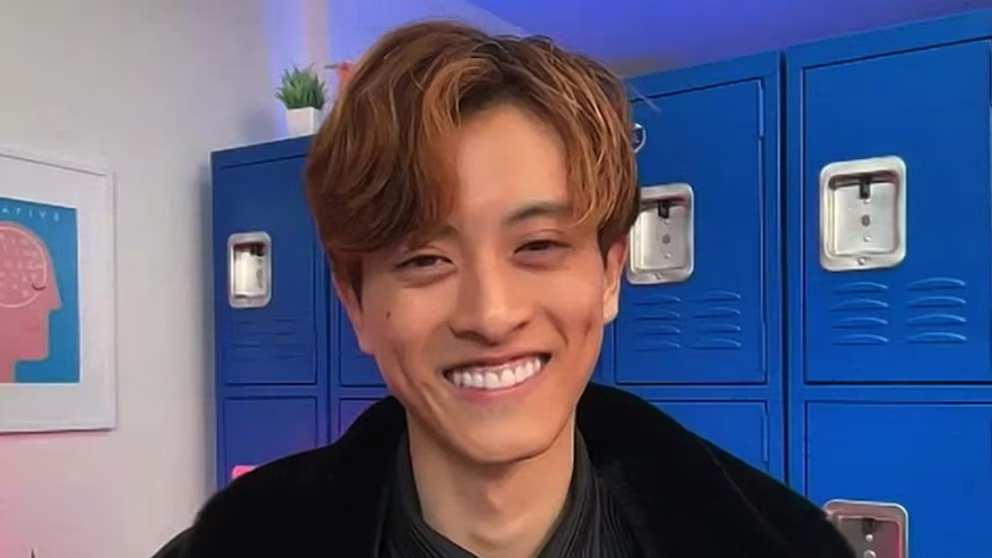
Alan Chikin Chow is an American writer, actor, producer and digital creator whose career bridges Hollywood television and creator-led online entertainment. Born in Texas and raised in the Dallas area, he developed an early interest in filmmaking by making videos intended to amuse his mother. He later studied business administration and screenwriting at the University of Southern California, a combination that helps explain both the narrative structure of his work and the commercial discipline behind it. The South China Morning Post profile of Chow’s upbringing and education describes his Cantonese family background, Texas childhood and USC training. Those details matter because Chow did not arrive online as an accidental viral celebrity: he deliberately combined performance, writing and audience analysis.
Before his name became associated with YouTube Shorts, Chow worked through the conventional entertainment system. He modelled as a teenager, performed voice roles and secured relatively small parts in series including Grey’s Anatomy and Into the Dark. The work provided professional set experience but did not make him a major television star. As the Fortune account of his transition from acting to short-form video explains, he began studying YouTube after finding that Hollywood acting alone was not producing the career he wanted. In late 2019 he started posting short comic videos on TikTok. During 2020, he left his day job and treated content creation as a full-time occupation. That decision placed creative control, rather than casting decisions, at the centre of his career.
The breakthrough years
The career decisions and defining moments that turned recognition into sustained earning power.
Chow’s breakthrough came from tightly constructed, family-friendly skits that could be understood even when dialogue was limited. Facial expressions, instantly recognisable school or relationship scenarios and decisive visual endings allowed the material to travel across language barriers. When the possibility of a United States TikTok ban emerged, he did not leave the audience concentrated on one platform. According to Forbes’s interview about his platform-diversification strategy, Chow began expanding to YouTube and Instagram in 2020. YouTube eventually became the largest part of his reach. The shift also reduced dependence on any single recommendation algorithm and turned a collection of skits into a repeatable, multi-platform production business.
What the work can earn
Reported pay, contracts, royalties and performance income reveal how the fortune was funded.
Chow progressed from standalone Shorts to Alan’s Universe, a continuing teen-oriented series built around friendship, romance, school conflict and supernatural plots. This was a meaningful change: longer episodes required recurring performers, sets, scripts and an organised production schedule rather than a creator filming alone. He signed with Creative Artists Agency, and a Variety report on the CAA representation agreement recorded the enormous monthly audience his channel was already attracting. His creator-led series later expanded beyond YouTube. A Roku distribution announcement for Alan’s Universe reported that the programme would reach the Roku Channel and highlighted Chow’s move into a substantial Los Angeles production facility. These developments positioned him less like a conventional influencer and more like the head of an independent studio.
Industry recognition has followed the scale of the channel. Chow has appeared on Forbes creator rankings and its 30 Under 30 list, as well as creator and influence lists from other major publications. His public profile increasingly emphasises writing and producing, not simply appearing in viral clips. The current Forbes creator profile for Alan Chikin Chow identifies him as the writer and actor behind Alan’s Universe and records the exceptional size of his subscriber audience. Rankings are snapshots rather than permanent measures of value, but they strengthen his leverage when negotiating distribution, representation and advertising. They also show that professional recognition now attaches to his ability to build an entertainment operation around intellectual property he controls.

The business beyond the main career
Endorsements, ownership interests and investments can keep compounding long after the initial breakthrough.
Advertising is part of Chow’s commercial model, but public reports do not provide a complete ledger of every campaign or its fee. His broad, brand-safe style gives him obvious appeal to consumer and entertainment companies, while his large global audience supports integrations across several platforms. The responsible valuation approach is therefore to recognise sponsorship income without inventing contract values. A separate development may ultimately be more important than conventional endorsements: Forbes reported Chow’s Netflix and HYBE America series partnership, with Chow serving as an executive producer. This is a production and intellectual-property relationship, not merely a paid social post. Any corporate financing, Netflix production budget or HYBE resources remain institutional assets unless evidence shows an ownership interest belonging personally to Chow.
The clearest business venture is the production ecosystem around Alan’s Universe. Chow has leased a large studio and developed longer-form programming alongside Shorts, giving his team room to produce sets, music and recurring storylines. In an interview with the Television Academy about his studio and long-form plans, he described the Burbank facility as a base for expanding output and discussed possible clothing and music extensions. A larger strategic step followed when Chow and HYBE America formed a venture designed to combine a pop group with scripted storytelling. The Variety report on the HYBE America casting project describes a joint label and a series built around a mixed-gender music group. Such projects can create revenue from production, music and licensing, although the venture’s assets should not automatically be treated as Chow’s personal property.
Notable luxury item
A reported property or major asset offers a tangible glimpse of the wealth behind the public estimate.
The most visible operating asset associated with Chow is the Burbank production space used by his team. Reporting describes it as leased, which is important: a lease gives use of a building but does not establish ownership of the underlying real estate. Cameras, sets, editing systems and other production equipment may belong to Chow, a production company, a lessor or vendors; no reliable public inventory resolves that ownership. The same caution applies to intellectual property. Chow appears to control or participate in the Alan’s Universe brand, but the exact split between personal rights and company rights has not been published. There is also no sufficiently documented public record of a personal property portfolio or collectible holdings. Consequently, this estimate does not add speculative mansions, vehicles or the full value of studio assets to his personal balance sheet.
Alan Chikin Chow’s estimated net worth
Public estimates vary because private contracts, investments, taxes and liabilities are not fully disclosed.
How this estimate is calculated
The estimate uses a career-based method rather than assuming that views convert directly into personal wealth. Relevant inputs include several years of platform advertising, sponsorship activity, acting income, and the commercial value of a globally recognised creator brand. The calculation also allows for the cost of a professional production team, leased facilities, sets, distribution, representation, tax and reinvestment. It treats published annual creator earnings as revenue-period indicators, not as a balance-sheet figure: gross earnings are not the same as retained wealth. No value is assigned to a partner’s resources, a streaming service’s production budget or HYBE America’s assets. Because the precise ownership of Chow’s companies and intellectual property is private, the result is a reasoned range rather than a claim of audited fact.
Alan Chikin Chow’s estimated net worth is $12 million to $18 million. The range reflects his sustained advertising reach, recognised creator earnings, studio-scale production and increasingly valuable scripted-media partnerships, while allowing for high operating expenses and taxes. It is moderately above a single year’s reported earnings because the channel has produced income for several years and has developed durable intellectual property. It remains below valuations that simply capitalise every view or follower because neither private-company accounts nor Chow’s personal asset statements are public. This is an editorial estimate of personal wealth, not the value of Netflix, HYBE America, CAA, a production budget or any property merely used by his business.
Chow’s public image is unusually optimistic and deliberately non-partisan. His stories favour accessible emotional themes, heightened school drama and lessons about kindness, which makes them suitable for younger viewers and international distribution. He often describes his mother as the original audience for his videos, a personal story that reinforces the family-friendly brand. Publicly accessible reporting provides less detail about a formal charitable foundation or sustained programme of personal giving. It would therefore be inaccurate to assign charity assets or donation totals to him without documentation. His broader public contribution is more clearly visible in employment, creator training and representation: a substantial production operation gives actors, writers and crew an alternative route into scripted entertainment while demonstrating that Asian-American-led digital stories can command a worldwide audience.
Chow has avoided the scale of personal controversy associated with many large creators, but that does not remove legitimate scrutiny. The growth of highly optimised, emotionally direct short-form content raises questions about repetition, younger audiences and dependence on opaque platform algorithms. Rapid subscriber growth also invites observers to compare audience size with depth of engagement. Chow’s own response has been to diversify platforms and invest in longer stories rather than rely solely on Shorts. The planned expansion into a pop group and streaming series creates additional scrutiny over labour, artist development and ownership, though no credible source reviewed for this profile establishes misconduct by Chow. Criticism of a format should not be converted into a personal allegation, and normal online scepticism is not evidence of wrongdoing.