
 How Much Are They Worth?
Celebrity fortunes, explained
How Much Are They Worth?
Celebrity fortunes, explained










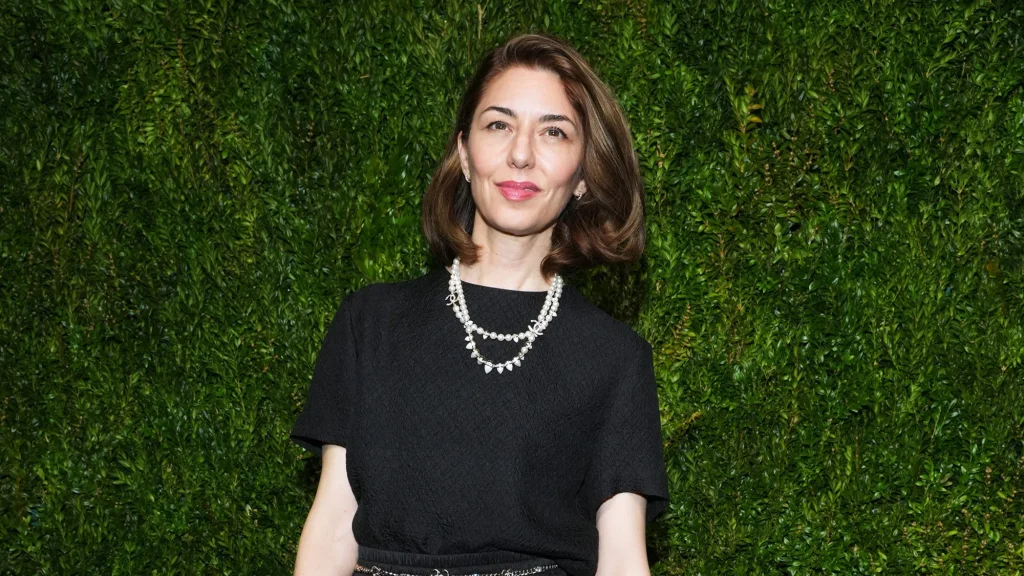
How did Sofia Coppola build this fortune?
The answer unfolds through the career, earnings, deals and assets behind the headline estimate.
Before the fame
The background and early turning points that shaped Sofia Coppola’s route to prominence.
Sofia Carmina Coppola was born on May 14, 1971, in New York City, the daughter of director Francis Ford Coppola and documentarian and artist Eleanor Coppola, according to Wikipedia’s biography of Coppola. She was raised largely on her parents’ farm in Rutherford, California, and made her screen debut as an infant, playing Michael Francis Rizzi in the baptism scene of “The Godfather” (1972). She went on to appear in eight of her father’s films through childhood and adolescence, including “The Outsiders,” “Rumble Fish” and “The Cotton Club,” before taking the role of Mary Corleone in “The Godfather Part III” (1990) at short notice. That performance was widely panned and won her a Golden Raspberry Award, an experience that pushed her away from acting and toward the fine arts. She studied painting at Mills College and the California Institute of the Arts before attending the Art Center College of Design, and at 15 she had interned at Chanel, an early sign of the fashion-world ties that would later shape parts of her income.
Coppola’s first income outside acting came from fashion rather than film. In 1994 she co-founded the Japan-based streetwear label Milk Fed with Stephanie Hayman and Sonic Youth’s Kim Gordon, a line that is still sold in Japan today. She also worked in television, co-creating and appearing on the short-lived Comedy Central sketch show “Hi Octane” in 1994, and directed the 1998 short film “Lick the Star,” her first credited work as a director. Her feature debut, “The Virgin Suicides” (1999), adapted from Jeffrey Eugenides’ novel and co-produced through her father’s company American Zoetrope, premiered at the Sundance Film Festival and established the muted, dreamlike visual style that would define her later work. None of this period paid Hollywood-scale money; HMW treats her mid-1990s output as low, largely fashion-and-television income rather than director-level film compensation.
The breakthrough years
The career decisions and defining moments that turned recognition into sustained earning power.
“Lost in Translation” (2003), written and directed by Coppola on a $4 million budget, went on to gross close to $118.7 million worldwide, according to Box Office Mojo’s box office record for the film. The film won Coppola the Academy Award for Best Original Screenplay and earned her nominations for Best Picture and Best Director, making her the third woman in Oscar history nominated for Best Director and the first American woman in that category. That single film, made for a fraction of a typical studio budget and returning nearly thirty times its cost, is the clearest turning point in her earning power, moving her from a promising first-time director to one of the most commercially reliable arthouse filmmakers in the industry.

What the work can earn
Reported pay, contracts, royalties and performance income reveal how the fortune was funded.
Coppola followed with “Marie Antoinette” (2006), a $40 million Versailles-set production that grossed roughly $60.9 million worldwide per Box Office Mojo’s figures for the film and won the Academy Award for Best Costume Design. “Somewhere” (2010) won the Golden Lion at the Venice Film Festival, making her the first American woman to take that prize, and “The Beguiled” (2017) won her the Best Director award at Cannes, the second time a woman had won that prize and the first for an American. Her most recent feature, “Priscilla” (2023), based on Priscilla Presley’s memoir, premiered at the Venice Film Festival, where star Cailee Spaeny won the Volpi Cup for Best Actress, according to Wikipedia’s entry on the film; the film grossed roughly $33.1 million worldwide against a $20 million budget. Across an Academy Award, a Cannes directing prize and a Venice Golden Lion, Coppola holds one of the more decorated resumes among working American directors, though her films rarely reach blockbuster box office scale.
Coppola’s public profile rests less on tabloid visibility than on being treated as a defining American auteur of her generation, someone whose name alone can secure financing and festival slots. Her Oscar win made her a fixture of retrospectives on women directors, and her Cannes and Venice prizes extended that recognition into Europe’s top festival circuit, an unusual double for an American filmmaker. She has also become a reference point for discussions of pay equity in directing; in a BBC interview published in December 2023, she said plainly, “I just see all these men getting hundreds of millions of dollars and then I’m fighting for a tiny fraction of that,” attributing the gap to industry culture rather than her own box office record, according to HuffPost UK’s report on the interview. That combination, critical prestige paired with modest studio budgets, is central to how her recognition translates, or fails to translate, into industry-scale pay.

The business beyond the main career
Endorsements, ownership interests and investments can keep compounding long after the initial breakthrough.
In 2001, Marc Jacobs chose Coppola as the face of his Marc Jacobs Daisy fragrance campaign, photographed by Jürgen Teller, one of the few times she has appeared as a paid brand face rather than as a director-for-hire on advertising. More often she has worked behind the camera on branded content: she directed a 2008 Christian Dior advertisement and a 2014 Gap holiday campaign, functions closer to commercial directing fees than to a long-term spokesperson deal. In 2024 she released a lip balm line in collaboration with the skincare brand Augustinus Bader, a smaller licensing-style arrangement rather than a major endorsement contract. HMW models these deals as modest, largely one-off commercial director fees and licensing payments rather than an ongoing sponsorship income stream, since no long-running brand ambassadorship is documented for her in mainstream entertainment or fashion trade coverage.
Coppola’s largest business interest outside directing is her ownership stake in American Zoetrope, the production company her father co-founded with George Lucas. By 2007 Francis Ford Coppola had passed ownership to his children, and Sofia and her brother Roman are listed as owners alongside him, according to Wikipedia’s entry on American Zoetrope; nearly all of her features, from “The Virgin Suicides” through “The Beguiled,” have been produced through the company. She and Roman also ran the low-budget production venture Commercial Pictures as far back as 1988, giving her an unusually long financial stake in the family business rather than only director-for-hire income. In fashion, she designed the “SC Bag” handbag collection for Louis Vuitton starting in the late 2000s under Marc Jacobs’ creative direction, a minimalist, lower-logo line aimed at a different customer than the house’s usual monogrammed pieces. HMW treats her American Zoetrope ownership as a modest but recurring source of producing income layered on top of her director fees, rather than a source of outsized wealth on its own.

Notable luxury item
A reported property or major asset offers a tangible glimpse of the wealth behind the public estimate.
Coppola and her first husband, director Spike Jonze, bought a loft-style condominium at 161 Grand Street in Little Italy/Nolita in 2002 for $1.16 million; she and her second husband, Phoenix musician Thomas Mars, sold the same 1,770-square-foot property for $2.75 million a decade later, according to The Real Deal’s report on the sale. Around the same time, the couple purchased an 18-foot-wide townhouse on Morton Street in the West Village for $9.85 million, about $1 million over asking, a property with a roughly 2,000-square-foot garden and marble en suite baths, as detailed by Top Ten Real Estate Deals’ coverage of the purchase. The family has also spent extended periods living in Paris, closer to Mars’ home country and career. HMW includes the appreciation and equity built through these Manhattan property transactions as a modest but real component of her balance sheet, alongside standard investments built from two decades of director, producer and licensing income.
Sofia Coppola’s estimated net worth
Public estimates vary because private contracts, investments, taxes and liabilities are not fully disclosed.
How this estimate is calculated
HMW builds this estimate from a documented filmography running from 1999’s “The Virgin Suicides” through 2023’s “Priscilla” rather than adopting a single third-party number outright. Early features are modeled at modest, arthouse-scale director and screenwriter fees consistent with their small budgets, including the $4 million “Lost in Translation,” and pay is scaled up meaningfully after that film’s Oscar win and nearly thirty-times return proved her commercial reliability on modest budgets. “Marie Antoinette” and “Priscilla” are modeled with studio-scale but not blockbuster-scale director fees, consistent with their $40 million and $20 million budgets respectively, and HMW layers in a recurring, minority producing income stream tied to her American Zoetrope ownership rather than treating her as a pure director-for-hire. Fashion and brand work, the Marc Jacobs Daisy campaign, the Louis Vuitton SC Bag collection and smaller licensing deals, are added as modest supplementary income rather than a major revenue line, and documented Manhattan real estate transactions are folded in as realized property gains. Celebrity Net Worth, a secondary aggregator rather than a primary financial record, publishes its own standing estimate for Coppola; HMW treats that figure as a directional anchor only, widening it into a range that accounts for her American Zoetrope stake and two decades of layered director, producer and licensing income, after deducting for the consistently modest budgets, relative to her male peers, that define most of her filmography.
This range reflects a director with an unusually prestigious but budget-constrained filmography, anchored by the outsized return on “Lost in Translation,” steady producing income through her American Zoetrope ownership stake, realized gains on Manhattan real estate, and modest fashion and licensing income, offset by two decades spent making arthouse-scale films that, by her own account, are financed at a fraction of what comparable male directors command.
No specific named charity, foundation or recurring donation amount tied to Coppola is documented in mainstream entertainment or philanthropy coverage; unlike some of her Hollywood peers, she has not built a public-facing charitable foundation or become closely associated with a single cause. Her public image instead rests on cultural stewardship rather than direct giving: she sits on the board of the Gagosian Gallery, a major contemporary art institution, and in 2016 she directed her first opera, a Rome production of Verdi’s “La Traviata” with costumes by Valentino, working under the guidance of her great-uncle, the centenarian conductor Anton Coppola, who helped teach her the basics of opera, according to OperaWire’s report on the production. The staging proved successful enough to tour internationally and was later broadcast to mark its own anniversary. HMW does not add a philanthropic giving line to her estimate given the absence of documented donations, and instead treats her public image and cultural credibility as an asset that supports her ability to attract financing and cast, rather than as a direct source of income or expense.
Coppola has faced no personal financial or legal scandal; the scrutiny in her career has consistently centered on casting and representation choices in her films. “Lost in Translation” drew criticism from Asian media watchdogs and critics who characterized its depiction of Tokyo as Orientalist, a charge Coppola addressed directly, saying, “I can see why people might think that, but I know I’m not racist.” “The Bling Ring” (2013) was criticized for altering the ethnicity of a character based on a real Colombian-American member of the burglary ring it depicted, and “The Beguiled” (2017) drew a similar controversy for removing a enslaved Black character present in the original novel and its 1971 film adaptation, choices Coppola defended as a deliberate narrowing of focus onto the white characters’ perspective. She has also faced recurring “nepo baby” criticism common to directors from film dynasties, though she has pushed back on the idea that her family name made her career easy, pointing instead to the industry-wide budget gap she described in her December 2023 comments about “fighting for a tiny fraction” of what male directors receive. None of this amounts to a financial or legal controversy; it reflects a filmmaker whose creative choices, not her conduct, have drawn public debate.