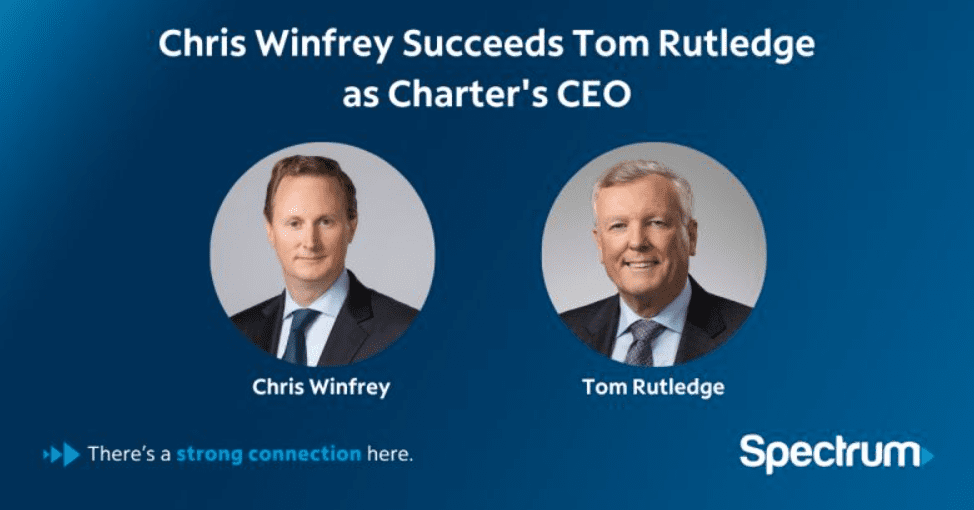

Christopher L. Winfrey – Charter Communications (USA)
Net worth revealed after 6 slides
Begin the countdown ↓
How did Christopher L. Winfrey – Charter Communications (USA) build this fortune?
The answer unfolds through the career, earnings, deals and assets behind the headline estimate.
Before the fame
The background and early turning points that shaped Christopher L. Winfrey – Charter Communications (USA)’s route to prominence.
Christopher L. Winfrey was born in 1976 in Kentucky, according to his Wikipedia biography. He earned a Bachelor of Science in Accounting and an MBA from the University of Florida, where he later joined the Business School Advisory Council, a connection noted on Charter Communications’ official leadership page.
That accounting and finance background set the stage for a career spent almost entirely on the financial and operational side of the cable and telecommunications industry, first in Europe and later in the United States, rather than in the engineering or marketing roles more commonly associated with rising to the top of a media company.
Winfrey began his career as a senior associate in private equity at Communications Equity Associates, then moved into director-level financial planning and operations roles at NTL Incorporated across continental Europe, according to his Wikipedia profile.
He went on to become Senior Vice President of Corporate Finance and Development at Cablecom GmbH in Switzerland, then Chief Financial Officer and Managing Director of Unitymedia GmbH, Germany’s second-largest cable operator, where he oversaw the company’s cable operations, broadcasting and satellite entities. That decade of European cable finance experience is what Charter Communications was hiring for when it brought him to the United States in 2010.
The breakthrough years
The career decisions and defining moments that turned recognition into sustained earning power.
Winfrey joined Charter Communications as Chief Financial Officer in 2010, taking responsibility for accounting, financial planning and analysis, procurement, real estate, tax, treasury, mergers and acquisitions, capital structure activities and investor relations, according to Charter’s corporate leadership biography.
As CFO he played a central role in Charter’s transformational acquisitions of Time Warner Cable and Bright House Networks in 2016, deals that roughly quadrupled the company’s size and turned Charter into the second-largest cable operator in the United States. Charter expanded his CFO mandate to include oversight of the Spectrum Enterprise fiber business in 2019, and he was promoted to Chief Operating Officer in 2021, taking charge of all cable operations including marketing, sales, field operations and customer operations.
What the work can earn
Reported pay, contracts, royalties and performance income reveal how the fortune was funded.
Winfrey was named President and Chief Executive Officer of Charter Communications effective December 1, 2022, succeeding long-time CEO Tom Rutledge, as announced in Charter’s official newsroom release. He was subsequently appointed to Charter’s board of directors in November 2023.
In December 2025, Charter’s board extended his employment agreement through December 1, 2028, and raised his minimum base salary to $2.5 million with a target bonus equal to 300% of base salary, along with a commitment to annual stock option grants worth at least $23 million beginning in 2027, terms reported by Investing.com based on Charter’s SEC filing. The extension reflects the board’s commitment to his leadership through Charter’s ongoing broadband, video and mobile transition.
Winfrey is a regular presence in business and financial press coverage of the cable and broadband industry, both for his role steering one of the largest broadband, cable and mobile providers in the country and for the size of his pay packages, which have repeatedly made headlines. His 2023 compensation of $89.1 million was reported by Deadline as one of the largest single-year packages disclosed by any major U.S. media or telecommunications executive that year.
He is also frequently quoted in financial media discussing Charter’s broadband subscriber trends, pricing strategy and the company’s rollout of mobile and rural fiber service, appearances that have made him one of the more visible spokespeople in the cable industry relative to peer CEOs at Comcast and Cox.
The business beyond the main career
Endorsements, ownership interests and investments can keep compounding long after the initial breakthrough.
As a corporate chief executive rather than a public-facing entertainer or athlete, Winfrey has no personal brand endorsement deals, sponsorships or licensing agreements. Charter Communications spends heavily on consumer advertising for its Spectrum brand, including national marketing and sports sponsorships, but these are corporate marketing expenditures rather than personal income for Winfrey.
No publicly disclosed personal endorsement or sponsorship agreements tied to Winfrey have been identified in SEC filings or press coverage. This category of income, common for athletes and entertainers profiled elsewhere on this site, is not a meaningful part of his financial profile.
Winfrey has not founded outside companies or ventures; his career and resulting wealth are tied almost entirely to executive roles at Charter Communications and, earlier, Unitymedia and Cablecom. His outside business involvement instead shows up as industry governance: he serves as Chairman of the Board of the Internet & Television Association (NCTA) and of CableLabs, the cable industry’s research and development consortium, and sits on the board of C-SPAN, roles described on Charter’s corporate leadership page.
These positions place him at the center of cable-industry policy and standards-setting, but they are unpaid or nominally compensated industry roles rather than personal business ventures, and none of them have been identified as a material source of his personal wealth.
Notable luxury item
A reported property or major asset offers a tangible glimpse of the wealth behind the public estimate.
Winfrey’s most significant disclosed asset is his direct equity stake in Charter Communications, built through more than fifteen years of stock and option grants. SEC filings tracked by InsiderTrades.com showed him holding 74,409 Charter shares directly, worth roughly $12.8 million, as of an April 2026 filing date, a figure the site explicitly notes reflects only his disclosed direct stock position and not the full value of unvested options or other assets.
No reliable public record of Winfrey’s personal real estate holdings, including any primary residence, has been identified in property records or verified press reporting available at the time of writing. This profile does not speculate about holdings that have not been independently confirmed.
Christopher L. Winfrey – Charter Communications (USA)’s estimated net worth
Public estimates vary because private contracts, investments, taxes and liabilities are not fully disclosed.
How this estimate is calculated
Winfrey’s net worth is derived primarily from executive compensation disclosed in Charter Communications’ SEC proxy statements rather than from outside business ownership. His reported total compensation was $89.1 million in 2023, driven mostly by $75 million in stock option awards and $8.7 million in stock awards tied to a long-term performance equity program, according to Charter’s 2024 DEF 14A filing and contemporaneous reporting by Deadline. That fell to $5.75 million in 2024, consisting of a $1.7 million base salary, a $3.75 million non-equity incentive payment and $296,500 in other compensation, with no new equity granted that year, as detailed in Charter’s 2025 DEF 14A filing and reported by Yahoo Finance.
Layered on top of that two-year snapshot are more than a decade of prior CFO and COO-level salary, bonus and equity compensation dating back to 2010, a fresh one-time $6 million stock option top-up awarded in January 2026, and a new employment agreement effective December 2025 committing Charter to annual option grants worth at least $23 million starting in 2027. Against that, his currently disclosed direct stock position was worth only about $12.8 million as of April 2026, reflecting how much of his historical equity compensation has already been exercised, sold or remains in unvested option form rather than held as shares outright, per InsiderTrades.com. Secondary financial-data aggregators publish estimates for Winfrey ranging from roughly $10 million to more than $120 million depending on whether they count only current disclosed share holdings or attempt to capture the value of prior stock and option grants; those aggregator figures are treated here only as a secondary cross-check rather than a primary source, given how widely their methodologies diverge. Combining the documented multi-year compensation history with the disclosed current equity stake and applying reasonable assumptions about taxes, exercised-option proceeds and living expenses produces the broader estimate below.
Combining Winfrey’s SEC-disclosed compensation since becoming CFO in 2010, his outsized 2023 equity grant, his current disclosed Charter stock position, and committed future option awards, cross-checked against secondary net worth aggregators, Christopher L. Winfrey’s estimated net worth as of August 2026 falls in the following range.
Winfrey sits on the University of Florida’s Business School Advisory Council and serves on the board of the Greenwich Center for Hope & Renewal, a Connecticut-based addiction recovery nonprofit, according to Charter’s corporate leadership biography.
He has not signed the Giving Pledge or established a large public personal foundation, and specific dollar figures for personal charitable giving are not part of the public record. His public image is shaped less by philanthropy than by his operating record at Charter and by the scale of his compensation, which has drawn sustained scrutiny discussed below.
Winfrey and Charter’s chief financial officer, Jessica Fischer, are named defendants in a federal securities class action filed in the U.S. District Court for the Southern District of New York in August 2025, according to Broadband Breakfast. The suit alleges the executives made materially misleading statements about Charter’s ability to absorb the end of the federal Affordable Connectivity Program, which had subsidized broadband service for roughly 5 million Charter customers, and that Charter’s July 2025 disclosure of accelerating broadband losses erased approximately $9.8 billion in market value in a single trading session. The claims remain allegations that Charter has not been reported to have admitted.
The lawsuit followed a broader pattern of subscriber and stock pressure: Charter lost 120,000 broadband subscribers in a single quarter, more than double the prior year’s decline and worse than analyst estimates, sending shares tumbling roughly 24% in one session, as reported by Broadband Breakfast. Winfrey has publicly pushed back on the market reaction, telling analysts the selloff overstated the underlying business trends, but the recurring subscriber losses and resulting stock volatility have remained a persistent point of criticism from analysts and shareholders during his tenure as CEO. Separately, his 2023 pay package of $89.1 million, most of it in stock options, drew attention in the financial press as unusually large relative to Charter’s stock performance that year, though Charter’s board has not held a binding say-on-pay vote that would formally test shareholder support for his compensation.
JavaScript is off, so all sections are displayed together.