
 How Much Are They Worth?
Celebrity fortunes, explained




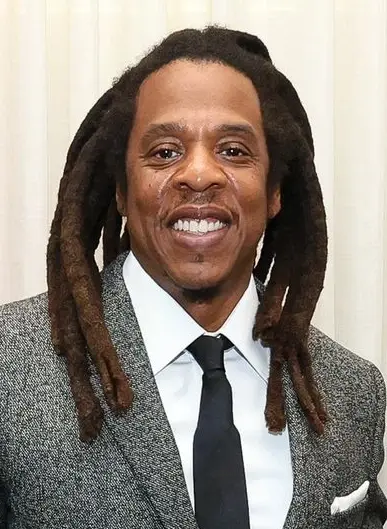
How did Jay-Z build this fortune?
The answer unfolds through the career, earnings, deals and assets behind the headline estimate.
Jay-Z before the fame
The background and early turning points that shaped Jay-Z’s route to prominence.
Shawn Corey Carter was born on 4 December 1969 in Brooklyn and grew up in the Marcy Houses. He released Reasonable Doubt in 1996 on Roc-A-Fella, the label he co-founded with Damon Dash and Kareem Burke, and has spent the three decades since moving from recording artist to owner of the businesses around the music.
That trajectory is why his profile is harder to price than a musician’s normally is. Almost none of his wealth sits in royalties; it sits in private companies whose accounts are not filed, and in two disposals whose terms were sealed.
Roc-A-Fella began as a distribution workaround: three partners pressing and selling records themselves because the majors were not interested. The label was later absorbed into Def Jam, and Carter served as that label’s president from 2004 to 2007 – an executive role, not an artist’s imprint.
The pattern set in that decade repeats throughout. He takes equity in the thing he is promoting rather than a fee for promoting it, which is why his income is opaque and his upside has been large.
Jay-Z’s breakthrough years
The career decisions and defining moments that turned recognition into sustained earning power.
Commercially the breakthrough record was The Blueprint in 2001; structurally it was 2008, when he left Def Jam, signed a ten-year agreement with Live Nation reported at 150 million dollars covering touring, publishing and three albums, and used the joint venture inside it to launch Roc Nation (CNBC).
Roc Nation became the vehicle for everything since. The 2008 agreement was renewed in May 2017 on a further ten-year touring deal reported at 200 million dollars (Forbes).

What Jay-Z’s work can earn
Reported pay, contracts, royalties and performance income reveal how the fortune was funded.
The achievement carrying the most financial weight is the Rocawear sale. Carter sold the clothing brand to the licensing group Iconix in 2007 for 204 million dollars – a figure on the public record only because it later became the subject of a regulatory investigation into the buyer (Billboard).
He also built and sold a streaming service. Carter’s group acquired the Norwegian company behind Tidal in 2015; in March 2021 Jack Dorsey’s Square bought a majority stake for 297 million dollars in cash and stock (Deadline, The Hollywood Reporter), with Carter and a group of artist shareholders retaining the rest (Square Inc. announcement).
Recognition, in his case, has been commercial rather than ceremonial. When Forbes began listing him among the wealthiest figures in music, the number rested less on record sales than on stakes in a champagne brand, a cognac brand, a streaming service and an agency.
The 2019 partnership between Roc Nation and the NFL, giving his company a role in the league’s live entertainment and social justice programming, is the clearest example: an institution buying cultural authority rather than a performance (NFL.com).

Jay-Z’s business beyond the main career
Endorsements, ownership interests and investments can keep compounding long after the initial breakthrough.
He is not, in the conventional sense, an endorser. Where another artist signs an ambassadorial contract, Carter has generally taken ownership of the product instead – the champagne and cognac ventures paid him as a shareholder, not as a face.
The institutional partnerships work the same way. The NFL arrangement was struck with Roc Nation as a company rather than with Carter as a performer (NFL.com), and its value to him is a share of private revenue that has never been broken out.
In February 2021 LVMH’s Moët Hennessy division bought 50 per cent of Armand de Brignac, the champagne brand better known as Ace of Spades (CNBC). Carter had taken a half share in the brand in 2006 and bought the rest in 2014.
The terms were not disclosed. The widely repeated figure of roughly $315 million comes from a Forbes valuation of the whole brand at about $630 million, halved (The Business of Fashion) – an inference from an outside estimate, not a price either party has confirmed.
The D’Ussé cognac venture ended in litigation. Carter held 50 per cent; Bacardi held the rest. Negotiations collapsed after Bacardi offered $500 million for his interest and rejected his $1.5 billion counter-offer for theirs, and the dispute ran through arbitration and several courts (Bloomberg Law).
The February 2023 settlement had a Bacardi affiliate buy out most of his stake, leaving Bacardi with at least 75.01 per cent and Carter retaining what was described only as a significant holding through his company SCLiquor. Terms were again undisclosed. The $750 million figure that circulated afterwards derives from the $3 billion valuation his own lawyers argued for – a number produced by one side of an argument about price, which is not the price (Bloomberg Law).

Jay-Z’s notable luxury item
A reported property or major asset offers a tangible glimpse of the wealth behind the public estimate.
The largest reported property transaction is the Bel Air estate he and Beyoncé bought in 2017 for 88 million dollars, then the largest residential sale of the year in Los Angeles County (Billboard).
Beyond that, the asset side is inference. No filing lists his holdings, the retained stakes in Armand de Brignac and D’Ussé have no published valuation, and his share of Roc Nation is not disclosed.
Jay-Z’s estimated net worth
Public estimates vary because private contracts, investments, taxes and liabilities are not fully disclosed.
How this estimate is calculated
Documented. Rocawear sold to Iconix for 204 million dollars in 2007 (Billboard); Square’s 297 million dollar purchase of a Tidal majority in 2021 (Deadline, Square Inc. announcement); Live Nation agreements reported at 150 million in 2008 and 200 million in 2017 (CNBC, Forbes); an 88 million dollar house (Billboard).
Not documented. The two largest disposals. Neither the champagne sale nor the cognac settlement has a published price (CNBC, Bloomberg Law), and neither Roc Nation’s accounts nor his retained drinks stakes are filed anywhere.
The arithmetic. Taking the reported valuations at face value, the champagne stake produced roughly $315 million gross (BoF) and the cognac settlement somewhere between Bacardi’s rejected $500 million offer (Bloomberg Law) and the $750 million implied by his lawyers’ valuation. Before tax that is a band of about $800 million to $1.07 billion from the two disposals, set against retained stakes in both brands, Roc Nation, the catalogue and property. Both sales were paid into holding structures rather than to Carter personally, and neither the tax treatment nor what he reinvested has been disclosed, so this arithmetic sizes the disposals rather than his balance sheet.
Against a published total. Forbes puts him in the region of 2.5 billion dollars. The band below sits either side of that figure rather than on it, because a total of this kind depends on private company valuations that are not filed – which is why published estimates for him vary by hundreds of millions.
The honest limit. Two transactions do most of the work in any number attached to his name, and both closed under confidentiality, so the estimate rests on valuations argued in public by interested parties rather than on sums anyone has confirmed receiving.
Confidence: Partly documented — anchored in published sale prices for Rocawear and Tidal, but the champagne and cognac proceeds that dominate the total are sealed.
Think you know Jay-Z? Take the quiz: Easy · Medium · Legendary
The Shawn Carter Foundation, set up in 2003 with his mother Gloria Carter, funds students through college with awards of up to 15,000 dollars each (Shawn Carter Foundation).
In January 2019 he co-founded the Reform Alliance with Meek Mill and a group of sports and finance backers, launched with a 50 million dollar commitment to changing probation and parole rules in the United States (Rolling Stone). Neither organisation’s spending can be traced to his personal accounts, so neither moves the estimate below.
Tidal was investigated in Norway in 2019 after the newspaper Dagens Næringsliv reported that the service had inflated streaming figures for particular albums; Norway’s economic crime authority took it up after complaints from artists’ associations (Bloomberg, Variety).
The Rocawear sale produced a longer legal entanglement. The Securities and Exchange Commission investigated Iconix over its accounting for the transaction and subpoenaed Carter as a witness; when he did not appear, the regulator went to court in 2018 to compel his testimony (NBC News, Billboard). He was not accused of wrongdoing.
The NFL partnership drew sustained criticism when announced, on the grounds that it gave the league a reputational benefit while its treatment of protesting players was still unresolved (NFL.com).