 How Much Are They Worth?
Celebrity fortunes, explained
How Much Are They Worth?
Celebrity fortunes, explained









How did Bong Joon-ho build this fortune?
The answer unfolds through the career, earnings, deals and assets behind the headline estimate.
Before the fame
The background and early turning points that shaped Bong Joon-ho’s route to prominence.
Bong Joon-ho was born on September 14, 1969, in Daegu, South Korea, and moved to Seoul with his family while still in elementary school, according to Wikipedia’s biography of Bong. His father, Bong Sang-gyun, worked as a graphic and industrial designer and later taught art at Yeungnam University, and his maternal grandfather, Park Taewon, was a well-known Korean novelist. Despite wanting to study film, Bong enrolled in sociology at Yonsei University in 1988 because his parents disapproved of theatre as a major, a detail confirmed by Britannica’s profile of the director. While at Yonsei he co-founded the campus film club Yellow Door and shot his first short films, “Looking for Paradise” and “White Man,” before completing compulsory military service and graduating in 1993. He later trained formally at the Korean Academy of Film Arts, where he made the shorts “Incoherence” and “Memory Within the Frame.” This period produced no meaningful income; HMW treats it purely as unpaid or minimally paid training.
Bong’s feature debut, “Barking Dogs Never Bite” (2000), was a black comedy that performed modestly at the Korean box office. His second film, “Memories of Murder” (2003), a fictionalized account of Korea’s real and then-unsolved Hwaseong serial murders, became a critical breakthrough and one of the most acclaimed Korean films of its decade. Neither film paid director fees comparable to what Bong would later command; the Korean film industry of the early 2000s was smaller and less internationally financed than it is today. HMW models this period as low, feature-length director pay rather than applying his later commercial rate retroactively.
The breakthrough years
The career decisions and defining moments that turned recognition into sustained earning power.
“The Host” (2006), a monster film about a creature emerging from Seoul’s Han River, became the highest-grossing South Korean film in the country’s history at the time of its release, selling roughly 13 million tickets domestically and grossing close to $90 million worldwide, a milestone widely reported in coverage of the film’s box office run. That commercial result moved Bong from a respected arthouse name to a director capable of opening a wide domestic release, and it materially increased the budgets and fees available to him for his next projects, including 2009’s Cannes-selected “Mother.”

What the work can earn
Reported pay, contracts, royalties and performance income reveal how the fortune was funded.
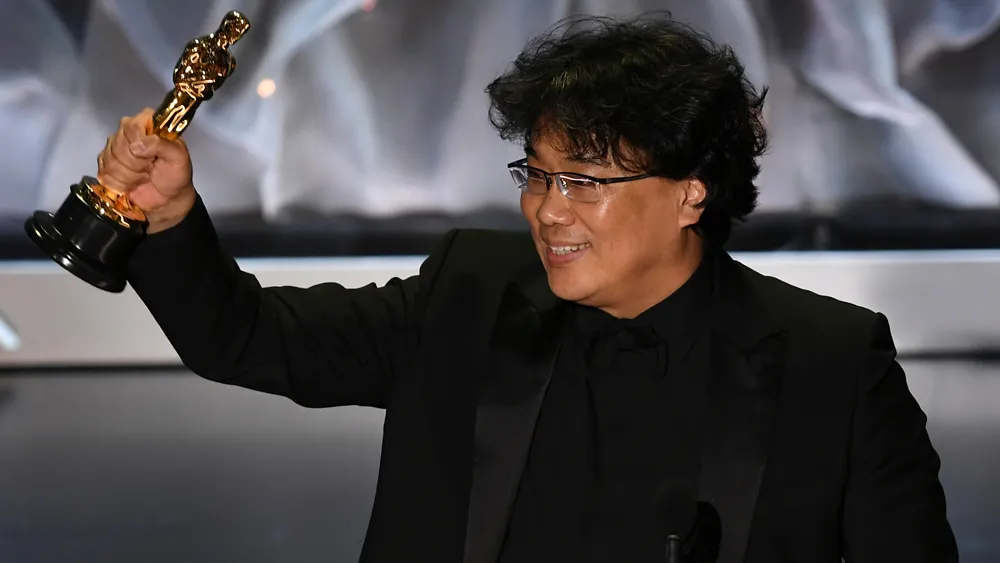
Bong’s English-language debut, “Snowpiercer” (2013), grossed roughly $86 million worldwide on a reported $40 million budget, per Celebrity Net Worth’s account of his filmography, and introduced him to international co-production financing as well as a dispute with producer Harvey Weinstein over the film’s final cut, detailed by IndieWire’s account of the standoff. Netflix then financed “Okja” (2017) at roughly $50 million, a deal that funded ambitious visual effects work in exchange for a simultaneous streaming release. The clearest financial and cultural landmark remains “Parasite” (2019), which won the Palme d’Or at Cannes, becoming, according to CBC’s report on the festival win, the first Korean film to take the prize, before going on to win four Academy Awards including Best Picture and Best Director. Box Office Mojo records worldwide box office of roughly $263 million against an $11 million production budget.
Parasite’s Oscar sweep made Bong a rare instance of a subtitled-film director becoming a mainstream American awards-season figure, memorably quoting Martin Scorsese’s line that “the most personal is the most creative” in his Golden Globes acceptance speech. The film also received a Special Award from the American Film Institute, and Bong later served as jury president at the Venice Film Festival. His profile crossed into politics when then-President Trump publicly mocked the film’s Best Picture win at a February 2020 campaign rally, asking “what the hell was that all about?” and complaining about trade with South Korea, according to Variety’s report on the remarks; distributor Neon responded on social media that Trump “can’t read,” a reference to the film’s subtitles. That exchange, rather than any personal scandal, is the clearest evidence of how far Bong’s public recognition extended beyond the film industry.

The business beyond the main career
Endorsements, ownership interests and investments can keep compounding long after the initial breakthrough.
Unlike many entertainment figures of comparable fame, Bong does not appear in consumer brand advertising, and no endorsement deal, spokesperson role or sponsorship agreement is documented in mainstream entertainment or business coverage. His only clearly commercial licensing product is “Parasite: A Graphic Novel in Storyboards,” published by Grand Central Publishing and listed among his represented works by his talent agency, Aevitas Creative Management, where literary agent David Kuhn handles his representation. HMW assigns this a modest, one-time licensing payment rather than an ongoing royalty stream, and assumes no brand endorsement income given the absence of any documented deal.
Bong has told interviewers he has no interest in running his own production company, saying the idea is “not really within my personality,” according to CNBC’s coverage of his Telegraph interview. Instead, he has built a long, repeat relationship with the Korean production and distribution company Barunson E&A, which produced both “Mother” and “Parasite” and, per a report on the company’s upcoming slate, is attached to his next projects, including an animated deep-sea feature. In 2026, Bong reunited with Parasite distributor Neon on his first animated film, “Ally,” a partnership Variety reported reflects the durability of that relationship. His most expensive undertaking to date is “Mickey 17” (2025), a Warner Bros. science-fiction film starring Robert Pattinson with a reported production cost of $118 million after tax rebates; box office tracking and subsequent trade coverage indicate the film grossed roughly $133 million worldwide, short of the total generally needed for a film of that budget to turn a profit. HMW treats Bong’s compensation on that project as a large, contracted director fee rather than a backend-dependent payday, given the film’s reported box office shortfall.

Notable luxury item
A reported property or major asset offers a tangible glimpse of the wealth behind the public estimate.
No sale price, address or valuation for a personal residence owned by Bong has been reported in mainstream property or entertainment coverage, and he has generally kept his private life out of the press. In the same Telegraph interview covered by CNBC, Bong described his creative process as built around “a very simple lifestyle” of coffee, writing and limited socializing, and said that after Parasite’s award run “nothing had changed except the trophy that I have.” That account is consistent with the absence of published real estate, vehicle or luxury-asset stories about him, in contrast to many of his Hollywood peers. HMW therefore does not assign a named property or asset to Bong’s estimate and instead models a general allowance for savings, retained earnings and standard investments built from two decades of director and producer income.
Bong Joon-ho’s estimated net worth
Public estimates vary because private contracts, investments, taxes and liabilities are not fully disclosed.
How this estimate is calculated
HMW builds this estimate from a documented 2000 to 2026 filmography rather than adopting a single third-party figure outright. Early features (“Barking Dogs Never Bite,” “Memories of Murder”) are modeled at low, industry-standard Korean director fees, consistent with a period when Bong was also effectively excluded from government funding by the artists’ blacklist. Compensation rises after “The Host” made him a proven commercial director domestically, and rises again after “Snowpiercer” and “Okja” brought international co-production and Netflix financing. “Parasite” is modeled with a meaningful backend allowance: HMW starts from the film’s roughly $263 million worldwide gross against an $11 million budget, reduces that figure for distributor, marketing and exhibitor costs, and assigns Bong only a minority participation share alongside his fellow producers and Barunson E&A. “Mickey 17” is treated as a large fixed director fee rather than a backend payday, given its reported box office shortfall against its $118 million cost. Celebrity Net Worth, a secondary aggregator rather than a primary financial record, publishes its own standing net worth estimate for Bong; HMW treats that published figure as a directional anchor rather than a final answer, widening it into a range that also accounts for his ongoing Barunson E&A producer relationship, the upcoming Neon-backed animated film “Ally,” and modest licensing income, before deducting agency commissions through Aevitas Creative Management and blended South Korean and US tax exposure. No named property or luxury asset is included, consistent with the absence of any documented real estate or vehicle holdings.
This range reflects a director whose personal spending appears modest relative to his fame, built on rising per-film fees since “The Host,” a substantial but shared backend position on “Parasite,” a large fixed fee for the English-language “Mickey 17,” and ongoing producer income through Barunson E&A, offset by two decades in a career where several early films paid Korean-industry-standard rates rather than Hollywood-scale compensation.
Bong’s most documented act of philanthropy came during the early days of the COVID-19 outbreak in his home city. In February 2020, he donated more than $82,000 to the Hope Bridge Korea Disaster Relief Association to fund masks and hand sanitizer for Daegu, then the epicenter of South Korea’s coronavirus outbreak, alongside a separate donation from BTS member Suga that brought the combined total past $164,000, according to Newsweek’s report on the donations. Beyond that gift, Bong’s public image rests less on charitable giving than on his standing as an outspoken chronicler of Korean inequality, the military-industrial complex and climate change, themes that run through “Memories of Murder,” “Snowpiercer” and “Parasite” alike.
Bong has no personal scandal on the public record; the friction in his career has come from institutions reacting to his politics and his films rather than from his own conduct. Under the Lee Myung-bak and Park Geun-hye administrations, he was placed on a secret government blacklist of “left-leaning” artists compiled by South Korea’s National Intelligence Service, a list that eventually grew to thousands of names and was designed to cut blacklisted artists off from state funding, as reported by NextShark’s account of the scandal. On “Snowpiercer,” he fought producer Harvey Weinstein over demands to cut roughly 25 minutes from the film for its US release, a dispute IndieWire covered in detail and that Bong ultimately won by securing a contractual right to test his preferred cut. More recently, “Mickey 17” drew comparisons between its villain, a populist politician played by Mark Ruffalo, and Donald Trump, prompting Bong to clarify in interviews that the character was drawn from “a mix of many different politicians” rather than one figure, per Deadline’s report on those comments. None of this amounts to personal wrongdoing; it reflects a director whose work has consistently provoked reaction from governments, financiers and politicians.