 How Much Are They Worth?
Celebrity fortunes, explained
How Much Are They Worth?
Celebrity fortunes, explained


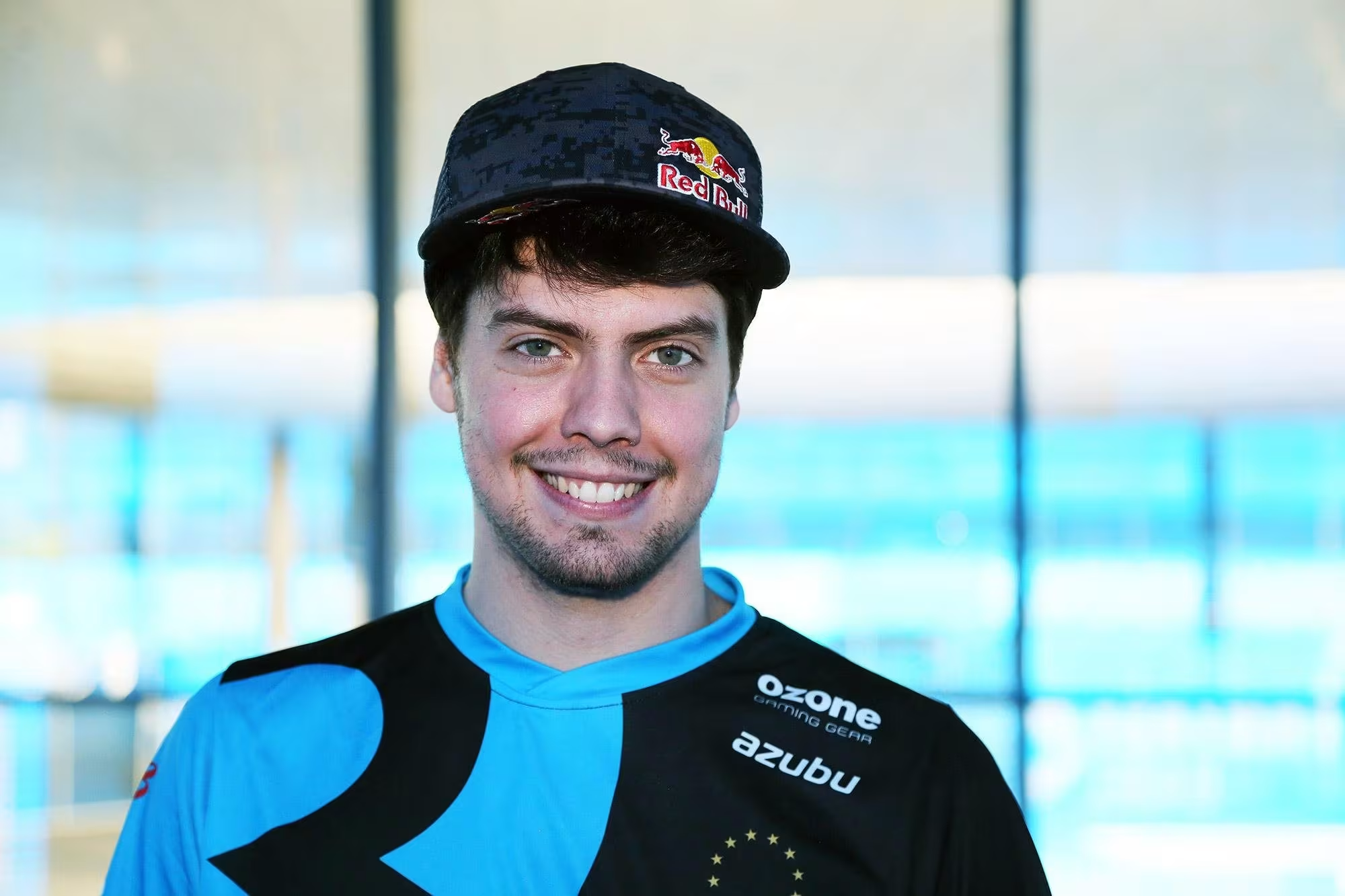







How did VanossGaming (Evan Fong) build this fortune?
The answer unfolds through the career, earnings, deals and assets behind the headline estimate.
Before the fame
The background and early turning points that shaped VanossGaming (Evan Fong)’s route to prominence.
Fong was born in Toronto in 1992 and studied economics before leaving university to focus on video production. His VanossGaming channel was created in September 2011. Rather than streaming unedited sessions, he built tightly cut multiplayer comedy videos around games including Call of Duty, Grand Theft Auto V and Garry’s Mod. That editing-heavy format required time and collaborators, but it also made individual uploads replayable and helped create a catalogue that continued attracting views after release.
The channel’s early growth came from recurring multiplayer groups, recognisable owl branding and consistent uploads. By early 2015 it had passed ten million subscribers, according to the Canadian Press profile published by Radio Canada International. Early revenue would have included YouTube advertising and occasional sponsorship, but HMW does not apply today’s scale to 2011–2013. Equipment, editing, management and collaborator costs also mean gross channel receipts were never identical to Fong’s personal income.
The breakthrough years
The career decisions and defining moments that turned recognition into sustained earning power.
By 2017 VanossGaming was one of YouTube’s largest commercial creators. Forbes estimated $15.5 million of annual earnings and reported that sponsors could pay up to $450,000 for a placement. The following ranking period produced another large figure: Forbes placed VanossGaming at $17 million. Both readings were pretax estimates and included more than basic advertising.

What the work can earn
Reported pay, contracts, royalties and performance income reveal how the fortune was funded.
Fong maintained an audience across successive gaming cycles rather than relying on one viral title. By July 2026, Social Blade recorded about 26 million subscribers, more than 17 billion lifetime views and roughly 2,280 uploads. The same page showed daily view gains that frequently exceeded one million. Those metrics establish durable reach, but Social Blade’s wide advertising estimates are not used as direct income because they do not know Fong’s actual RPM or sponsor contracts.
YouTube advertising, sponsorship integrations and catalogue views are the central sources. The two Forbes periods together establish more than $32 million of gross estimated earnings before tax and professional fees, but they overlap broad revenue categories and cannot be extrapolated unchanged through 2026. HMW models lower earnings in the launch years, peak-level years around the published figures, and a declining but still substantial later run supported by current view activity. Platform share, editor payroll, agency commissions and Canadian or US tax materially reduce the total.

The business beyond the main career
Endorsements, ownership interests and investments can keep compounding long after the initial breakthrough.
Fong expanded into music as Rynx, releasing original singles and remixes. The Apple Music artist page documents releases beginning with “Want You” and later work involving THEY., Sasha Sloan, Gallant and Alison Wonderland. Streaming royalties are treated as a secondary source because play counts, label terms and ownership splits are not public. Voice and producer work on Alpha Betas similarly adds fees and potential rights without supporting a separate large valuation.
Fong was among the founders of 3BLACKDOT. A 2016 company announcement names him alongside Adam Montoya, Tom Cassell, Angelo Pullen and Luke Stepleton and describes games and audience-driven intellectual property. The company later developed Alpha Betas with Starburns Industries. Fong’s stake, dilution and any sale proceeds are not disclosed, so HMW includes only a restrained venture allowance rather than crediting him with reported company-level transaction values.

Notable luxury item
A reported property or major asset offers a tangible glimpse of the wealth behind the public estimate.
Licensed merchandise creates another revenue stream, but retail price is not creator profit. The store’s January 2026 launch page describes apparel and accessories produced with print-on-demand partners, while its seller disclosure identifies Apollo Merch as seller of record and operator of fulfilment, returns and support. That suggests Fong’s economics are more likely a licensing or royalty share than total store revenue. No reliable public deed, purchase price or mortgage record was found for a property owned by Fong, so HMW adds no celebrity-home estimate and does not infer assets from filming locations.
VanossGaming (Evan Fong)’s estimated net worth
Public estimates vary because private contracts, investments, taxes and liabilities are not fully disclosed.
How this estimate is calculated
HMW begins with the documented $15.5 million and $17 million peak annual periods, builds lower ranges for earlier growth and later mature-channel years, and adds conservative sponsorship, music, animation, merchandise and venture proceeds without double-counting revenue already captured by Forbes. It then deducts YouTube’s share where relevant, editors and production, management, legal costs, Canadian and US tax and personal spending. A modest investment return is applied to retained cash, while no unverified house or full 3BLACKDOT enterprise value is added.
VanossGaming’s commercial appeal comes from a deep English-language gaming audience and recurring cast chemistry. Fong has generally kept his personal life away from the channel, making the owl identity more prominent than his face. Traditional media also recognised the scale: Vanity Fair’s Alpha Betas feature reported 25.1 million subscribers in 2020 and described the ageing-up of a community built over many years. HMW values monetised work, not followers themselves.
The strongest evidence is Forbes’ two annual estimates, the channel’s observable lifetime activity and exact disclosures about 3BLACKDOT and merchandise operations. The largest unknowns are YouTube RPM, sponsor frequency, ownership percentages, music accounting, investment returns and residence. Forbes’ figures are estimates rather than tax returns, and a historical sponsor ceiling is not an average fee. HMW excludes unsourced claims about technology investments, luxury cars and property and does not multiply 17 billion views by a single universal advertising rate.