
 How Much Are They Worth?
Celebrity fortunes, explained








How did Martin Luther King Jr. build this fortune?
The answer unfolds through the career, earnings, deals and assets behind the headline estimate.
Martin Luther King Jr. before the fame
The background and early turning points that shaped Martin Luther King Jr.’s route to prominence.
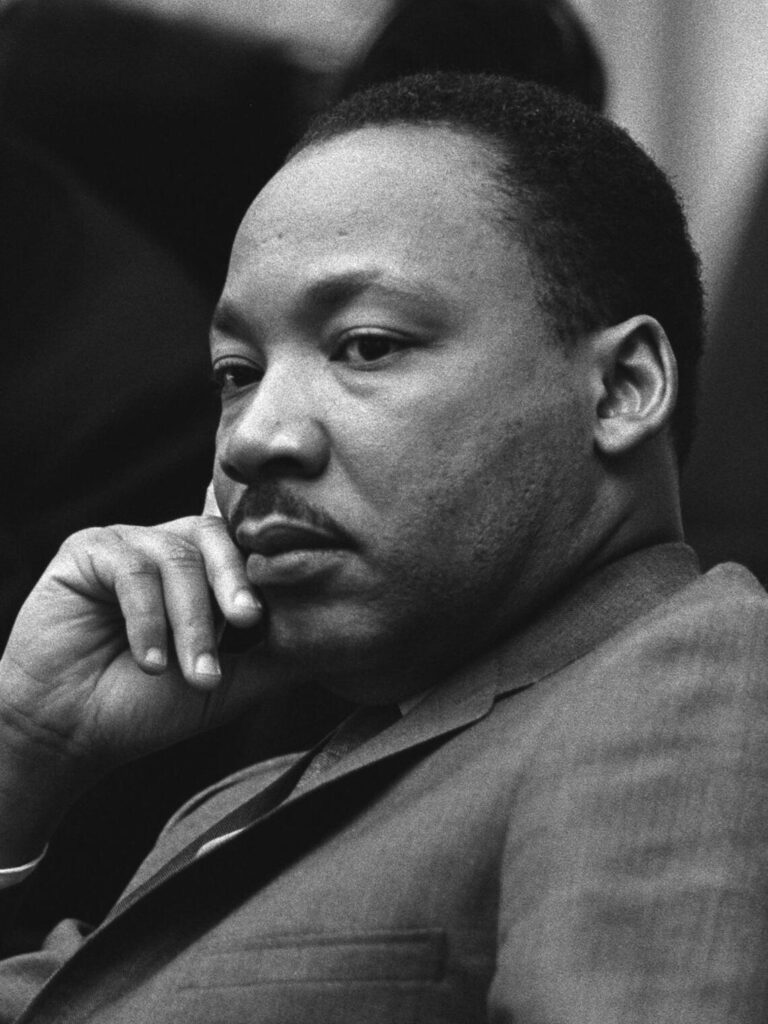
Martin Luther King Jr. was born in Atlanta on 15 January 1929, took his first degree at Morehouse College and a doctorate at Boston University in 1955. He was killed in Memphis on 4 April 1968, aged 39.
The money on this page is the documented money. In his lifetime: a pastor’s salary, five books, a Nobel award and a token dollar a year from the organisation he led. Since his death: the licensing of his name, image and speeches, which his heirs have run as a reported business for decades. The two are separate, and this page keeps them apart.
He took his first pulpit in 1954 as pastor of the Dexter Avenue Baptist Church in Montgomery, Alabama, on a salary of about $4,200 a year, among the better-paid positions open to a Black minister in that city, and his one steady income when the bus boycott began the following year.
The Southern Christian Leadership Conference was founded in 1957 with King as its president. He drew a nominal salary of a dollar a year from it, which is the governing fact about his personal finances: the organisation at the centre of his working life paid him nothing.
Martin Luther King Jr.’s breakthrough years
The career decisions and defining moments that turned recognition into sustained earning power.
He moved to Atlanta in 1960 as co-pastor of the Ebenezer Baptist Church, his father’s congregation, at a salary of about $6,000 a year. Across fourteen years of ministry, the two pulpits together paid him something near $73,000 in the dollars of the day.
Publishing paid more. Five books appeared between 1958 and 1967 — Stride Toward Freedom, The Measure of a Man, Strength to Love, Why We Can’t Wait and Where Do We Go from Here — two of them substantial sellers. Our estimate of the advances and royalties they generated in his lifetime is about $250,000, a large sum in the publishing economy of the period.
The Nobel Peace Prize, awarded in 1964 when he was 35, carried a cash award of $54,123, as the Nobel Prize organisation records. He kept the medal and gave the money to the movement.
Speaking was the fourth stream and the hardest to count: he delivered hundreds of addresses a year at his peak and routinely assigned the fees to the SCLC.
Added together, the money his own name generated in his lifetime comes to roughly $380,000 in the dollars of the day, equivalent to about $3.5 million today. What makes this profile unusual is how little of it he kept.

What Martin Luther King Jr.’s work can earn
Reported pay, contracts, royalties and performance income reveal how the fortune was funded.
Those years produced the Montgomery bus boycott of 1955 and 1956, the Birmingham campaign of 1963, the March on Washington in August of that year, the Selma to Montgomery marches of 1965 and the Poor People’s Campaign he was organising in 1968. The Civil Rights Act of 1964 and the Voting Rights Act of 1965 followed.
Time named him its Man of the Year for 1963, and the Nobel committee’s award came the following year, making him the youngest recipient of the peace prize to that date.
The posthumous honours are extensive: the Presidential Medal of Freedom in 1977, a Congressional Gold Medal in 2004, a federal holiday signed into law in 1983 and first observed in 1986, and a memorial on the National Mall in Washington dedicated in 2011.
That last one matters commercially as well as symbolically, because the foundation that built it had to license his words and his likeness from his family in order to do so.

Martin Luther King Jr.’s business beyond the main career
Endorsements, ownership interests and investments can keep compounding long after the initial breakthrough.
He endorsed nothing in his lifetime. The commercial use of his words and image is a posthumous activity of the estate, and the published figures for it concern the Washington memorial.
The Associated Press, reviewing the memorial foundation’s financial documents, reported that it paid $761,160 to Intellectual Properties Management in 2007 for the use of his words and image, and a management fee of $71,700 to the family estate in 2003 — about $800,000 in all. The family said at the time that the proceeds would go to the King Center.
The King estate is a working business. Intellectual Properties Management, based in Atlanta and run by his heirs, is the exclusive licensor of his name, likeness and written and spoken works, and the King Center directs permission requests to it. Its licences have run from documentary use to a 2018 Super Bowl advertisement.
The largest single transaction came in June 2006. the New Georgia Encyclopedia records that Atlanta philanthropists and corporate donors, assembled by the city’s mayor Shirley Franklin, bought a collection of his papers from the family for $32 million, a week before a scheduled Sotheby’s auction, and placed them at Morehouse College; PBS put the collection at more than 7,000 items. That price bought the physical papers, while the literary rights stayed with the estate, which is why the licensing business continued.

Martin Luther King Jr.’s notable luxury item
A reported property or major asset offers a tangible glimpse of the wealth behind the public estimate.
At his death his assets were modest and almost entirely domestic. Clayborne Carson, who led the King Papers Project at Stanford’s Martin Luther King, Jr. Research and Education Institute, has put his worth then at between $50,000 and $60,000, most of it in the Atlanta house.
The durable asset was not property but copyright. Works in the United States are protected for seventy years after an author’s death, which places his writings and speeches in copyright until 2038. That copyright, not the house and not the papers, is what the estate has monetised.
Martin Luther King Jr.’s estimated net worth
Public estimates vary because private contracts, investments, taxes and liabilities are not fully disclosed.
How this estimate is calculated
The figure we publish is what he personally held at his death, restated in today’s money. It is not the value of the estate’s licensing business, which belongs to his heirs and postdates him by decades, and it is not the $32 million the papers later fetched, which his family received and he never did.
The anchor is Clayborne Carson’s estimate, made at Stanford’s Martin Luther King, Jr. Research and Education Institute, of $50,000 to $60,000 at April 1968, most of it the Atlanta house. Converting the midpoint of that band at United States consumer-price inflation from 1968 to 2026, a factor of roughly nine and a half, gives about $520,000.
The lifetime earnings cross-check supports it. Of roughly $380,000 gross in period dollars — $73,000 of pastoral salary, about $250,000 of book income and the $54,123 award the Nobel Prize organisation records — the prize money was given away whole, the speaking fees were assigned to the organisation, and a family was supported in Atlanta on a minister’s pay. An estate in the tens of thousands is what that pattern produces.
The working supports a range of $475,000 to $575,000 in today’s money, and the figure we publish is its midpoint.
The softest input is the book income: our $250,000 is reasoned from print runs and period royalty rates. It barely moves the headline, since so much of it left his hands in his lifetime. What would change this page is a probate inventory, which would replace the one estimated figure in the calculation.
Confidence: Partly documented — the salary, prize and sale figures are on the record, while the estate value rests on a historian’s estimate restated for inflation.
The $54,123 Nobel award went to the movement whole. The dollar-a-year SCLC salary and the assignment of speaking fees to the organisation belong in the same column: the money his name raised was directed away from him by his own choice.
The Poor People’s Campaign, which he was building in 1968 around economic rather than legal remedies, was the logical end of that pattern.
The scrutiny attaches to the estate rather than to him. The family’s licensing of his image has been criticised, and the memorial fee drew objections when the figures became known; two of his children later said that arrangement had been handled without their knowledge.
The heirs have also litigated repeatedly. MPR News set out disputes including a 2013 action the estate brought against the King Center over its licence terms, and a later case between the siblings that was dismissed as they sought a private settlement. the historian David Garrow criticised the 2006 sale on separate grounds, writing that its terms restricted quotation from King’s works without the family’s permission.