
 How Much Are They Worth?
Celebrity fortunes, explained








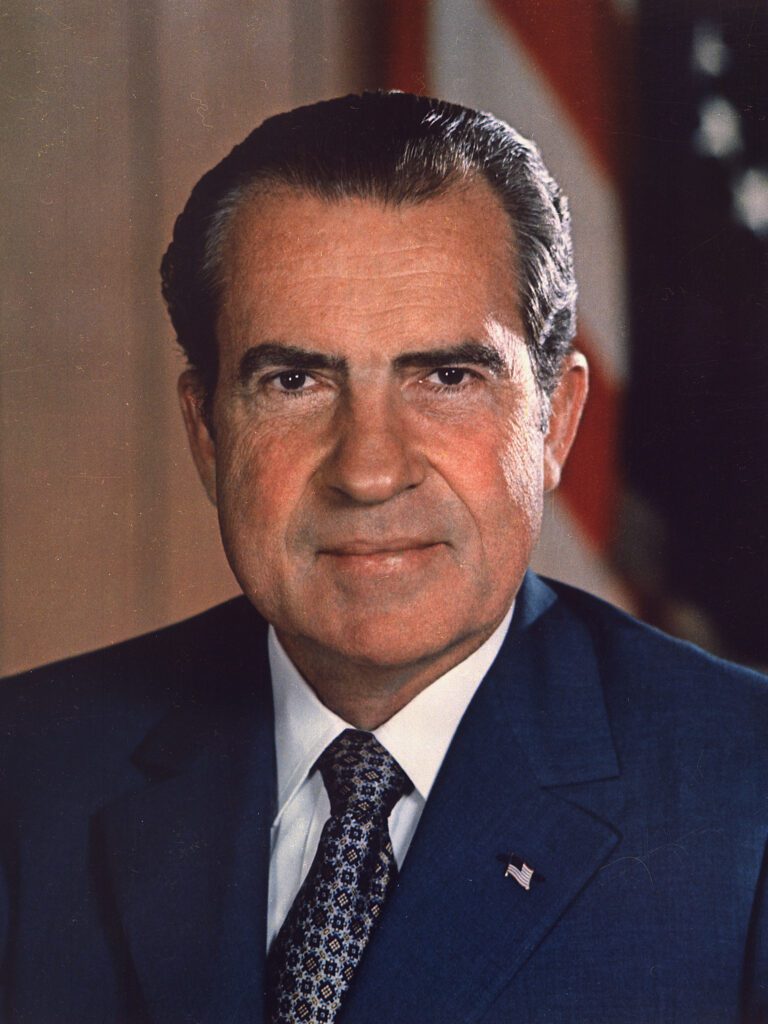
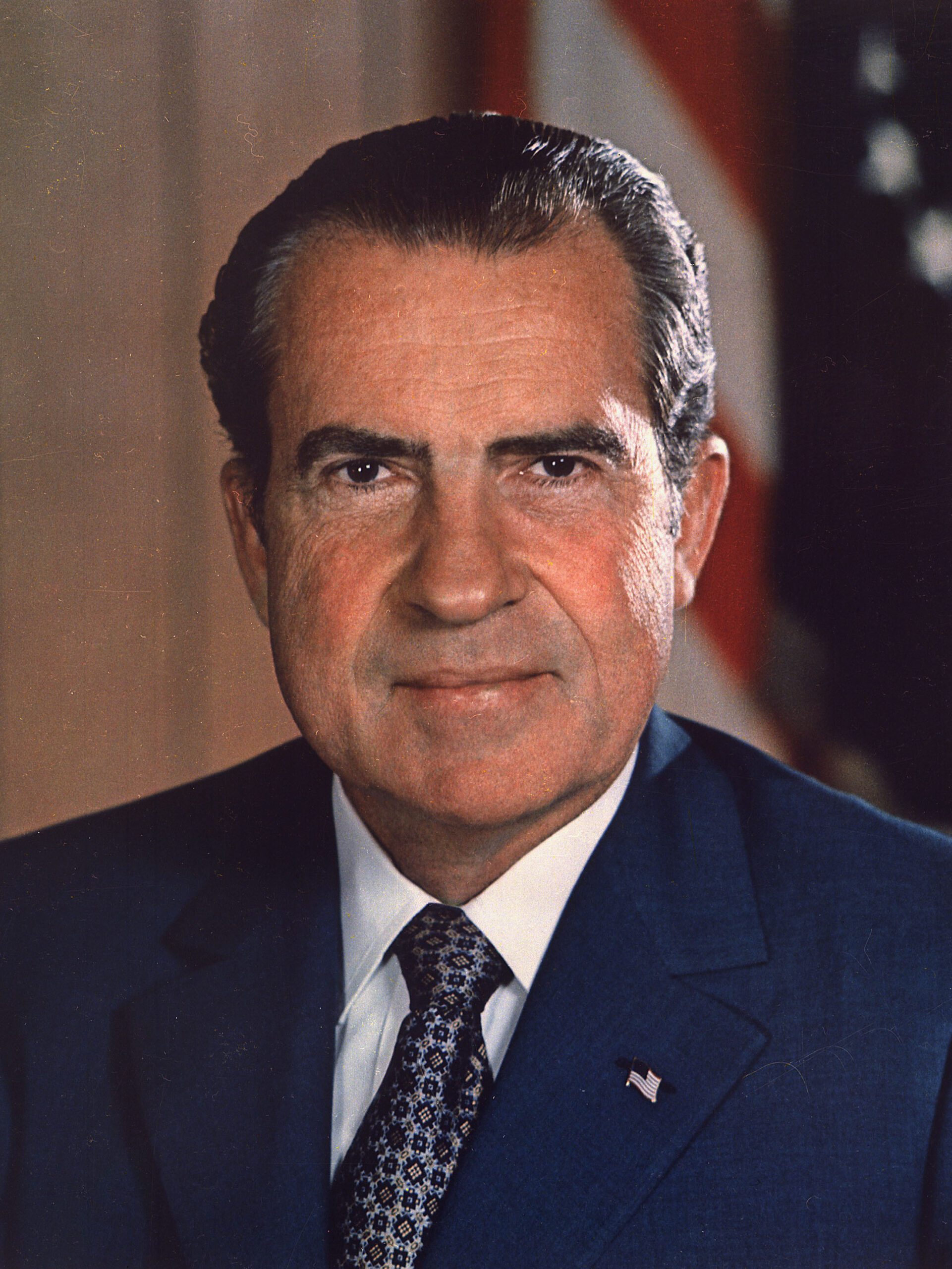
How did Richard Nixon build this fortune?
The answer unfolds through the career, earnings, deals and assets behind the headline estimate.
Richard Nixon before the fame
The background and early turning points that shaped Richard Nixon’s route to prominence.
Richard Milhous Nixon was born on 9 January 1913 in Yorba Linda, California, into a Quaker family of no money at all. His father ran a grocery store and filling station in Whittier, and two of his brothers died young.
He worked his way through Whittier College, won a scholarship to Duke University School of Law and graduated third in his class in 1937, then went home to practise law because New York firms would not hire him. He died on 22 April 1994 aged 81.
After wartime service in the Office of Price Administration and then the Navy, he was elected to the House in 1946, to the Senate in 1950 and became Vice-President in 1953 at forty.
The most useful document on this page comes from that period. Accused in 1952 of benefiting from a private fund, he went on television and itemised his own balance sheet, as the Miller Center transcript records: a $13,000 house in Whittier, a $41,000 house in Washington, a 1950 Oldsmobile, $4,000 of life insurance, no stocks or bonds, and some $38,000 of mortgages and loans against them. PBS notes that the speech saved his place on the ticket. On his own account the future President was then worth under $30,000.
Richard Nixon’s breakthrough years
The career decisions and defining moments that turned recognition into sustained earning power.
Beaten by Kennedy in 1960 and by Pat Brown in the 1962 California governor’s race, he moved to New York and became a name partner at Nixon, Mudge, Rose, Guthrie and Alexander. the Richard Nixon Foundation has examined those years as the ones that rebuilt him, and they were the best-paid years of his working life.
Here is the craft money. Congressional, Senate and vice-presidential salaries from 1947 to 1961 ran from $12,500 to $35,000 a year, roughly $250,000 across fourteen years. A senior Wall Street partner’s draw in the mid-1960s we put at $200,000 to $300,000 a year, or $1.2 million to $1.8 million across his six years at the firm, in a decade when the median American household earned under $7,000. That partnership, not politics, first made him comfortable.

What Richard Nixon’s work can earn
Reported pay, contracts, royalties and performance income reveal how the fortune was funded.
As President from 1969 he opened relations with China, signed the first strategic arms limitation treaty with the Soviet Union, created the Environmental Protection Agency, ended the draft and presided over the moon landings. The salary was $200,000 a year plus a $50,000 expense allowance, of which TIME reported he spent $108,000 of the $200,000 available across four years.
The presidency is also the only stretch of his life for which audited net-worth statements exist. The same accounting put him at $307,141 at the start of 1969 and $988,522 on 31 May 1973, a tripling in four and a half years on a $200,000 salary, driven by property. Afterwards writing paid best: the Miller Center records that his memoirs sold for more than $2 million and the David Frost interviews brought $600,000, with nine further books between 1980 and 1994.
No American politician has fallen further or climbed back further. Within six years of resigning he was advising his successors, and by the late 1980s he was consulted by Presidents of both parties and treated as an elder statesman on Russia and China.
The Richard Nixon Library and Birthplace opened at Yorba Linda in 1990, built with more than $20 million raised privately — a sum that was itself a measure of how far his standing had recovered. The rehabilitation had a commercial effect: it is why the later books sold and why he could charge for his time.

Richard Nixon’s business beyond the main career
Endorsements, ownership interests and investments can keep compounding long after the initial breakthrough.
American Presidents do not take endorsements. His nearest equivalent was paid access to himself, and he was the first former President to monetise it on that scale.
The Frost interviews of 1977 were the landmark: $600,000 plus a fifth of the profits for twenty-eight hours of recording. We put paid speaking and consulting between 1980 and 1994 at $1 million to $3 million. He also drew a former President’s pension from 1974, worth $1.5 million to $2.5 million across twenty years as the rate rose.
Nixon’s income came from three things across his working life: fees from the practice of law, the salaries of public office, and book advances and royalties. The estimate counts those and the property they bought.
The nearest thing to a venture was the law partnership, an equity stake in a profitable enterprise, and the Nixon Library Foundation, a fundraising vehicle from which he took nothing. That shapes the arithmetic rather than the character: unlike a modern former President, the money he accumulated after 1974 is traceable to writing, royalties and property, and the estimate below counts only those three lines.

Richard Nixon’s notable luxury item
A reported property or major asset offers a tangible glimpse of the wealth behind the public estimate.
Property is where his wealth was actually made. He bought the Key Biscayne houses in December 1968 for $253,455 and La Casa Pacifica at San Clemente in 1969 for about $1.5 million, largely with loans from his friend Robert Abplanalp. TIME reported that in December 1970 he sold all but a few acres of the estate for $1,249,000 to a company owned by Abplanalp and Charles Rebozo, booking a gain on a house he went on living in.
He sold the Florida properties to clear his debts after 1974, sold what remained of San Clemente in 1980, then moved east: a Manhattan townhouse, Saddle River from 1981, finally Park Ridge. The last house we put at $1 million to $1.8 million in 1994 money.
Richard Nixon’s estimated net worth
Public estimates vary because private contracts, investments, taxes and liabilities are not fully disclosed.
How this estimate is calculated
Two audited statements of his personal wealth are in the public record: $307,141 in 1969 and $988,522 in May 1973, from the returns he released under audit. His presidential salary, the $476,431 tax finding, the memoir advance, the $600,000 Frost fee, the San Clemente transactions and the 1992 and 1993 library gifts are all documented. What his estate came to is not, so the final figure is ours.
The path. He left office in 1974 close to ruined: more than $1 million spent on Watergate legal fees, $465,000 of back taxes paid, no salary, the Florida houses sold to meet the bills. The recovery ran on writing — the memoirs, then nine further books — plus the Frost money, a pension of $1.5 million to $2.5 million over twenty years, speaking and consulting of $1 million to $3 million, and two decades of property gains through Manhattan, Saddle River and Park Ridge. Lifetime earnings in money of the day come to roughly $9 million to $15 million.
Valuing what he held in April 1994: the Park Ridge house $1 million to $1.8 million; investments, securities and cash $4.5 million to $10 million; book copyrights and royalties $1 million to $2.5 million; personal effects not left to the library $500,000 to $700,000. That is a working range of $7 million to $15 million, and we publish its midpoint, in 1994 dollars. The spread is wide for one reason no further research will close: Nixon was audited line by line while in office and never again, so the twenty years in which he actually got rich are the twenty for which no statement of his finances was ever produced.
Confidence: Partly documented — his 1969 and 1973 net worth, presidential salary, tax settlement, memoir advance and Frost fee are on the public record, while the value of his estate in 1994 is our own estimate.
His giving went almost entirely to his own library, and the figures in his will show it was substantial. He contributed $1,450,000 in 1992 and pledged a further $1,200,000 in 1993, and left the library his awards, medals, works of art and correspondence.
The will set out cash bequests of $50,000 to each surviving grandchild, with $70,000 to one and $30,000 to another, and divided his diaries between his daughters. A man able to give his library $2.65 million in two years and still leave those bequests was not short of money, which is the best evidence of where he had got to.
Five men were arrested breaking into the Democratic National Committee offices at the Watergate complex in June 1972. The cover-up was traced to the White House through congressional hearings and Nixon’s own tapes, and on 9 August 1974 he resigned, the only American President to have done so. Gerald Ford pardoned him a month later.
The financial scandal ran alongside it and is the one that bears on this page. TIME reported a $482,018 deduction claimed for the gift of his vice-presidential papers, disallowed because the gift came after the law changed in July 1969. NBC News records that he released his returns while under audit; the Joint Committee on Internal Revenue Taxation concluded he owed $476,431, as the United States Capitol Historical Society has documented, and he paid about $465,000 in 1974.