
 How Much Are They Worth?
Celebrity fortunes, explained
How Much Are They Worth?
Celebrity fortunes, explained










How did Steve Ballmer build this fortune?
The answer unfolds through the career, earnings, deals and assets behind the headline estimate.
Steve Ballmer before the fame
The background and early turning points that shaped Steve Ballmer’s route to prominence.
Steven Anthony Ballmer was born on March 24, 1956, in Detroit, Michigan, the son of Frederic Henry Ballmer, a manager at Ford Motor Company, and Beatrice Dworkin Ballmer. He grew up in the Detroit suburb of Farmington Hills and attended the private Detroit Country Day School, where he graduated as valedictorian. He went on to Harvard University, where he studied mathematics and economics, managed the football team, wrote for the Harvard Crimson, and lived down the hall from a fellow undergraduate named Bill Gates. Ballmer graduated magna cum laude in 1977 and briefly enrolled in Stanford’s MBA program in 1980 before leaving, one class short of finishing, to join Microsoft. He has been married to philanthropist Connie Snyder Ballmer since 1990, and the couple has three sons.
After Harvard, Ballmer spent two years at Procter & Gamble as an assistant product manager, where he was officemates with future General Electric CEO Jeffrey Immelt, before enrolling at Stanford’s Graduate School of Business. In 1980, his former Harvard hallmate Bill Gates recruited him to join the small software company he had co-founded with Paul Allen, and Ballmer left Stanford to become Microsoft’s first business manager and, by most accounts, its 30th employee, at a starting salary of $50,000 a year plus a small equity stake that Gates insisted on giving him. Over the next two decades Ballmer built out and ran Microsoft’s sales, marketing, and operations functions, helping turn a small Seattle-area software firm into the dominant force in personal computing, and was named the company’s president in 1998, positioning him as Gates’s eventual successor.
Steve Ballmer’s breakthrough years
The career decisions and defining moments that turned recognition into sustained earning power.
Ballmer succeeded Bill Gates as Microsoft’s chief executive in January 2000 and ran the company for fourteen years, a tenure defined by the continued dominance of Windows and Office, the successful launch of the Xbox gaming franchise in 2001, and steady growth in revenue and profit — Microsoft’s annual revenue roughly quadrupled during his time as CEO. That growth was overshadowed, however, by a stock price that stayed largely flat for most of his tenure, as the company missed the early shift toward mobile devices and internet search, markets that came to be dominated by Apple’s iPhone and Google, respectively. Ballmer announced his retirement in August 2013 and formally stepped down as CEO in February 2014, handing the role to Satya Nadella and leaving Microsoft’s board later that year. Just months after leaving Microsoft, in August 2014, Ballmer completed the record-setting $2 billion purchase of the Los Angeles Clippers, beginning a second career as an NBA team owner that has continued for over a decade.

What Steve Ballmer’s work can earn
Reported pay, contracts, royalties and performance income reveal how the fortune was funded.
As Microsoft’s CEO, Ballmer’s formal compensation was modest relative to his eventual fortune: public filings show a base salary of roughly $650,000 to $700,000 in his final years in the role, with total annual compensation — including bonus and other pay, but excluding new equity grants, since he already held a large ownership stake — landing around $1.3 million to $1.4 million a year. Since retiring in 2014 he has drawn no corporate salary at all; his income today comes overwhelmingly from Microsoft’s quarterly dividend on his roughly 333 million shares. Microsoft raised its quarterly dividend to $0.91 per share in 2026, and Ballmer’s June 2026 payment alone came to roughly $303 million, meaning his dividend income from Microsoft now totals more than $1 billion a year. Records show no disclosed sales of Microsoft stock by Ballmer since he left the company, so this dividend stream, rather than any salary or stock-sale proceeds, is effectively his entire disclosed annual income.
Ballmer has no playing or performance “contracts” in the traditional celebrity sense; the defining financial agreements of his career instead relate to Microsoft equity and the Clippers purchase. His original 1980 hire came with a small ownership stake alongside his salary, which he built on for decades as an early employee and long-term holder rather than through subsequent stock sales, leaving him with roughly 4% of Microsoft’s outstanding shares — consistently the largest individual shareholding of anyone at the company besides Gates in the years immediately following the IPO. The other landmark deal was his August 2014 purchase of the Los Angeles Clippers for $2 billion in cash, a then-record price for an NBA franchise, agreed with owner Shelly Sterling after the league forced her husband Donald Sterling to sell the team following his recorded racist remarks. Ballmer’s bid comfortably beat a rival $1.6 billion offer from a group led by music mogul David Geffen that included Oracle’s Larry Ellison and Oprah Winfrey, as well as a $1.2 billion bid from investors Tony Ressler and Bruce Karsh, and the final $2 billion price stood as roughly four times the previous record sale price for an NBA team.

Steve Ballmer’s business beyond the main career
Endorsements, ownership interests and investments can keep compounding long after the initial breakthrough.
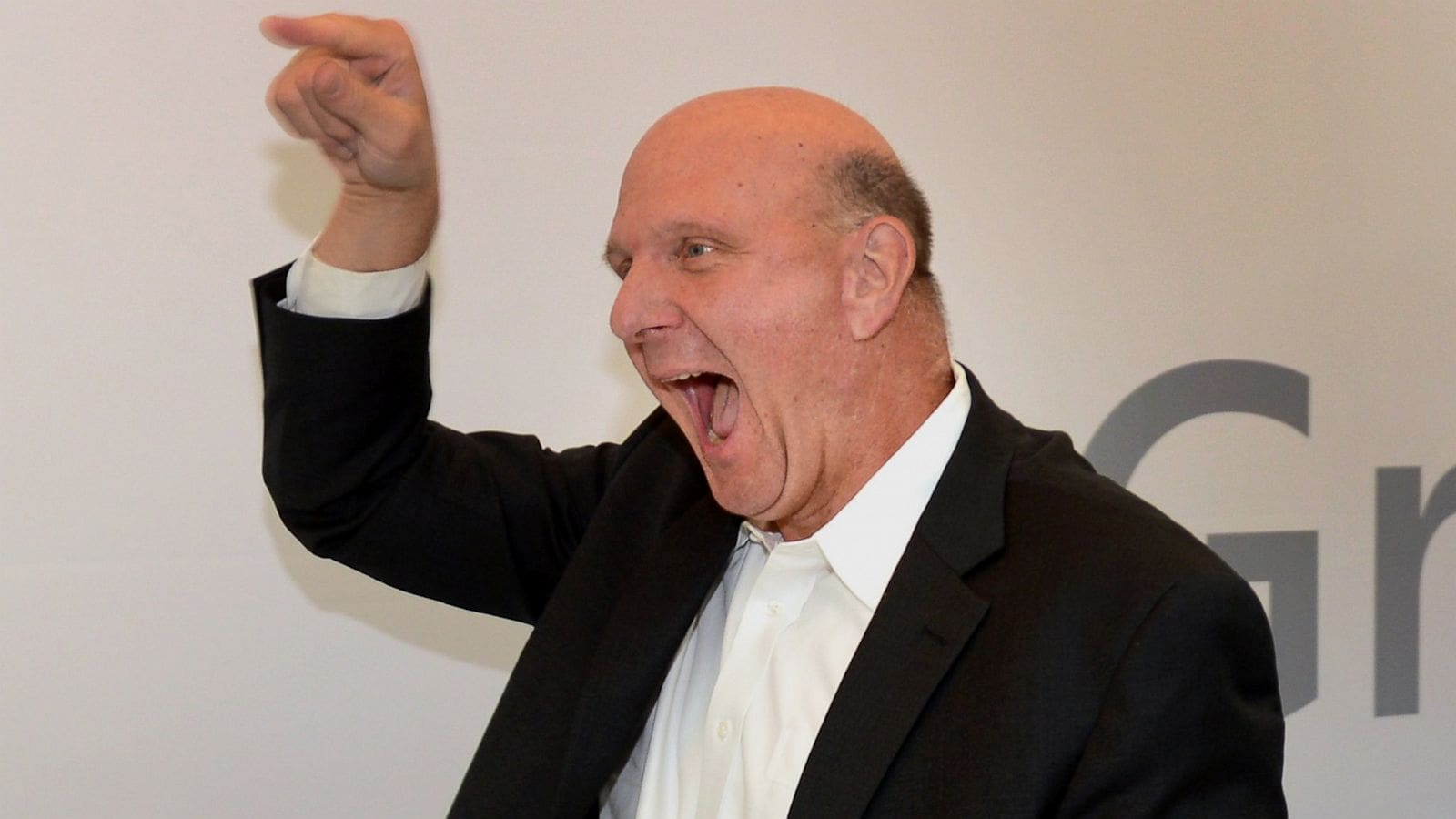
Unlike entertainers or athletes, Ballmer has no history of paid celebrity endorsement deals, and no reliable source documents him accepting a fee to promote a commercial product or brand. His public-facing appearances — including his famously energetic 2000 “developers, developers, developers” chant and Microsoft product launches during his CEO years, and more recent Clippers and Intuit Dome promotional appearances — have been in his capacity as an executive and team owner rather than as compensated third-party endorsements. No verified endorsement-deal figures should be assumed to exist for Ballmer, and none are cited here.
Ballmer’s primary business interest outside Microsoft is his full ownership of the Los Angeles Clippers, purchased in 2014 for $2 billion and now, according to Forbes’ 2026 NBA team valuations, worth in the range of $7 to $7.5 billion, a roughly 3.5-times increase driven partly by league-wide franchise appreciation and partly by Ballmer’s own investment in the team. That investment includes the Intuit Dome, the Clippers’ privately financed, roughly $2 billion arena in Inglewood, California, which Ballmer funded personally and which opened for the 2024-25 season, making him one of the very few NBA owners to build a new arena without public financing. Beyond sports, Ballmer founded and funds USAFacts, a nonprofit launched in 2017 that compiles publicly available government data into free, non-partisan reports on federal, state, and local spending and outcomes — a project he has said grew out of his own frustration, after leaving Microsoft, at how hard it was to get a clear factual picture of what government does with taxpayer money. He and his wife Connie are also signatories of the Giving Pledge and have committed significant philanthropic capital through the Ballmer Group, which focuses on economic mobility for children and families in the United States.

Steve Ballmer’s notable luxury item
A reported property or major asset offers a tangible glimpse of the wealth behind the public estimate.
Ballmer’s primary residence is a waterfront estate in Hunts Point, Washington, an exclusive Lake Washington enclave near Bellevue that is also home to other Microsoft-connected wealth. He and Connie originally purchased property there in 1987 for $1.3 million and have since expanded the holding through additional adjacent purchases, including a $9.8 million acquisition reported in 2020, bringing the combined estate to more than five acres of lakefront land. His largest single physical asset is arguably the Intuit Dome itself, the roughly $2 billion, 18,300-seat Clippers arena he built and owns outright in Inglewood, California, alongside the team’s adjacent practice facility and business headquarters. No comprehensive, independently verified public inventory of Ballmer’s other assets — private aircraft, additional homes, or art — was located, and none is asserted here; unlike his Microsoft stake, these physical assets represent a small fraction of his overall net worth.
Steve Ballmer’s estimated net worth
Public estimates vary because private contracts, investments, taxes and liabilities are not fully disclosed.
How this estimate is calculated
This figure comes from Forbes’ Real-Time Billionaires index, which on this date ranks Ballmer #9 in the world and updates his net worth continuously during trading hours based on Microsoft’s share price and his disclosed holding of roughly 333 million shares, or about 4% of the company. The Bloomberg Billionaires Index, which uses a broadly similar public-holdings methodology, has placed Ballmer’s fortune in a comparable but not identical range through 2026, estimating it at roughly $145 billion in February, $151 billion in late April, and around $146 billion later in the year — differences from the Forbes figure that reflect routine methodology and timing gaps between the two trackers rather than any real disagreement about his underlying share count. Aggregator site Celebrity Net Worth has listed a lower figure, around $143 billion as of March 2026, and is cited here only as a secondary, non-authoritative reference rather than a rigorous alternative to the Forbes and Bloomberg indices.
It is especially important to separate paper value from realized wealth in Ballmer’s case. Essentially all of his fortune is the current market value of a single concentrated, undiversified stock position — Microsoft shares he has held since the 1980s with no disclosed sales since leaving the CEO role in 2014 — rather than cash, diversified investments, or other liquid assets. That concentration cuts both ways: it is the reason his net worth has swung by tens of billions of dollars within a single year, including an estimated peak of roughly $183 billion in July 2025 followed by a decline of well over $30 billion in the months that followed, purely on Microsoft’s share-price movements, with no change in the number of shares he owns. His actual realized, spendable income is far smaller and far steadier than the headline net-worth figure: primarily the Microsoft dividend income of roughly $1 billion-plus a year discussed above, plus whatever cash flow the Clippers and Intuit Dome generate, none of which requires selling down his core Microsoft stake.
| Year | Estimated Net Worth / Milestone |
|---|---|
| 2000 | Becomes Microsoft CEO; net worth already in the billions from his roughly 4% stake, though the dot-com crash sharply reduces the value of Microsoft stock in the years that follow |
| 2014 | Steps down as Microsoft CEO and purchases the Los Angeles Clippers for $2 billion; Forbes estimates his net worth at approximately $20.6 billion |
| 2019 | Forbes estimates net worth at approximately $41.2 billion as Microsoft stock climbs under CEO Satya Nadella |
| 2021 | Ballmer’s net worth crosses $100 billion for the first time, reaching roughly $101 billion as Microsoft’s market capitalization surges |
| 2022 | Net worth falls to approximately $91.4 billion amid a broad tech-stock pullback |
| 2024 | Net worth recovers to approximately $123 billion; the Clippers open the new, privately financed Intuit Dome arena |
| July 2025 | Net worth reportedly peaks at approximately $183 billion as Microsoft’s market capitalization tops $4 trillion, briefly making Ballmer one of the five richest people in the world |
| March 2026 | Net worth estimated at approximately $143 billion following a pullback in Microsoft shares |
| August 17, 2026 | Forbes Real-Time Billionaires lists net worth at $152.3 billion, ranking him #9 globally |
Ballmer is most naturally compared to his own former boss and Harvard hallmate, Bill Gates, whose fortune (Forbes estimates it at roughly $105 to $109 billion in mid-2026) is now smaller than Ballmer’s, an unusual outcome given Gates co-founded Microsoft while Ballmer joined as an early employee; the gap exists largely because Gates has given away the majority of his original stake through the Bill & Melinda Gates Foundation, while Ballmer has held onto nearly all of his shares. Among fellow enterprise-software billionaires whose wealth swings sharply with a single company’s stock price, Ballmer is comparable to Oracle’s Larry Ellison, whose net worth (around $192.6 billion as of mid-August 2026, according to Forbes) has been similarly volatile, having briefly topped $400 billion in September 2025 before falling by more than $100 billion in the months that followed on Oracle share-price swings. Among current NBA owners, Ballmer is by a wide margin the wealthiest, with a net worth many multiples larger than the next-richest owners in the league, reflecting how unusual it is for a single individual to hold both a multibillion-dollar sports franchise and a multibillion-dollar stake in a trillion-dollar public company at the same time.
Sources and references
- Forbes Real-Time Billionaires — Steve Ballmer profile: forbes.com/profile/steve-ballmer
- Forbes Real Time Billionaires — full list and methodology: forbes.com/real-time-billionaires
- Bloomberg Billionaires Index — Steve Ballmer profile: bloomberg.com/billionaires/profiles/steven-a-ballmer
- 24/7 Wall St. — “Steve Ballmer Just Received a $303 Million Check From Microsoft”: 247wallst.com
- Sportico — “Steve Ballmer Net Worth Drops $14 Billion After Microsoft Shares Sink”: sportico.com
- CNBC — NBA Valuations 2026, Los Angeles Clippers: cnbc.com
- Forbes — Los Angeles Clippers team valuation: forbes.com/teams/los-angeles-clippers
- Celebrity Net Worth — Steve Ballmer profile (secondary aggregator, cited only as a cross-check): celebritynetworth.com
- Wikipedia — Steve Ballmer biography: en.wikipedia.org/wiki/Steve_Ballmer
- Wikipedia — USAFacts: en.wikipedia.org/wiki/USAFacts
- American Luxury — “Microsoft Billionaire Steve Ballmer Expands His Footprint in Hunts Point With $9.8M Purchase”: amlu.com
- Forbes — “Larry Ellison Overtakes Jensen Huang As 7th-Wealthiest Person In The World As Nvidia Shares Fall”: forbes.com