 How Much Are They Worth?
Celebrity fortunes, explained
How Much Are They Worth?
Celebrity fortunes, explained

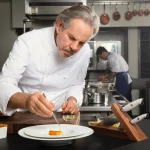




Enrico Crippa (Italy) – Piazza Duomo
Net worth revealed after 6 slides
Begin the countdown ↓How did Enrico Crippa (Italy) – Piazza Duomo build this fortune?
The answer unfolds through the career, earnings, deals and assets behind the headline estimate.
Before the fame
The background and early turning points that shaped Enrico Crippa (Italy) – Piazza Duomo’s route to prominence.
Enrico Crippa was born in 1971 in Carate Brianza, a town in Lombardy northeast of Milan, and has often traced his food instincts back to family influence rather than formal ambition: a love of cycling passed down from his father, and a passion for local markets and zero-kilometer ingredients inherited from his grandfather, according to Gambero Rosso’s profile of the chef and his restaurant.
That grounding in seasonal, local produce would later define his cooking at Piazza Duomo, but it started as a household habit rather than a culinary philosophy, as described in Fanpage’s biography of the three-Michelin-star chef.
Crippa began his professional training under Gualtiero Marchesi in Milan, the chef widely credited with founding modern Italian haute cuisine, before rotating through some of Europe’s most demanding kitchens: Christian Willer at the Palme d’Or in Cannes, Ghislaine Arabian at Ledoyen in Paris, Antoine Westermann at Buerehiesel in Strasbourg, Michel Bras in Laguiole, Alain Ducasse at Le Louis XV in Monaco, and Ferran Adria at El Bulli in Roses, according to Reporter Gourmet’s chef biography.
From 1996 to 1999, Crippa moved to Kobe, Japan, to run Marchesi’s restaurant there, an experience that reshaped his cooking by exposing him to the precision, restraint, and visual discipline of Japanese technique, a formative period documented by Fanpage. That three-year immersion is frequently cited as the bridge between his classical French-Italian training and the more restrained, ingredient-forward style he would later bring to his own restaurant.
The breakthrough years
The career decisions and defining moments that turned recognition into sustained earning power.
Crippa met members of the Ceretto family, the Piedmont winery dynasty, in 2003 to discuss the philosophy of a restaurant they wanted to build together, and in 2005 the two sides opened Piazza Duomo in Alba as a joint venture between the chef and the wine producer, according to Forbes’ feature on the Ceretto family’s Piedmont hospitality holdings. The arrangement made Piazza Duomo one of the only three-Michelin-star restaurants in the world to be co-owned by a wine producer rather than run purely as a chef-owned business.
The bet paid off quickly: Piazza Duomo earned its first Michelin star in 2006 and its second in 2009, establishing Crippa, still in his thirties, as one of Italy’s most closely watched young chefs, per Forbes’ behind-the-scenes report on the restaurant’s rise.
What the work can earn
Reported pay, contracts, royalties and performance income reveal how the fortune was funded.
Piazza Duomo received its third Michelin star in 2012, and the restaurant has held that rating ever since, cementing Crippa’s place among Italy’s elite chefs alongside names like Massimo Bottura, according to Forbes. The restaurant has also held a place on the World’s 50 Best Restaurants list continuously since 2013, when it debuted at number 41, and stood at number 32 in the 2025 edition, according to the World’s 50 Best Restaurants official listing for Piazza Duomo.
That combination, three Michelin stars sustained for more than a decade plus over ten consecutive years on a single global top-50 list, is rare even among the world’s most decorated chefs, and it is the single strongest evidence of Crippa’s standing in international fine dining.
In 2022, Piazza Duomo was awarded a Green Star by the World’s 50 Best organization for Crippa’s commitment to sustainable and biodynamic cooking, and the restaurant was separately ranked among the world’s top vegetable-forward restaurants, according to We’re Smart World’s coverage of the restaurant’s sustainability ranking.
Crippa has also carried his profile into mainstream Italian media, appearing as a guest chef on Italy’s MasterChef franchise starting with its third season and returning in subsequent editions, an appearance that introduced him to a television audience well beyond the fine-dining world, as reported by Il Messaggero’s profile tied to his MasterChef appearance.
The business beyond the main career
Endorsements, ownership interests and investments can keep compounding long after the initial breakthrough.
Crippa has not built the kind of broad consumer-brand endorsement portfolio common among television-first chefs; his commercial visibility instead comes largely through publishing and the international chef-conference circuit. In 2016 he published a recipe collection, “Best of Enrico Crippa,” through the Italian publisher Giunti Editore, a book aimed at both home cooks and professionals, according to the publisher’s listing for the title.
He has also appeared as an invited speaker at international culinary events, including Food On The Edge in Ireland, the kind of paid or expenses-covered speaking engagement that supplements restaurant income for chefs of his standing without amounting to a formal brand partnership, per his speaker profile for the conference. No major appliance, spirits, or lifestyle brand ambassadorship for Crippa is documented in available reporting.
Piazza Duomo remains Crippa’s primary business, structured as a joint venture with the Ceretto family rather than a restaurant he owns outright, a distinction that shapes how his personal financial upside is estimated, per Italia Secrets’ overview of the Ceretto-Crippa partnership. As part of that arrangement, the restaurant draws produce from a roughly 12-acre organic and biodynamic garden that Crippa personally helps tend, a hands-on model that also functions as the operation’s most distinctive asset, according to Restaurant Times’ feature on the garden-led restaurant.
Beyond the restaurant floor, Crippa teaches as an instructor at CAST Alimenti, the professional culinary training center in Brescia, a role that gives him a secondary, education-based income stream separate from restaurant revenue, according to his instructor profile on the CAST website.
Notable luxury item
A reported property or major asset offers a tangible glimpse of the wealth behind the public estimate.
No reliable public record of personal real estate, vehicles, or other major assets held by Enrico Crippa outside the restaurant business has surfaced in Italian or international reporting, and no specific figures for personal holdings should be assumed.
The one physical asset consistently tied to his name is the Piazza Duomo property itself, including its purpose-built organic garden and greenhouse in the hills outside Alba where roughly 400 varieties of vegetables, herbs, and flowers are cultivated, according to Restaurant Times. That property is owned through the joint venture with the Ceretto family rather than by Crippa personally, and its value has not been publicly disclosed, per Italia Secrets’ account of the ownership structure.
Enrico Crippa (Italy) – Piazza Duomo’s estimated net worth
Public estimates vary because private contracts, investments, taxes and liabilities are not fully disclosed.
How this estimate is calculated
Enrico Crippa does not appear prominently on English-language celebrity-wealth aggregators the way television-first chefs do. One such secondary aggregator site places his net worth in a broad $1 million to $5 million range, but that figure is unsourced and should be treated as a rough secondary indicator rather than verified data, per TheCityCeleb’s biography page, which also cites Piazza Duomo’s annual turnover at roughly £4.2 million.
Because Piazza Duomo is a joint venture with the Ceretto family rather than a restaurant Crippa owns outright, his personal share of that turnover is almost certainly a minority profit-split plus a chef-operator’s compensation, not full restaurant equity, which caps how much of the business’s revenue can reasonably be attributed to his personal wealth. Layered on top of that restaurant income are smaller, undisclosed secondary streams: teaching fees from his instructor role at CAST Alimenti, cookbook royalties from Giunti Editore, and paid appearances at international events such as Food On The Edge and MasterChef Italia. Twenty years of sustained three-Michelin-star operation and a continuous run on the World’s 50 Best list support a moderate estimate, while the joint-ownership structure argues against assuming full restaurant-scale wealth.
No dedicated charitable foundation bearing Crippa’s name has been documented, and his public generosity is expressed mainly through sustainability practice and teaching rather than a formal philanthropic vehicle. His 2022 Green Star recognition for biodynamic, low-impact cooking is the clearest institutional acknowledgment of that commitment, according to We’re Smart World.
Publicly, Crippa is known almost as much for his personal habits as for his cooking: colleagues and profile writers regularly describe him as a chef who personally harvests his own garden each morning and who is an avid cyclist, earning him an informal reputation in the Italian press as the three-star “chef-gardener,” according to Cookist’s profile of the chef. That image, understated and craft-focused rather than celebrity-driven, has become central to how he is perceived in Italian food media.
No major personal or financial scandal involving Enrico Crippa is documented in Italian or international press. The scrutiny that exists is limited to ordinary fine-dining criticism, chiefly over pricing: reviewers have flagged the cost of individual courses and tasting menus as steep even by three-star standards, with one wine-and-food review noting portions that felt small relative to price alongside dishes praised as excellent, according to TerroirSense Wine Review’s account of a meal at Piazza Duomo.
Menu pricing at Piazza Duomo has ranged widely by format, from a Barolo-paired tasting menu priced at around 500 euros to a shorter “Art Bites” menu offered at roughly 170 euros, a spread that critics have described as reasonable given the restaurant’s prestige even as individual dishes draw occasional complaints, per the same TerroirSense review. Beyond pricing debates typical of any three-Michelin-star destination, Crippa’s public reputation has remained largely uncontroversial.