
 How Much Are They Worth?
Celebrity fortunes, explained
How Much Are They Worth?
Celebrity fortunes, explained

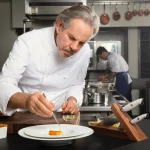




How did Niko Romito (Italy) – Reale build this fortune?
The answer unfolds through the career, earnings, deals and assets behind the headline estimate.
Before the fame
The background and early turning points that shaped Niko Romito (Italy) – Reale’s route to prominence.
Niko Romito was born on 30 April 1974 in Castel di Sangro, a small town in the Abruzzo region of central Italy, at the foot of the Apennines. His family ran a modest local bar and restaurant, and cooking was never part of his own plan growing up. Romito enrolled at university in Rome to study economics, pursuing a career path entirely outside the kitchen (Hospitality Design).
That path changed abruptly in 2000, when his father died and left behind the family’s small restaurant, Reale, in Castel di Sangro. With no professional culinary training and no formal apprenticeship, Romito made the decision to leave his studies and take over the business alongside his sister, Cristiana, who has managed the front of house and hospitality side ever since (Wikipedia Italia).
Romito is almost entirely self-taught. Rather than working his way up through established restaurant kitchens, he spent his early years experimenting alone in Castel di Sangro, developing a personal approach built around reducing dishes to a small number of ingredients cooked with precision. He has described his method as an attempt to strip Italian cuisine back to essentials rather than layering on classical French technique, a stance that set him apart from many contemporaries who trained in traditional brigades (Fine Dining Lovers).
This unconventional route was not universally welcomed at first. Early reviewers and diners in Abruzzo, unused to his pared-back style, sometimes misread his techniques altogether, including a well-known incident in which a critic described his signature bread as undercooked when it was in fact intentionally dense and moist from a high hydration dough. Despite the initial skepticism, Romito kept refining the same core ideas rather than chasing trends (Interni Magazine).
The breakthrough years
The career decisions and defining moments that turned recognition into sustained earning power.
Recognition came quickly once the restaurant’s identity crystallized. Reale earned its first Michelin star in 2007, its second in 2009, and its third in November 2013, effective for the 2014 Michelin Guide, making it the first and still only three-starred restaurant in Abruzzo (nikoromito.com).
In 2011, Romito and his sister relocated the restaurant to Casadonna, a 16th-century former Benedictine monastery on the outskirts of Castel di Sangro, which they restored into a combined restaurant, nine-room boutique hotel and later the headquarters of his cooking school. The same year he won the Best Chef Award at Identità Golose, one of Italy’s most closely watched culinary events, cementing his reputation beyond his home region (Interior Design).

What the work can earn
Reported pay, contracts, royalties and performance income reveal how the fortune was funded.
Reale has held three Michelin stars continuously since 2013 and has been repeatedly named one of the best restaurants in Italy by the Gambero Rosso guide. It entered The World’s 50 Best Restaurants list in 2017 and climbed to number 36 in the 2018 ranking, giving Romito international standing alongside chefs whose restaurants operate in far larger cities (Restaurant Times).
Beyond Reale itself, Romito built out an entire group of ventures under his name, including the Accademia Niko Romito cooking school, the Spazio bistro concept, the Bomba street-food format, and consulting restaurants inside Bulgari Hotels worldwide. Italian trade press has reported that the Gruppo Niko Romito’s revenues reached roughly €9.6 million in 2023, a 26 percent increase on the prior year, reflecting the scale the operation reached well beyond a single fine-dining room (Cibo Today).
Romito is now regularly named among Italy’s most influential chefs in national and international press, and Reale is treated as a required stop on serious culinary itineraries to Italy, despite sitting in a small mountain town rather than a major city. His story of arriving at cooking without formal training after a family tragedy is frequently cited in profiles as one of the more unusual paths to three Michelin stars in modern European fine dining (Cibo Today).
His profile has also grown through media appearances and interviews across Italian and international outlets discussing his cooking philosophy, which he frames around simplicity, technique and using very few ingredients per dish, a position that has made him a frequently quoted voice on the direction of contemporary Italian cuisine (Gambero Rosso International).

The business beyond the main career
Endorsements, ownership interests and investments can keep compounding long after the initial breakthrough.
Romito’s most significant brand relationship is his long-running consulting partnership with Bulgari, which has put his name and cooking style on hotel restaurants across seven cities on three continents rather than a traditional celebrity-endorsement deal. He has also partnered with Autogrill, Italy’s largest motorway and travel catering operator, to bring the Bomba format into transit locations, extending his cooking into a mass-market retail setting well outside fine dining (Pizza e Pasta Italiana).
Rather than lending his name to unrelated consumer products, Romito has concentrated his commercial partnerships within hospitality, food retail and education, an approach consistent with how he discusses his brand in interviews, where he frames Reale, Bomba, the academy and the hotel consulting work as one interconnected group rather than separate side deals (Gruppo Niko Romito).
Romito’s largest expansion beyond Reale is Bomba, a street-food format built around fried and baked “bombe,” savory and sweet filled dough specialties from Abruzzo. The first retail Bomba outlet opened in June 2018 at Milan’s Piazza XXV Aprile in partnership with Autogrill, followed by ALT Stazione del Gusto locations at service stations in Castel di Sangro and, from December 2021, Montesilvano, plus a presence inside the Spazio Niko Romito bar in Rome (HorecaNews).
Since 2017, Romito has also acted as consulting chef for Bulgari Hotels & Resorts, developing the menus and training the kitchen teams for Il Ristorante – Niko Romito outposts in Milan, Beijing, Dubai, Shanghai, Paris, Tokyo and Rome, with the Tokyo location going on to earn its own Michelin star. Separately, he founded Niko Romito Formazione, later renamed Accademia Niko Romito, a professional cooking school based at Casadonna that has trained close to 300 chefs over roughly a decade, most of whom have gone on to open their own businesses or lead professional kitchens (Bulgari Hotels).
Notable luxury item
A reported property or major asset offers a tangible glimpse of the wealth behind the public estimate.
Romito’s primary physical asset is Casadonna itself, the roughly 32,300-square-foot former 16th-century Benedictine monastery outside Castel di Sangro that he and his sister acquired and converted starting in 2011. The property, immersed in the Abruzzo National Park landscape, now combines the three-Michelin-star Reale dining room, a nine-room boutique hotel, an experimental vineyard and herb garden, and the campus of the Accademia Niko Romito, making it as much a working estate as a restaurant address (Interior Design).
Public filings compiled by Italian business registries show Niko Romito Formazione e Consulenza Srl, one of the corporate entities behind his group, registered and headquartered in Castel di Sangro, consistent with the group keeping its operational base anchored to the Casadonna property rather than relocating to a larger city (FatturatoItalia).
Niko Romito (Italy) – Reale’s estimated net worth
Public estimates vary because private contracts, investments, taxes and liabilities are not fully disclosed.
How this estimate is calculated
No public financial disclosure states Niko Romito’s personal net worth, since Reale and the wider Gruppo Niko Romito are privately held Italian companies. The estimate below is built from the pieces of financial and business information that are publicly documented: Italian trade press reporting group revenues of roughly €9.6 million in 2023, ownership of the Casadonna estate that houses a three-Michelin-star restaurant, a nine-room hotel and a cooking academy, an active multi-city consulting arrangement with Bulgari Hotels since 2017, and a growing retail food format in Bomba operating in partnership with Autogrill (Cibo Today).
Weighed against that documented business scale, a handful of celebrity-net-worth aggregator sites circulate a figure of around $4 million for Romito, but these sites do not cite underlying financial statements or sourcing and should be treated as a secondary, lower-confidence data point rather than a verified figure (TheCityCeleb, secondary source). Given that his group’s reported annual revenue alone approaches that figure, and that he owns real estate, a restaurant business, an education company and an international consulting contract accumulated over more than two decades, a reasoned range sitting somewhat above that single aggregator estimate is more consistent with the available business evidence.
Romito has channeled a meaningful part of his public work into food education rather than conventional celebrity charity. Since 2014, the Accademia Niko Romito has distributed roughly €250,000 in scholarships to 69 students who could not otherwise afford the school’s tuition, with top annual awards of €5,000 for first place and €3,000 each for second and third (Accademia Niko Romito).
He has also led #iomangioascuola, a project with the Abruzzo Region and regional universities that applies his low-waste, high-technique cooking methods to school cafeteria menus, aiming to improve nutritional quality for children while cutting food waste and costs in public kitchens. The initiative reflects the same circular-cuisine philosophy he applies commercially, redirected toward public health and education rather than profit (Abruzzo News).
Romito has not been the subject of any major public scandal or legal controversy. The scrutiny he has faced has stayed within the normal range of restaurant criticism: some reviewers have noted inconsistency across a tasting menu built on very few ingredients per dish, arguing that when a plate relies on two or three components, any weak link is more exposed than in a more elaborate style of cooking (Gastromondiale).
His minimalist style also drew skepticism early in his career from diners and critics more accustomed to classical technique, including the widely repeated misreading of his high-hydration bread as underbaked. That kind of pushback has faded as his reputation solidified, and current coverage of Romito centers overwhelmingly on his cooking philosophy and business expansion rather than any unresolved dispute (Interni Magazine).