 How Much Are They Worth?
Celebrity fortunes, explained
How Much Are They Worth?
Celebrity fortunes, explained


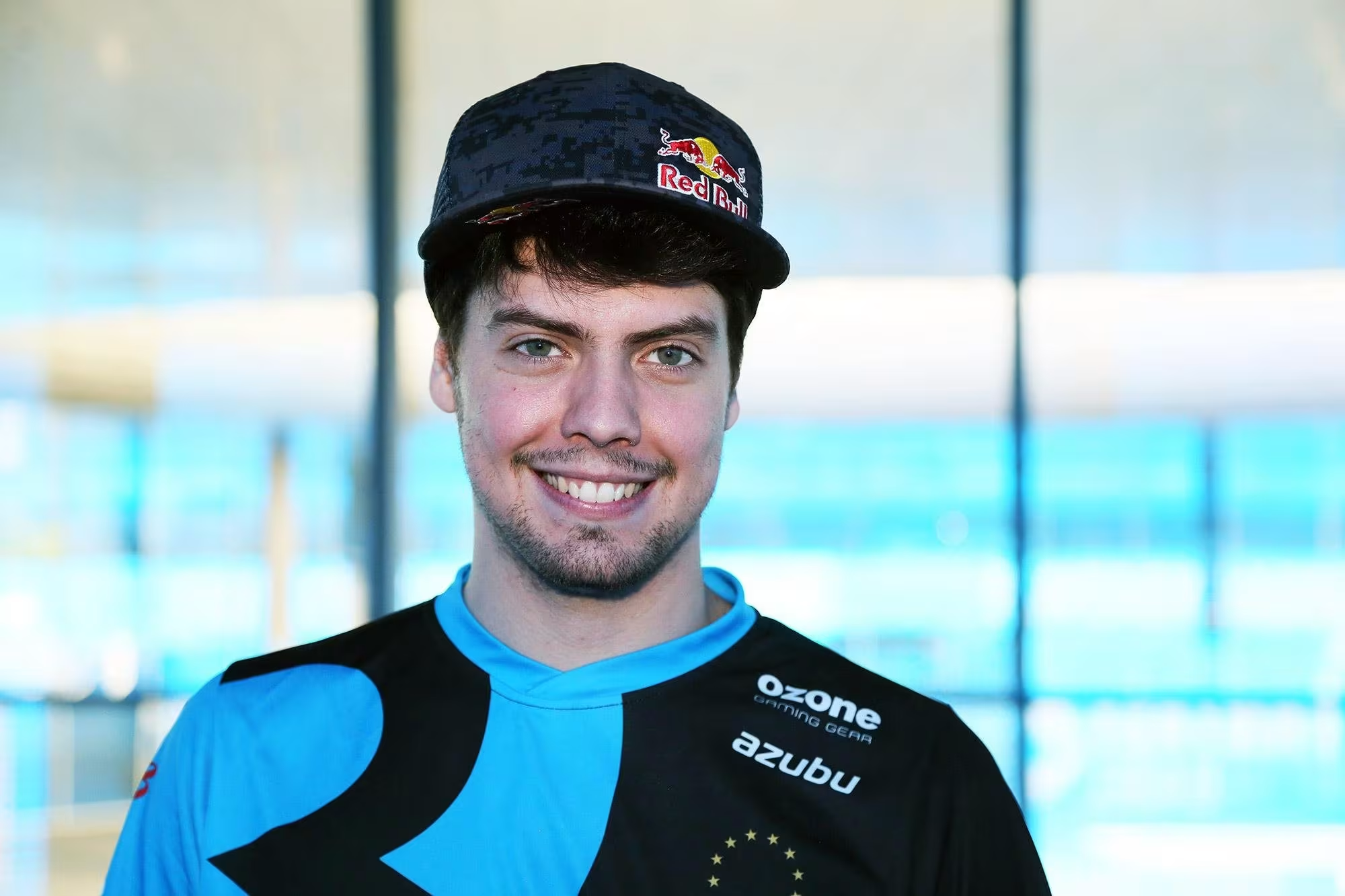






How did Amaz (Jason Chan) build this fortune?
The answer unfolds through the career, earnings, deals and assets behind the headline estimate.
Before the fame
The background and early turning points that shaped Amaz (Jason Chan)’s route to prominence.
Jason Chan, better known by his competitive gaming alias Amaz, was born on April 12, 1991, in Hong Kong, details confirmed by Wikipedia. He moved to Vancouver, Canada, with his mother when he was in fourth grade, and it was there that he learned English through ESL classes and was first introduced to computer games after watching a friend play Warcraft III, an origin story recounted on the Hearthstone Wiki. He quickly became what Wikipedia describes as a “self-described Blizzard fanboy,” a fandom that would eventually shape his entire career.
When Chan reached high school, he and his mother returned to Hong Kong to reunite with his father, and he was placed in an international school because his Chinese language skills had lapsed during his years in Canada. It was during this period that his World of Warcraft habit deepened into something closer to a second job, and per the Hearthstone Wiki‘s biography of him, he spent seven years playing the game in total, two of them as guild master and raid leader of a guild that briefly ranked second on its server.
Chan went on to study mathematics at the University of Waterloo in Ontario, but his studies were derailed when his mother was diagnosed with cancer and later died while he was living in Toronto, a loss the Hearthstone Wiki says left him struggling and “not caring about anything,” with WoW raiding becoming one of the few things that kept him going. He put his degree on hold for two years and returned to Hong Kong to be with his family, taking an office job through his father that he found too boring to stick with.
In the years that followed, Chan returned to practicing the saxophone, earned a diploma and began tutoring students for money, while also developing a board game called Scribe’s Arena that he successfully funded through Kickstarter, according to the same profile. When Hearthstone was announced, his lifelong card game interest and Blizzard fandom pulled him in immediately, and a friend’s offhand suggestion that he try streaming set the next phase of his life in motion. His channel had roughly 200 concurrent viewers in February 2014; by June that year, helped by streaming alongside fellow personality Artosis, that number had grown a hundredfold to 20,000.
The breakthrough years
The career decisions and defining moments that turned recognition into sustained earning power.
Chan’s competitive career moved fast once it started. He joined ROOT Gaming in March 2014, then became Team Liquid’s first Hearthstone division streamer that June, later going on to commentate the 2015 Hearthstone World Championship, a résumé detailed on Wikipedia. In November 2014 he founded his own organization, Team Archon, and signed reigning BlizzCon 2014 world champion Firebat, instantly making the roster one of the most talked about in the scene.
His signature moment came at DreamHack Summer 2014, where he reached the grand final against Romanian player Radu “Rdu” Dima in a match that carried the largest prize in competitive Hearthstone history at the time. Rdu won 3-0, and Amaz took home the $5,000 runner-up prize, a result confirmed by Esports Earnings. The final was overshadowed by a “ghosting” controversy after messages sent to Rdu’s friends list revealed details of Amaz’s hand mid-match, prompting DreamHack officials to wipe both players’ friends lists rather than replay the game, as reported by PCGamesN. Amaz publicly defended his opponent afterward, saying “Rdu is definitely not cheating. Sometimes you get into the finals and your friends get crazy,” a response that drew praise for its graciousness even as he pushed organizers to improve their safeguards.

What the work can earn
Reported pay, contracts, royalties and performance income reveal how the fortune was funded.
Chan’s breakout year was recognized industry wide when he won Best Hearthstone Streamer at the Blizzard 2014 Stream Awards, also placing second for Most Active Chat and fifth for Highest Mean Viewership across all Blizzard titles on Twitch, honors documented by AffairPost. He backed that up competitively with a second place finish worth $6,000 at the ESL Hearthstone League Season in Katowice in 2015, one of several deep tournament runs that built his reputation as one of the West’s strongest players.
As his career shifted from pure competition toward production and streaming, Chan organized the Archon Team League Championship, which distributed a combined $220,000 in prize money and which Wikipedia describes as “the most successful third-party tournament in Hearthstone” of its era. His later Hearthstone Battlegrounds and variety game results added to the tally, including a first place finish worth $26,250 at Battlegrounds Brawl in November 2019 and a $10,947.51 win at GlitchCon 2020’s Fall Guys Super Team Showdown, contributing to career tournament earnings of $86,501.66 across 32 events and several different games, per Esports Earnings.
Beyond competition, Chan became one of Hearthstone’s most visible ambassadors. Blizzard tapped him to voice act cards from the Blackrock Mountain expansion in both Cantonese and Taiwanese, a direct commercial nod to his bilingual background that few other Western personalities received, a credit listed on Wikipedia. His profile within card game esports eventually extended past Hearthstone entirely, and he was later given a special invitation to Magic: The Gathering’s Pro Tour Kyoto in 2017, an unusual crossover recognition for a competitor best known for a different game.
His fanbase also became known for a distinct piece of stream culture: Amaz’s habit of saying “we” when addressing his audience, with catchphrases like “Can we do that?” becoming closely associated with his channel, a trait highlighted in his Hearthstone Wiki profile. That connection with viewers helped him build a following that, combined across Twitch and YouTube, has run into the high hundreds of thousands over the course of his career.

The business beyond the main career
Endorsements, ownership interests and investments can keep compounding long after the initial breakthrough.
Chan’s commercial relationships have tracked his career moves closely. He streamed under Team Liquid’s banner as its first Hearthstone division member starting in June 2014, then moved to NRG Esports in September 2016, where he has remained since, a history laid out on Wikipedia. Those team partnerships came with steady support for his content rather than one-off appearance fees, reflecting the longer term nature of streamer sponsorships in esports.
He also built a direct paid relationship with Blizzard itself, most notably through his Blackrock Mountain voice acting work, a level of direct publisher involvement most streamers never receive. More recently, Chan has expanded into Magic: The Gathering, where he is sponsored by ChannelFireball as an Arena streamer and content producer, a current role reflected in his Wikipedia biography.
Chan’s most significant business venture was Team Archon, the organization he founded in November 2014 and built around marquee signings like Firebat before departing in September 2016 to join NRG Esports, a timeline confirmed by Wikipedia. Running alongside the team was his tournament production work, most notably the Archon Team League Championship series, which paid out $220,000 in total prizes and stood as one of the largest community run events in Hearthstone at the time, according to AffairPost‘s account of his career.
Not every venture succeeded. A planned second edition of his tournament series, crowdfunded through Kickstarter in 2016, fell short of its funding target and was ultimately cancelled, a setback noted on Wikipedia. Earlier in his life, before Hearthstone existed, Chan had also co-created a board game called Scribe’s Arena that he did successfully fund on Kickstarter, showing an entrepreneurial streak that predated his gaming fame.
Notable luxury item
A reported property or major asset offers a tangible glimpse of the wealth behind the public estimate.
Chan has not disclosed any real estate, vehicles or other major personal assets through his public channels, and none of the profiles of his career, including his detailed Hearthstone Wiki biography and his Esports Earnings tournament history, reference a home, investment property or notable purchase of any kind. Unlike some streamers who showcase studio upgrades or vehicles as part of their brand, Amaz’s public persona has stayed centered on his gameplay, commentary and production work rather than displays of wealth.
No reliable public record of specific property or asset ownership exists for him at this time, consistent with a career built primarily on streaming income, tournament winnings and freelance production work rather than the kind of business exit or endorsement windfall that tends to generate public financial disclosures.
Amaz (Jason Chan)’s estimated net worth
Public estimates vary because private contracts, investments, taxes and liabilities are not fully disclosed.
How this estimate is calculated
Chan’s direct tournament winnings are modest relative to his public profile, totaling $86,501.66 across 32 tournaments and multiple games between 2014 and 2020, according to Esports Earnings, with his largest individual paydays coming from Battlegrounds Brawl ($26,250), GlitchCon 2020’s Fall Guys event ($10,947.51), a Magic: The Gathering Mythic Championship ($7,500), ESL Katowice 2015 ($6,000) and his DreamHack Summer 2014 runner-up finish ($5,000). That leaves the large majority of his career earnings tied to more than a decade of streaming and content income rather than prize money.
That income stream includes over ten years of Twitch subscriptions and YouTube advertising revenue built from a channel that grew from roughly 200 concurrent viewers to 20,000 within four months of launching in 2014, plus ongoing team backing from Team Liquid and later NRG Esports, direct paid work for Blizzard including voice acting and the $220,000 in prize money he helped organize through the Archon Team League Championship, and his current ChannelFireball sponsorship for Magic: The Gathering Arena content. Secondary estimates of his overall net worth vary considerably: AffairPost placed it around $500,000 as of early 2019, citing roughly $130,000 a year in YouTube earnings alongside his Twitch subscriber income, while NetWorth Database, used here only as a secondary source, puts the figure considerably higher at $1.5 million without publishing a specific methodology. Combining his documented tournament record with a decade plus of sustained streaming income, sponsorship deals and paid publisher work, while noting that no audited figure has ever been released, produces a reasoned range rather than one precise number.
No large scale personal charitable foundation or major publicized donation has been documented under Chan’s name. His public image has instead been shaped by the personal story behind his career, including the loss of his mother during his university years and his return to a modest tutoring job before streaming took off, details he has spoken about that give his fanbase a more grounded picture of him than the typical “overnight success” narrative, as recounted on the Hearthstone Wiki.
That relatable image was reinforced by his conduct during his highest profile loss, the 2014 DreamHack Summer final, where he chose to defend his opponent against cheating accusations rather than dispute the result, a moment covered by PCGamesN. Combined with his inclusive “we” catchphrase and years of consistent content, that reputation has generally painted him as one of competitive Hearthstone’s more even tempered public figures.
The most serious controversy tied to Chan’s name dates back to the 2015 Archon Team League finals, when a hospitality worker hired for the event said organizers repeatedly pressured her to get into a hot tub with players and, when she said she did not own a swimsuit, gave her a company card and sent her to buy one. Those allegations became public on social media in 2020, five years after the event, and the Hearthstone Fandom Wiki states that Blizzard subsequently removed Amaz from a Hearthstone Battlegrounds Brawl event, citing accusations that he and a fellow organizer had forced her into the hot tub. Separately, the same woman alleged she was sexually assaulted that same weekend by a different individual, her direct supervisor at the event, a distinct allegation not made against Chan himself but one that intensified scrutiny of the entire event he had helped organize.
Chan faced a separate incident in 2019 at a Magic: The Gathering Grand Prix in Las Vegas, where he was disqualified from the remainder of the tournament following a physical altercation with a judge after losing his fourteenth round match. According to Esports Talk, Chan said he took a shortcut through the play area against a judge’s earlier instruction and denied being aggressive, while the judge described being bumped or pushed and some spectators offered accounts that contradicted Chan’s version of events; the tournament’s head judge ultimately ruled the disqualification stood.