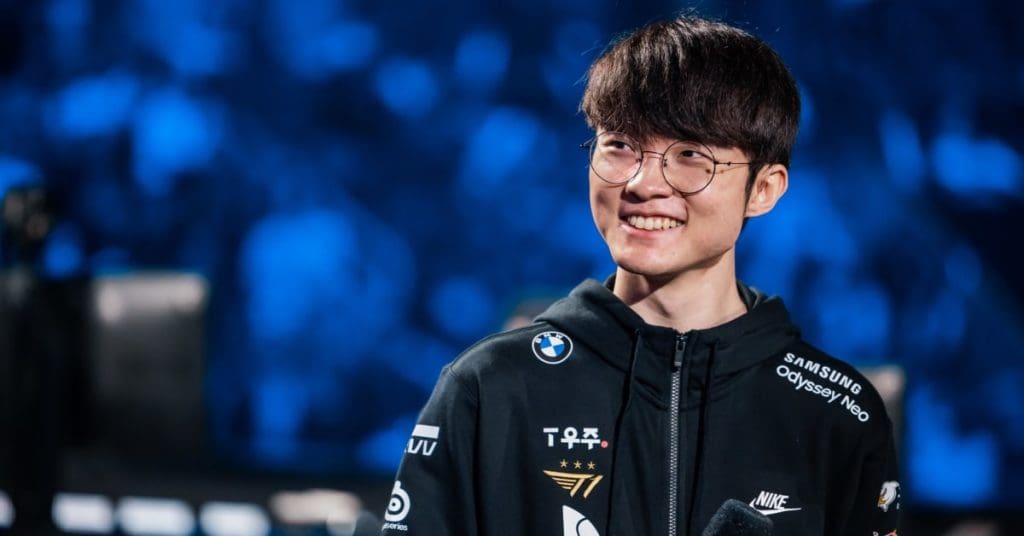
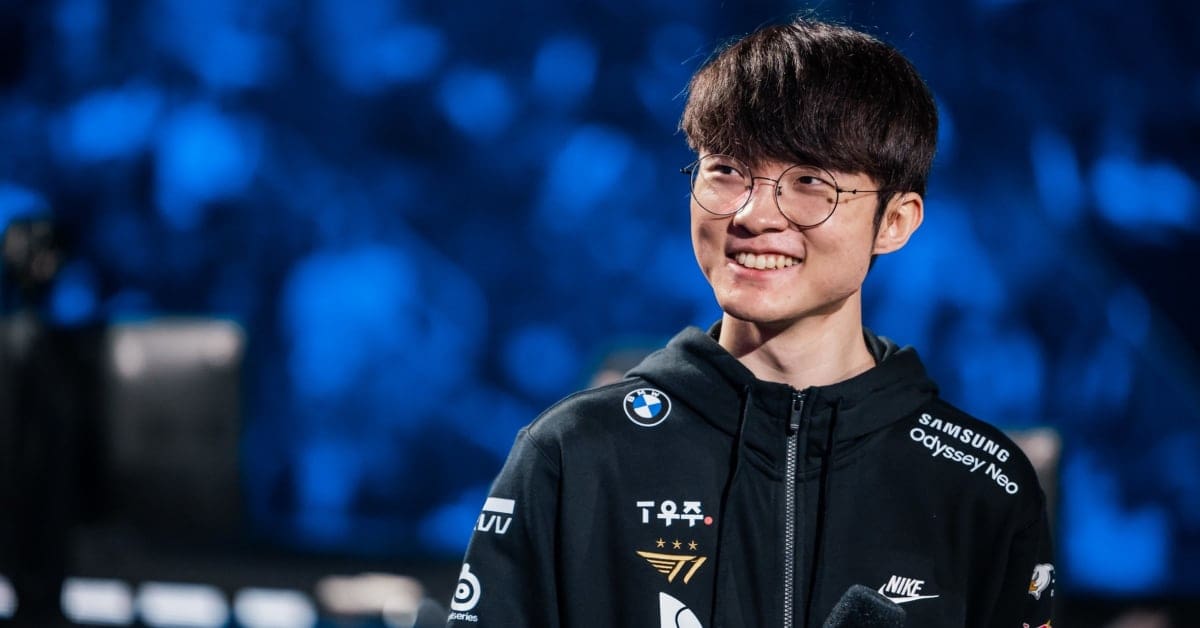
How did Faker (Lee Sang-hyeok) build this fortune?
The answer unfolds through the career, earnings, deals and assets behind the headline estimate.
Before the fame
The background and early turning points that shaped Faker (Lee Sang-hyeok)’s route to prominence.
Lee was born in Seoul in 1996 and grew up in the Gangseo district. Exceptionally high solo-queue rankings drew SK Telecom T1’s attention, and he left high school to join the organization’s League of Legends roster in 2013. Esports Earnings’ team chronology shows an uninterrupted competitive relationship with SKT T1 and successor T1 from 2013 onward. That continuity distinguishes his finances from players who cycle through short contracts and frequent relocations.
Faker debuted as a mid laner and won the 2013 World Championship during his rookie season. His champion mechanics, particularly an iconic Zed outplay, helped create the “Unkillable Demon King” reputation. Two more world titles followed in 2015 and 2016. Early Korean esports salaries were lower than later reports, so HMW does not apply today’s elite compensation to his teenage seasons. Tournament shares and team bonuses provide the measurable early foundation.
The breakthrough years
The career decisions and defining moments that turned recognition into sustained earning power.
World titles, domestic championships and repeated international finals made Faker the central commercial face of League of Legends. The detailed prize ledger records personal shares of $200,000 from the 2013 world title, $166,666.67 in 2015 and $338,000 in 2016. Those figures are gross tournament awards, not after-tax savings, and they exclude salary and publisher-funded skin revenue.
What the work can earn
Reported pay, contracts, royalties and performance income reveal how the fortune was funded.
Faker’s longevity added titles in 2023, 2024 and 2025, reinforcing bargaining power well beyond a normal esports career. Riot selected him as the inaugural Hall of Legends inductee in 2024. Riot’s Hall of Legends announcement documented ten LCK championships, consecutive international titles and his influence on the game. Awards themselves are not assets, but they support premium salary, sponsorship and licensed digital-content demand.
Team salary is probably the largest recurring cash source. Exact contracts remain confidential, but Korean and industry reporting commonly places recent annual compensation near $6 million to $7 million. Esports Insider’s 2026 reconstruction uses roughly $6 million and separately reports approximately $2.14 million of tournament winnings under the Liquipedia methodology. HMW models a steep salary progression rather than multiplying the current report by all thirteen seasons.
The business beyond the main career
Endorsements, ownership interests and investments can keep compounding long after the initial breakthrough.
Faker has appeared in campaigns connected with Nike, Razer, Red Bull, Samsung and other T1 partners, and streaming adds platform revenue. Some agreements belong to T1 rather than Lee personally, so the whole sponsorship value cannot be assigned to him. His Hall of Legends event also generated a commemorative Ahri skin and event pass. Riot did not publish his individual royalty, and HMW includes only a restrained licensing allowance rather than a percentage of guessed skin sales.
A 2020 contract made Faker a part-owner and future executive of T1 through an equity arrangement. The most concrete outside valuation is Forbes’ 2022 estimate of T1 at $220 million, with $17 million of estimated 2021 revenue. Later Korean reporting described a stock option potentially representing about 5.66%. HMW does not simply multiply those numbers: an option may require exercise payment, vesting and tax, while private-company shares lack a ready buyer and may be diluted.
Notable luxury item
A reported property or major asset offers a tangible glimpse of the wealth behind the public estimate.
Lee owns a commercial building popularly called Faker Tower in Hwagok-dong. ONE Esports identified the nine above-ground floors, two basement levels and tenant uses. Korean business press adds a useful transaction clue: Maeil Business Newspaper reported that the property was bought roughly two billion won below a comparison level because of favorable floor-area utilization. Exact purchase price, mortgage, net rent and current appraisal remain unclear, so HMW applies a conservative equity allowance rather than capitalizing gross rent.
Faker (Lee Sang-hyeok)’s estimated net worth
Public estimates vary because private contracts, investments, taxes and liabilities are not fully disclosed.
How this estimate is calculated
HMW begins with the $1.92 million documented prize ledger, then models salary rising from modest rookie compensation to the reported recent $6 million–$7 million level. It adds conservative streaming, personal endorsement, digital-item and appearance income. T1 equity is valued using the $220 million Forbes benchmark, but heavily discounted for option exercise, vesting, private-company illiquidity, dilution and valuation age. Faker Tower receives a restrained net-equity and rental allowance after assumed debt, maintenance and property tax. Korean income tax, agents, training support, travel, legal and accounting costs, equity exercise, property costs and living expenses are deducted. Reported rejected offers from Chinese teams are assigned zero income.
In South Korea, Faker’s recognition extends beyond esports into national advertising, television and the Asian Games. His reserved public image and loyalty to one organization have made him attractive to long-term partners. Still, T1 social followers and broadcast audiences belong partly to the team and league. HMW does not value reach separately; it uses verified relationships and contract evidence to support income assumptions.
Prize data are unusually specific: Esports Earnings totals $1,922,084.56 from 74 tournaments, while other databases differ because they allocate team prizes differently. Salary reports are estimates, endorsement values are private, and the T1 stake may be an option rather than fully vested common shares. HMW also lacks Faker Tower debt, Korean corporate structures, agent fees and family transfers. It excludes unsupported claims that he automatically owns six percent free and clear.
JavaScript is off, so all sections are displayed together.