 How Much Are They Worth?
Celebrity fortunes, explained
How Much Are They Worth?
Celebrity fortunes, explained









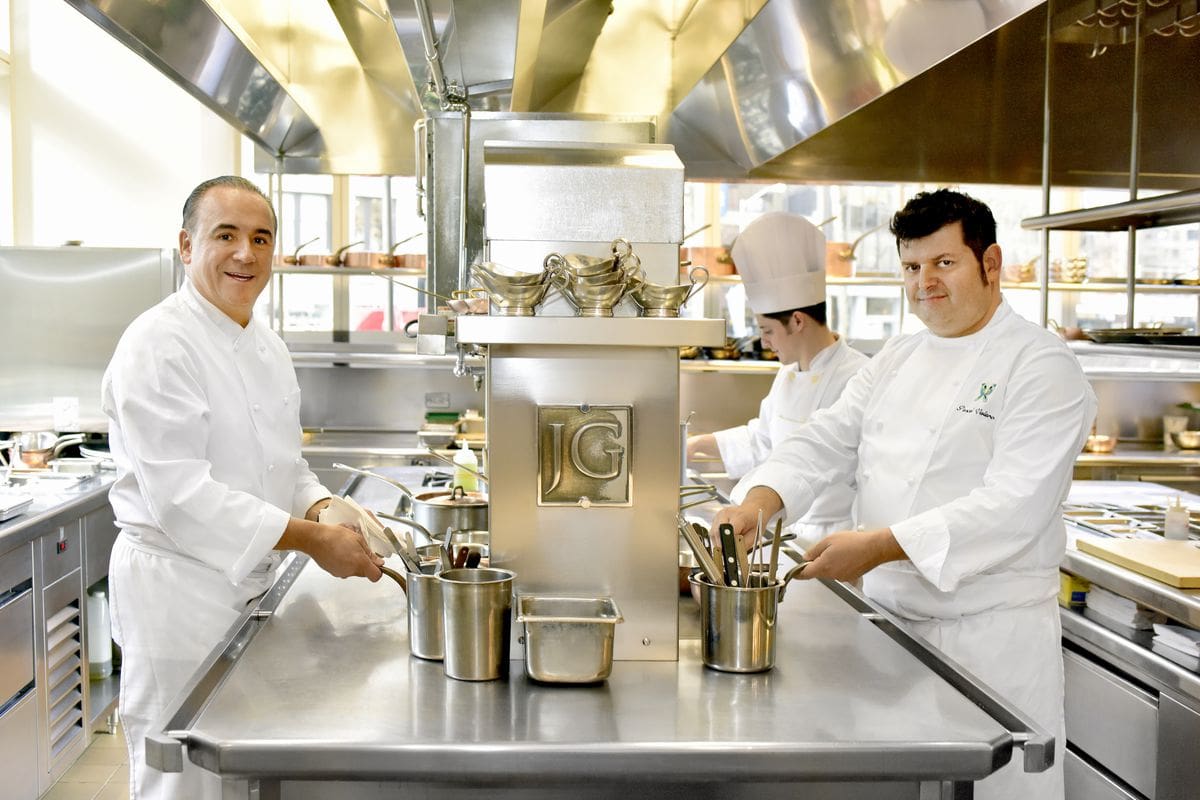
Jean-Georges Vongerichten (USA) – Jean-Georges
Net worth revealed after 6 slides
Begin the countdown ↓
How did Jean-Georges Vongerichten (USA) – Jean-Georges build this fortune?
The answer unfolds through the career, earnings, deals and assets behind the headline estimate.
Before the fame
The background and early turning points that shaped Jean-Georges Vongerichten (USA) – Jean-Georges’s route to prominence.
Jean-Georges Vongerichten was born on March 16, 1957, in Illkirch-Graffenstaden, on the outskirts of Strasbourg in Alsace, France. He grew up in a household built around food, where his mother and grandmother cooked lunch every day for close to 50 employees of the family’s coal and heating-oil business. His path into cooking was set at age 16, when his parents took him for a birthday dinner at the three-Michelin-starred Auberge de l’Ill, an experience he has repeatedly cited as the moment he decided to become a chef. He apprenticed soon after under chef Paul Haeberlin at that same restaurant, then went on to train with two of France’s most influential chefs, Paul Bocuse and Louis Outhier at L’Oasis, a three-Michelin-starred restaurant on the Riviera. These early years are documented on his Wikipedia biography and on the official Jean-Georges Restaurant biography page.
Working under Louis Outhier, Vongerichten spent the early 1980s opening restaurants at luxury hotels across Asia, including the Oriental Hotel in Bangkok, the Meridien Hotel in Singapore, and the Mandarin Hotel in Hong Kong, a stretch that shaped the light, herb- and citrus-driven style that would later define his cooking. He arrived in the United States in 1985 under Outhier’s sponsorship to open Le Marquis de Lafayette in Boston, then moved to New York in 1986 to run Lafayette at the Drake Swissotel. At just 29 years old, he earned a four-star review from The New York Times for that restaurant, an unusually fast rise for a chef who had only recently crossed the Atlantic. This period of his career is covered on his Wikipedia page.
The breakthrough years
The career decisions and defining moments that turned recognition into sustained earning power.
In 1991, Vongerichten partnered with restaurateur Phil Suarez, who would go on to help open nearly 40 of his restaurants, to launch JoJo on Manhattan’s Upper East Side. JoJo was named Best New Restaurant of the year and earned three stars from The New York Times, giving Vongerichten his first restaurant as an owner rather than a hired chef. He followed it with Vong, a Thai-French fusion concept whose recipes were precise enough to be replicated reliably by other kitchens, which became the template for a licensing model that carried Vong outposts to Chicago, London, Hong Kong, and Mexico City. The turning point came in 1997, when he opened his flagship, Jean-Georges, on Central Park West, which was awarded three Michelin stars once the New York Michelin Guide launched and made him Esquire’s Chef of the Year. Details on this stretch of his career appear in Fortune’s 2024 profile of his career.

What the work can earn
Reported pay, contracts, royalties and performance income reveal how the fortune was funded.
In 1998, the James Beard Foundation gave Vongerichten what is widely described as a “triple crown,” naming Jean-Georges Best New Restaurant while simultaneously honoring him as America’s Outstanding Chef, the first time the Foundation had given a chef two major awards in the same year. He added a James Beard Award for Best Cookbook in 1999 for Cooking at Home with a Four Star Chef, part of a body of work that now spans five cookbooks, two of them co-authored with food writer Mark Bittman. His flagship restaurant has held Michelin stars continuously since the New York guide’s 2005 launch, currently holding two, and JoJo has held a Michelin star of its own since 1991. His restaurant group today spans roughly 60 locations across six continents. These achievements are detailed by Oysterlink’s chef profile and on his official restaurant biography.
Vongerichten’s influence on American fine dining has been recognized well beyond his own restaurants. New York magazine credited him with reshaping the city’s dining culture over two decades, and he was one of the chefs featured in the James Beard Foundation’s retrospective marking 25 years of its award-winning chefs. He has appeared on the Today Show and Top Chef, and in 2011 he co-hosted the PBS culinary travelogue Kimchi Chronicles with his wife, actress and model Marja Vongerichten, exploring Korean and Korean-American food across New York and South Korea. Fortune’s 2024 feature also singled him out as a rare example of a fine-dining chef whose restaurants have survived for decades, including a global pandemic, describing his hands-on grasp of every restaurant’s staffing, overhead, and break-even numbers as central to that longevity. Coverage of this recognition appears in Fortune’s profile and on his Wikipedia page.

The business beyond the main career
Endorsements, ownership interests and investments can keep compounding long after the initial breakthrough.
In October 2024, Williams Sonoma launched Jean-Georges for Williams Sonoma, an eight-product line of condiments, rubs, and marinades built around the French, Asian, and New York flavor combinations found across his restaurants. The retailer had actually carried his grapeseed oil, spices, and condiments in stores as far back as 2001, making the 2024 line a formalized revival of a relationship more than two decades old rather than a first-time celebrity licensing deal. The launch was supported with in-store tastings at Williams Sonoma locations. Unlike DJs or athletes with large individual sponsorship rosters, most of Vongerichten’s outside income runs through this kind of product licensing and consulting relationship rather than brand ambassadorships. The collaboration is detailed in Williams Sonoma’s official press release via Business Wire.
Vongerichten’s holding company, Jean-Georges Enterprises LLC, was founded in 1990 and had grown to an estimated $50 million in annual sales with roughly 2,000 employees by 2004, according to the International Directory of Company Histories, figures that predate most of the group’s later international expansion. The company mixes wholly owned restaurants with licensed concepts, a structure that traces back to the early Vong outposts and that let the group scale to close to 60 restaurants worldwide without financing every location itself. His most ambitious recent venture was The Tin Building by Jean-Georges, a $200 million, 53,000-square-foot food hall built with real estate developer Howard Hughes Corporation at New York’s South Street Seaport, which opened in September 2022 on the site of the old Fulton Fish Market with six full-service restaurants, six fast-casual counters, and a grocery market. Details on the Tin Building’s launch and scope are covered by Forbes, and the company’s early financial scale is documented on Encyclopedia.com.

Notable luxury item
A reported property or major asset offers a tangible glimpse of the wealth behind the public estimate.
Vongerichten’s most documented personal property is a weekend house in Waccabuc, in Westchester County, New York, which he and his wife Marja bought after she spotted a real estate listing for a stone-and-shingle home overlooking a lake. The house, designed by architect Michael DeCandia, replaced a 1970s flat-roofed contemporary structure that previously stood on the lakeside lot, and the family uses it as a retreat from the couple’s demanding New York City restaurant and television schedules. Beyond that documented retreat, Vongerichten maintains a primary base in New York City, but specific figures on any Manhattan real estate holdings or other major personal assets are not publicly disclosed. The Waccabuc property is profiled in Westchester Magazine’s feature on the home.
Jean-Georges Vongerichten (USA) – Jean-Georges’s estimated net worth
Public estimates vary because private contracts, investments, taxes and liabilities are not fully disclosed.
How this estimate is calculated
Vongerichten’s wealth rests on nearly four decades of restaurant ownership and licensing rather than any single windfall. His holding company, Jean-Georges Enterprises, was already generating an estimated $50 million a year with about 2,000 employees by 2004, a snapshot from long before the group grew to its current scale of roughly 60 restaurants spread across six continents, and it has continued adding revenue streams since, including a 2024 consumer products deal with Williams Sonoma and decades of cookbook royalties across five published titles. Working against that growth is the real, recently documented loss on The Tin Building, which is reported to have lost more than $100 million of its $200 million investment before closing in February 2026, a setback that would meaningfully dent any personal capital tied up in the venture. The only concrete, dated net worth figure published by a mainstream outlet is The Daily Meal’s 2017 estimate of $6.8 million, a number that predates much of his later international expansion and product licensing and likely understates his current position, but no larger figure has been backed by comparable sourcing since. Aggregator sites circulate estimates anywhere from roughly $25 million to $250 million for Vongerichten, but Celebrity Net Worth does not include him on its ranked list of the top 50 richest celebrity chefs at all, and most of the higher figures online trace back to unsourced content pages rather than financial reporting, so those numbers should be treated as unverified rather than authoritative. Weighing the scale and age of his restaurant group against the confirmed 2017 baseline and the recent Tin Building loss produces a wide, defensible range rather than a single precise figure. The Daily Meal’s figure and methodology can be reviewed on its 2017 most successful chefs feature.
Vongerichten serves on the Food Council of City Harvest, the New York City food rescue organization that redistributes surplus food to people facing hunger, and he founded his own charitable initiative, Food Dreams. Publicly, he is generally portrayed less as a media-first celebrity chef and more as a still-working kitchen operator. Fortune’s 2024 profile noted that even in his late 60s he keeps kitchen hours from around 9am to at least 11pm and personally tracks who is cooking, what each restaurant’s overhead looks like, and where its break-even point sits, rather than delegating that oversight to executives, which has shaped his image as an unusually hands-on restaurateur among his peers. These details are covered in Wikipedia’s biography and Fortune’s profile.
Vongerichten’s restaurant group settled a lawsuit in September 2008 for $2.2 million after employees alleged that tips meant for service staff were being redirected to managers, a claim that mirrored disputes playing out across the New York restaurant industry at the time. He has also faced a long-running, good-natured dispute with chef Jacques Torres over his claim to have invented the molten chocolate cake in the late 1980s, which Torres has publicly contested. The far larger recent setback came in February 2026, when The Tin Building by Jean-Georges permanently closed its doors after roughly three and a half years in operation, following losses reported at more than $100 million on the $200 million project, a shortfall attributed to the food hall’s location away from the city’s densest foot traffic and to competition from a wave of comparable high-end food halls that opened across New York in the years since. The Seaport space is being handed over to an immersive art venue, the Balloon Museum, set to open in summer 2026. The Tin Building’s closure is reported in detail by Time Out New York, and the 2008 tip lawsuit is noted on his Wikipedia page.