
 How Much Are They Worth?
Celebrity fortunes, explained
How Much Are They Worth?
Celebrity fortunes, explained

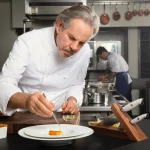



How did Vicky Cheng build this fortune?
The answer unfolds through the career, earnings, deals and assets behind the headline estimate.
Vicky Cheng before the fame
The background and early turning points that shaped Vicky Cheng (China) – VEA’s route to prominence.
Vicky Cheng was born in Hong Kong and raised largely in Toronto, Canada, growing up with a family heritage that includes a Shanghainese grandmother and a Chiu Chow (Teochew) father, a mixed background he has said shaped his palate long before he ever cooked professionally, according to Tatler Asia’s profile of Cheng and his restaurant Wing. He is the chef-owner of VEA Restaurant & Lounge and Wing, both housed in the same building on Wellington Street in Central, Hong Kong, not mainland China, despite his cooking sometimes being filed under a broader “Chinese fine dining” label. He trained formally at George Brown College in Toronto, per Wikipedia’s biography of Cheng, after being drawn to cooking around age 12 by watching television chefs Jamie Oliver and Emeril Lagasse, a spark he described in an interview with The World’s 50 Best Restaurants.
Cheng began working professional kitchens in Toronto as a teenager, training under chef Jason Bangerter at Auberge du Pommier and chef Anthony Walsh at Canoe, according to Wikipedia. He then moved to New York to work at Restaurant Daniel under Daniel Boulud, an apprenticeship that grounded him in classical French technique, per the same source. In 2011 Cheng relocated to Hong Kong, where he took the executive chef role at Liberty Private Works, a members-style dining concept; in an interview conducted while he ran that kitchen he described wanting “to do something really different for me alone… I wanted to create my own dishes,” per Jeannie Cho Lee’s Asian Palate interview with Cheng. In Hong Kong he also trained under Chinese cuisine specialists Chef Tam Kwok Fung and Chef Adam Wong, according to Tatler Asia, building the technical grounding in Chinese cooking that would later underpin his own restaurants.
Vicky Cheng’s breakthrough years
The career decisions and defining moments that turned recognition into sustained earning power.
Cheng’s defining breakthrough came in 2015, when he opened VEA Restaurant & Lounge on Wellington Street in Central, his first restaurant as sole owner-chef, per Wikipedia. The following year, VEA earned a Michelin star, formal recognition for what Cheng calls his “Chinese x French” philosophy, pairing French technique with Chinese ingredients, a description he has used repeatedly, including in the Tatler Asia profile covering Wing’s opening. VEA has held its Michelin star continuously since 2016 and has appeared on the Asia’s 50 Best Restaurants list in multiple years, according to Wikipedia’s account of his career.

What Vicky Cheng’s work can earn
Reported pay, contracts, royalties and performance income reveal how the fortune was funded.
In April 2021, in the middle of the Covid-19 pandemic, Cheng converted VEA’s former lounge space one floor below the restaurant into Wing, a second restaurant dedicated purely to reinterpreting the eight major regional Chinese cuisines, according to the Tatler Asia account of Wing’s launch. Wing’s rise has been fast: the restaurant debuted at number 20 on the World’s 50 Best Restaurants list in 2024 before climbing to number 11 in 2025, and it reached as high as number 3 on Asia’s 50 Best Restaurants in 2025, according to The Star’s coverage of Wing’s ascent and the official World’s 50 Best Restaurants listing for Wing. In 2025 Wing also won the Gin Mare Art of Hospitality Award and the Inedit Damm Chefs’ Choice Award at the Asia’s 50 Best ceremony, according to the World’s 50 Best interview with Cheng.
Cheng has become one of the most consistently profiled chefs in Hong Kong dining media, with feature coverage from the South China Morning Post, the Michelin Guide’s own editorial team and The World’s 50 Best Restaurants organization, per the South China Morning Post’s profile of his cooking and the Michelin Guide’s “Movers and Shakers” feature on Wing’s opening. Cheng has said peer recognition matters more to him than press coverage, noting “it’s not often you get compliments from chefs,” a remark he made in the World’s 50 Best interview after Wing’s Chefs’ Choice Award win.
Vicky Cheng’s business beyond the main career
Endorsements, ownership interests and investments can keep compounding long after the initial breakthrough.
Cheng is a featured chef collaborator for French tableware house Legle Porcelain, which showcases a “Ruyi Collection” of dinnerware selected by Cheng alongside a dedicated “Plating Inspiration” section built around his dishes, according to Legle Porcelain’s chef page for Cheng. He has also lent his name to guest curation projects, including T Australia’s “The T Australia List,” curated by Vicky Cheng. These are brand and media collaborations built around his culinary reputation rather than personal-appearance endorsement deals of the kind common in entertainment.
Cheng’s core business remains the two-restaurant operation at Wellington Street in Central, comprising VEA and Wing, run as distinct concepts sharing a building, according to Tatler Asia. He has since expanded outside Hong Kong for the first time with K by Vicky Cheng, a restaurant in Bangkok carrying his name and culinary approach into a second market, per the Michelin Guide’s listing for K by Vicky Cheng. Both VEA and Wing remain privately held; no public filing discloses their revenue or Cheng’s ownership stake in either restaurant or in the Bangkok venture.
Vicky Cheng’s notable luxury item
A reported property or major asset offers a tangible glimpse of the wealth behind the public estimate.
No public record reviewed for this profile discloses personal real estate, a vehicle collection or other major personal assets belonging to Vicky Cheng, and that absence is treated here as fact rather than filled in with a guess. What is documented is the commercial footprint of his restaurant business: VEA and Wing occupy leased premises on Wellington Street in Central, one of Hong Kong’s most expensive commercial districts for dining, with Wing built out as a 38-seat room plus two private dining spaces with terraces, according to the Tatler Asia account of Wing’s build-out. That is a business asset tied to the restaurant company rather than a disclosed personal property holding, so this section is best read as an honest absence of public record rather than a quantified estimate.
Vicky Cheng’s estimated net worth
Public estimates vary because private contracts, investments, taxes and liabilities are not fully disclosed.
How this estimate is calculated
Vicky Cheng does not appear on any published wealth-tracking list, and VEA and Wing are privately held companies that do not disclose revenue, profit or ownership stakes, so there is no filed financial statement to build an estimate from directly. This range is instead a reasoned estimate built from the visible scale of his business: two acclaimed restaurants sharing one address in one of Hong Kong’s most expensive commercial dining districts, a tasting menu at Wing priced at HK$1,580 (roughly US$200) per person, sustained Michelin recognition for VEA since 2016, a first international outpost in Bangkok, and a fast-rising international reputation for Wing that reached the World’s 50 Best and Asia’s 50 Best top tier by 2025, per Wikipedia, Tatler Asia and The Star. Independent, chef-owned restaurant groups of comparable scale and prestige, typically one Michelin-starred flagship plus a second acclaimed concept in a prime location, tend to generate a personal net worth in the low millions once lease obligations, build-out costs and reinvestment in expansion are weighed against annual profit, and that comparison anchors the range below rather than any disclosed figure.
This range reflects a privately held, owner-operated restaurant business rather than a publicly tracked fortune. It weighs the sustained prestige and pricing power of a Michelin-starred flagship in VEA, the rapid international rise of Wing into the World’s 50 Best and Asia’s 50 Best rankings, and a first overseas expansion into Bangkok against the high fixed costs of running two fine-dining rooms in Central Hong Kong, one of the world’s most expensive commercial dining districts. Because Cheng has never disclosed personal earnings, restaurant profit margins or an ownership split with any investors, actual wealth could fall outside this range in either direction.
Cheng’s most documented philanthropic effort is the Elizabeth Nutrition Fund, which he created in April 2017 to mark his daughter’s first birthday, asking well-wishers to donate rather than give gifts, according to the South China Morning Post’s account of the initiative. The fund partners with the Chicken Soup Foundation, a Hong Kong charity founded in 2013 that supports more than 1,100 underprivileged children, with donations of HK$600 funding three months of fruit for a malnourished child and HK$2,400 funding a full year of support, per the same report. Cheng credited his late father’s example for the impulse to give, saying “my dad, who is no longer with us, would always give to others whether he had the resources or not,” and credited his wife Polly’s generosity as well. Beyond that campaign, Cheng has spoken about a zero-waste cooking philosophy learned from an early mentor, turning kitchen offcuts into refined components rather than discarding them, according to the Jeannie Cho Lee interview.
No significant public controversy or scandal involving Vicky Cheng surfaced in the reporting reviewed for this profile. Coverage of Cheng across Hong Kong and international food media has been almost uniformly positive, centered on his cooking and restaurant openings rather than any personal or business dispute. The most pointed public commentary he attracts concerns his own unconventional path: he has said he never formally studied Chinese cooking and is “free to break the rules without offending anyone” because he is not bound by classical training in the cuisine, a self-description that invites occasional quiet skepticism from more traditionally trained peers but has not developed into any documented dispute, per the World’s 50 Best interview.