
 How Much Are They Worth?
Celebrity fortunes, explained
How Much Are They Worth?
Celebrity fortunes, explained










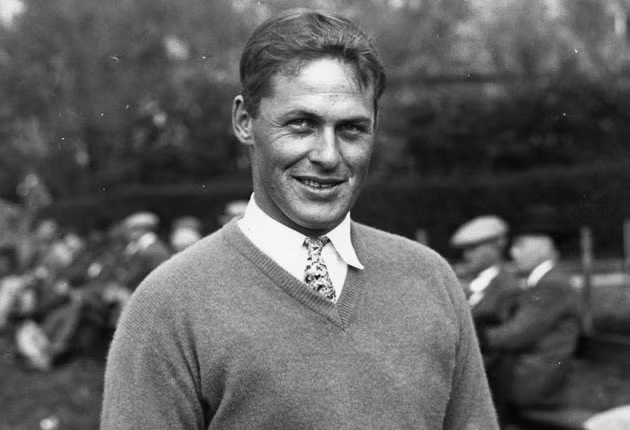
How did Bobby Jones build this fortune?
The answer unfolds through the career, earnings, deals and assets behind the headline estimate.
Before the fame
The background and early turning points that shaped Bobby Jones’s route to prominence.
Robert Tyre “Bobby” Jones Jr. was an American amateur golfer, born March 17, 1902, in Atlanta, Georgia, and widely regarded as one of the greatest players in the sport’s history. According to his Wikipedia biography, Jones is the only golfer to win the Grand Slam of golf’s four major championships in a single calendar year, a feat he achieved in 1930 before retiring from competitive golf at age 28 while still an amateur. He never turned professional, earning his living instead as a practicing lawyer, and later co-founded Augusta National Golf Club and the Masters Tournament. He died December 18, 1971, in Atlanta.
Because Jones was a lifelong amateur, he collected no tournament prize money, which sets this profile apart from most golfers covered on this site. His financial history instead has to be reconstructed from his law career, a handful of documented business deals, and property records, several of which are incomplete or disputed. Where a figure cannot be confirmed, that gap is stated directly rather than smoothed over.
Jones grew up in a comfortable Atlanta family and learned the game at East Lake Golf Club under professional Stewart Maiden. Per the New Georgia Encyclopedia, he was a prodigy, competing in his first U.S. Amateur Championship at 14 in 1916, and he paired that early talent with an unusually rigorous academic path, earning a degree in mechanical engineering from Georgia Tech and a degree in English literature from Harvard before later studying law at Emory University.
His playing career did not translate into major titles right away. From 1916 through 1922, Jones was recognized as one of the most talented amateurs in the country but was repeatedly unable to close out a national championship, a stretch golf historians often call his “seven lean years.”
The breakthrough years
The career decisions and defining moments that turned recognition into sustained earning power.
The breakthrough came at the 1923 U.S. Open at Inwood Country Club, where Jones won his first major title after years of falling short. As ESPN’s retrospective on his career recounts, Jones himself later described his early struggles bluntly, saying he had been “full of pie, ice cream and inexperience,” treating golf as little more than a game to beat someone rather than a discipline to master.
From 1923 to 1930, Jones won 13 major championships across the four events that defined the era’s majors, all while retaining his amateur status and refusing appearance fees or prize money. That sustained dominance, compiled without a professional income stream, is the foundation for everything else in this profile.

What the work can earn
Reported pay, contracts, royalties and performance income reveal how the fortune was funded.
Jones’s career peaked in 1930, when he became the only golfer ever to complete the Grand Slam, winning the British Amateur, the Open Championship, the U.S. Open and the U.S. Amateur all in the same calendar year. According to Britannica’s biography of Jones, he retired from competitive golf almost immediately afterward, at 28, choosing to walk away from the sport at the height of his powers rather than turn professional.
His total of 13 major championships stood as a record for more than 40 years and remains the statistical basis for his enduring commercial value, since nearly every income stream covered later in this profile traces back to the fame generated by that run.
Jones’s public standing rested as much on his conduct as on his results. He was widely known for calling penalties on himself, most famously during the 1925 U.S. Open, and reportedly dismissed praise for the gesture by comparing it to praising a man for not robbing a bank. That reputation for sportsmanship outlived him directly: the United States Golf Association’s Bob Jones Award, introduced in 1955 and first given to Francis Ouimet, remains the USGA’s highest honor and is presented annually to a golfer or golf figure who embodies the character Jones was known for.
Recognition of this kind is treated here as evidence of lasting cultural stature, not as a financial asset in its own right, since the award generates no income for Jones or his estate.

The business beyond the main career
Endorsements, ownership interests and investments can keep compounding long after the initial breakthrough.
Jones’s most significant personal endorsement was with A.G. Spalding & Bros., which he joined shortly after the 1930 Grand Slam to help design golf clubs. Early models carried his given name, Robert T. Jones Jr., before Spalding began stamping “Bobby Jones” onto club heads by the late 1930s. A PBS Antiques Roadshow appraisal of an authenticated Spalding Bobby Jones hickory-shafted set from around 1933 documents the arrangement, noting Spalding kept producing custom hickory-shafted clubs on special order for traditionalist buyers even as steel shafts became the industry standard.
No public record discloses the royalty terms of the Spalding relationship, so this profile treats it as a real and durable income source without assigning it a specific figure of its own.
After retiring from competition, Jones signed a motion picture contract with Warner Bros. in December 1930 to star in a series of golf instructional short films, “How I Play Golf” (1931) and its follow-up, “How to Break 90” (1933). Sources disagree sharply on what the deal was worth: a detailed account from Bright Wall/Dark Room’s history of the films cites figures ranging from roughly $101,000 to $250,000, with some estimates of total proceeds reaching $600,000 once exhibition payments are included, and notes that Jones routed the earnings into a trust fund for his children.
Decades after his death, the Jones family also licensed his name commercially. A 2004 agreement covered by Golf Business News granted rights to manufacture and market golf clubs, bags and apparel under the Bobby Jones brand. That licensing income belongs to his estate and heirs rather than to Jones personally, so it is noted here for context and excluded from the net worth estimate below.

Notable luxury item
A reported property or major asset offers a tangible glimpse of the wealth behind the public estimate.
Jones’s family home, built in 1929 in the Tuxedo Park section of Atlanta’s Buckhead neighborhood, was reportedly a gift from the city after his 1930 Grand Slam, and it was in the home’s library, according to a Robb Report feature on the property, that Jones and Clifford Roberts are said to have first worked out the concept for what became the Masters. The house last came on the market in 2025 for just under $9.8 million, a present-day listing price that reflects current Atlanta real estate values rather than Jones’s own historical net worth.
No probate record or estate valuation from 1971 is publicly available, so beyond that one documented residence, this profile does not assign a specific value to Jones’s broader property holdings and treats them as real but unquantifiable.
Bobby Jones’s estimated net worth
Public estimates vary because private contracts, investments, taxes and liabilities are not fully disclosed.
How this estimate is calculated
This estimate reflects Jones’s position at the time of his death in 1971, not a present-day inflation adjustment, because the underlying income streams are historical and cannot be meaningfully converted into current dollars without speculation. The floor is built from his decades-long Atlanta law practice, a steady but never publicly quantified income; the Warner Bros. film contract, credibly documented at somewhere between roughly $100,000 and $250,000 in early 1930s dollars; and the multi-decade Spalding equipment relationship, real but undisclosed in its exact terms. The Tuxedo Park home is treated as a known but non-liquid asset, and the posthumous Bobby Jones brand licensing and Emory scholarship trusts are excluded entirely, since neither reflects money Jones held personally during his lifetime.
Secondary celebrity finance sites vary on the figure, with Celebrity Net Worth citing an estimate around $5 million. That source is treated here only as a secondary, directional data point, since it does not cite primary estate or probate records, rather than as the basis for this estimate.
Jones’s philanthropic legacy is largely posthumous and family-directed. The Robert T. Jones Jr. Scholarship, established in 1976 by friends and family, funds a fully paid exchange year between Emory University and the University of St Andrews for graduates who demonstrate the character, integrity and citizenship Jones was known for, along with related fellowships at Emory and Georgia Tech.
Because the scholarship is funded by trusts set up after Jones’s death rather than drawn from his personal lifetime wealth, it is treated here as part of his public legacy rather than as a deduction from, or addition to, the net worth estimate.
Jones’s own record carries no major personal scandal. The lasting public scrutiny attaches instead to Augusta National Golf Club, which he co-founded with Clifford Roberts in the early 1930s. Per Wikipedia’s history of the club, Augusta National barred Black membership for decades, admitting its first Black member only in 1990, and did not admit women until 2012. Roberts himself was quoted saying that as long as he was alive, the golfers would be white and the caddies would be black.
The same account notes that Jones became largely inactive in the club’s governance after World War II because of the neurological illness that eventually confined him to a wheelchair, so this profile treats him as a co-founder operating within the exclusionary norms of the club’s founding era, rather than as the architect of its later-era policies.