
 How Much Are They Worth?
Celebrity fortunes, explained
How Much Are They Worth?
Celebrity fortunes, explained







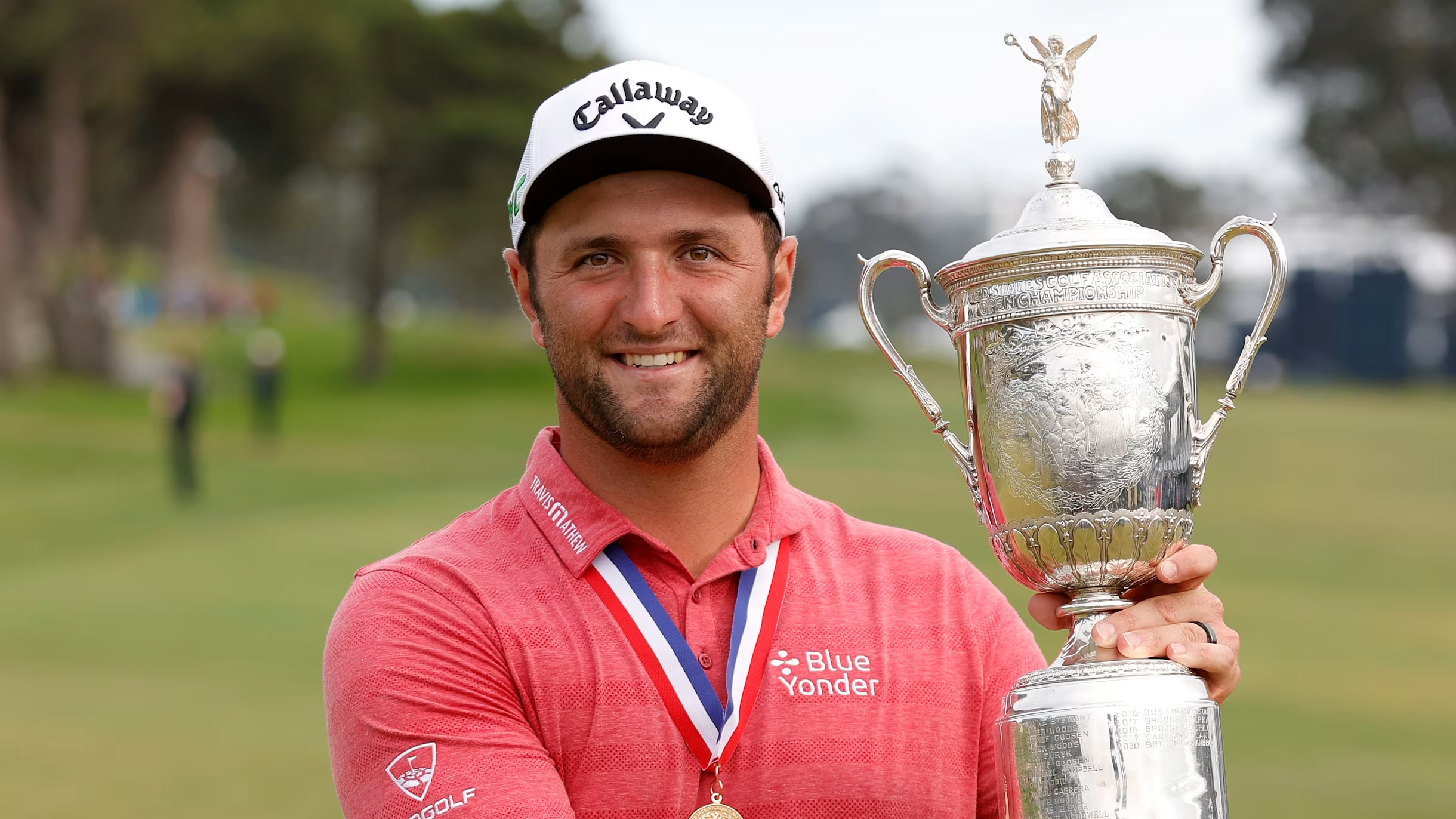
How did Hollis Stacy build this fortune?
The answer unfolds through the career, earnings, deals and assets behind the headline estimate.
Before the fame
The background and early turning points that shaped Hollis Stacy’s route to prominence.
Hollis Stacy was born on March 16, 1954, in Savannah, Georgia, the fourth of ten children in a large, athletic household — three brothers and six sisters. Her father was a scholarship athlete at Clemson University who lettered in football, basketball, and track before serving in World War II under General Patton. Her mother was an accomplished athlete in her own right, excelling at basketball and competitive dancing, and later served on United States Golf Association (USGA) committees, including work that helped establish uniform standards for junior competitors.
Stacy discovered golf at age ten and found in it a source of solitude amid a big, busy household. She practiced regularly at Savannah Golf Club, sometimes playing as many as 45 holes in a single summer day, and the club’s small, old-style push-up greens forced her to develop the sharp short game that would define her professional career. Her mother taught her a rhythmic waltz — “The Blue Danube” — to help her keep an even swing tempo, a trick Stacy used throughout her competitive career. Her younger sister, Martha Stacy, also became a USGA champion, winning the U.S. Mid-Amateur in 2006.
Stacy’s rise through the junior ranks was rapid. After a first-round loss at the 1967 U.S. Girls’ Junior and a playoff defeat in 1968, she broke through in 1969 at Brookhaven Country Club, then won again in 1970 at the Apawamis Club in New York, and completed an unmatched three-peat in 1971 at Augusta Country Club, edging Amy Alcott in a playoff after both players shot three-under 70. No other golfer has won the U.S. Girls’ Junior three consecutive times. In 1970 she added the North and South Women’s Amateur title at Pinehurst.
Her amateur success earned her a spot on the victorious 1972 U.S. Curtis Cup team at Western Gailes, Scotland, where she roomed with teammate Laura Baugh and contributed a crucial half-point to the American win. Stacy attended Rollins College in Winter Park, Florida, on a golf scholarship for about eighteen months before turning professional and joining the LPGA Tour in 1974.
The breakthrough years
The career decisions and defining moments that turned recognition into sustained earning power.
Stacy won her first LPGA Tour event in 1977, and it came with a major championship attached: the U.S. Women’s Open at Hazeltine National, where she closed with rounds of 75-74 to finish at 292 and beat Nancy Lopez by two strokes. She defended the title in 1978, shooting 289 to win by one stroke over JoAnne Carner and Sally Little — back-to-back U.S. Women’s Open titles. In 1983 she won the Peter Jackson Classic (the tournament later known as the du Maurier Classic, one of the LPGA’s recognized majors of that period) by two strokes at 11-under. She won her third U.S. Women’s Open in 1984 at Salem Country Club, edging Rosie Jones by a stroke — placing her among a small group of players in tour history with three or more Women’s Open titles.
Across her career Stacy won 18 LPGA Tour titles (six of them in playoffs), plus additional victories on the LPGA of Japan Tour and, later, the senior Legends Tour — 21 professional wins in total. From 1977 to 1983 alone she recorded 82 top-10 finishes; over her full LPGA career she posted 99 top-10s and 206 top-25 finishes. Her last LPGA Tour win came in 1991, and she wound down full-time competition around 2000. She joined the Women’s Senior Golf Tour (now the Legends Tour) and won the 2001 Shopko Great Lakes Classic. In 2012, Stacy was inducted into the World Golf Hall of Fame in the veterans category, cementing her place among the sport’s all-time greats. In 2024 the Robert Trent Jones Society honored her with its Legacy Award for lifetime contributions to golf.

What the work can earn
Reported pay, contracts, royalties and performance income reveal how the fortune was funded.
Detailed year-by-year prize money for Stacy’s playing career is not preserved in an easily verifiable public archive the way modern LPGA earnings are, and this article does not invent specific annual figures. What is clear from the record is the scale of the era she played in: LPGA purses in the late 1970s and 1980s were a fraction of today’s. The 1977 U.S. Women’s Open, for example, carried a total purse in the range of roughly $100,000, with the winner’s share around $17,000 — figures that look small next to a modern major purse of several million dollars. Stacy’s biggest paydays, by nature of her four major titles, would have come in 1977, 1978, 1983, and 1984, but a reliable, sourced year-by-year breakdown for those seasons is not publicly available.
Stacy’s income as a professional golfer came from LPGA Tour prize money rather than the appearance-fee or franchise-style contracts common in other sports. LPGA.com’s official statistics list her career earnings at $2.2 million across her competitive tenure on tour (1974 into the 2000s), built from 18 tour victories, 99 top-10 finishes, and 206 top-25 finishes. That figure reflects gross prize money won in competition, not take-home income after taxes, travel, coaching, and other expenses of a touring professional. Her later Legends Tour prize money, including her 2001 Shopko Great Lakes Classic win, is not separately broken out in public records.

The business beyond the main career
Endorsements, ownership interests and investments can keep compounding long after the initial breakthrough.
Like most leading players of her generation, Stacy carried equipment endorsements rather than the broad consumer-brand portfolios common among today’s top golfers. Wilson Sporting Goods produced a signature “Wilson Hollis Stacy” line of women’s golf clubs during her playing career, evidence of an equipment endorsement relationship typical for a multiple-major champion of that era. Specific contract values for that or any other sponsorship were not publicly disclosed at the time and have not surfaced since, so no dollar figures can be responsibly attached to them here.
After stepping back from full-time competition, Stacy moved into golf course design consulting, drawing on what she has described as a career-long appreciation for the work of golf course architects. She co-designed Blackhawk Golf Club in Pflugerville, Texas, alongside architect Charles Howard; the course opened in 1990. She has also served on the advisory board of EC4 Technologies, a security-credentials company, lending her name and golf-industry standing rather than running the business day to day.
Beyond course-design consulting and the EC4 Technologies advisory role, no other business ventures, franchises, or investment holdings for Stacy are documented in public sources. She has also stayed active in golf philanthropy, notably raising funds for Project Angel Heart, a Denver nonprofit that delivers meals to people with life-threatening illnesses, and volunteering with the USGA.

Notable luxury item
A reported property or major asset offers a tangible glimpse of the wealth behind the public estimate.
Golf and USGA profiles place Stacy’s residence in Denver, Colorado, in recent years. No specific property records, purchase prices, or additional real estate holdings for her are publicly documented, and this article does not speculate on address-level detail or asset values that cannot be verified. Beyond her home base, there is no public record of major assets such as a private jet, yacht, or notable vehicle collection associated with her.
Hollis Stacy’s estimated net worth
Public estimates vary because private contracts, investments, taxes and liabilities are not fully disclosed.
How this estimate is calculated
This is a broad estimate range, and deliberately so. The only hard financial figure attached to Stacy’s career is LPGA.com’s official tally of $2.2 million in career prize money won between 1974 and the early 2000s. That is gross competition earnings, not net worth — it does not account for taxes, travel, coaching and caddie costs, and other expenses that a touring professional carries over nearly three decades, nor does it capture whatever she has earned since from golf course design consulting, the EC4 Technologies advisory role, an era-typical equipment endorsement with Wilson, and Legends Tour play from 2001 onward, none of which come with disclosed dollar figures.
Several general celebrity-net-worth aggregator sites publish figures for Stacy that fall roughly within a $100,000 to $5 million band, but it is worth being direct about how thin that sourcing is: Stacy does not appear to have a dedicated, sourced profile on Celebrity Net Worth, the most commonly cited aggregator in this space, and the smaller sites that do publish a number for her do not show their work. Given that her documented, verifiable income is the $2.2 million gross prize-money figure, plus modest and unquantified consulting and endorsement income, and given there is no public record of a business windfall, a large real estate portfolio, or other major asset accumulation, this article’s estimate leans toward the lower-to-middle portion of that public range rather than its upper end. Readers should treat this as an informed estimate, not a confirmed figure — Stacy’s career predates the kind of detailed digital financial record-keeping available for today’s athletes, and no authoritative source publishes a precise net worth for her.
| Year | Milestone |
|---|---|
| 1954 | Born in Savannah, Georgia |
| 1969-1971 | Wins three consecutive U.S. Girls’ Junior titles, a record that still stands alone |
| 1972 | Member of the victorious U.S. Curtis Cup team |
| 1974 | Turns professional and joins the LPGA Tour |
| 1977 | First LPGA Tour win and first major title, U.S. Women’s Open at Hazeltine National |
| 1978 | Second consecutive U.S. Women’s Open title |
| 1983 | Wins the Peter Jackson Classic (du Maurier Classic era), her fourth major |
| 1984 | Third U.S. Women’s Open title, at Salem Country Club |
| 1990 | Co-designs Blackhawk Golf Club in Pflugerville, Texas |
| 1991 | Final LPGA Tour win, her 18th |
| 2001 | Joins the Women’s Senior Golf Tour (now Legends Tour); wins the Shopko Great Lakes Classic |
| 2012 | Inducted into the World Golf Hall of Fame, veterans category |
| 2024 | Receives the Robert Trent Jones Society Legacy Award |
| 1974-2000s (cumulative) | Official LPGA career earnings reach $2.2 million in gross prize money — not a net worth figure |
Stacy’s career sits alongside a group of LPGA Hall of Famers from the 1970s and 1980s — players such as JoAnne Carner, Amy Alcott, Sally Little, Nancy Lopez, and Judy Rankin — who built their reputations, and their earnings, in an era of far smaller tour purses than today’s LPGA. None of these contemporaries has a widely sourced, disclosed net worth either; like Stacy, most of their public wealth estimates online are unsourced guesses rather than figures backed by financial disclosures.
The clearest way to size Stacy’s earnings in context is generational rather than dollar-for-dollar: a four-time major champion playing today, with 18 wins and three U.S. Women’s Open titles, would be competing for purses many multiples the size of those available in the late 1970s and 1980s. Modern LPGA stars such as Lydia Ko or Nelly Korda can out-earn an entire 1970s-80s Hall of Fame career in a single strong season, which is a function of how much the tour’s prize money has grown rather than any difference in playing achievement.
Sources and references
- Wikipedia — Hollis Stacy
- World Golf Hall of Fame — Hollis Stacy
- LPGA.com — Hollis Stacy, Career Overview & Stats
- LPGA.com — Hollis Stacy, Bio
- USGA — Hollis Stacy, History’s Quiet Champion
- Golf Digest — Hollis Stacy’s Junior Hat Trick Recalled
- FORE the Good of the Game — Hollis Stacy, Part 1: The Early Years
- FORE the Good of the Game — Hollis Stacy, Part 2: Winning Back-to-Back Women’s U.S. Opens
- Club + Resort Business — Former LPGA Star Honored by Robert Trent Jones Society
- Encyclopedia.com — Stacy, Hollis (1954-)
- AmateurGolf.com — Hollis Stacy Inducted into World Golf Hall of Fame
- Legends Tour — Hollis Stacy Player Profile