How did Muhammad Ali build this fortune?
The answer unfolds through the career, earnings, deals and assets behind the headline estimate.
Before the fame
The background and early turning points that shaped Muhammad Ali’s route to prominence.
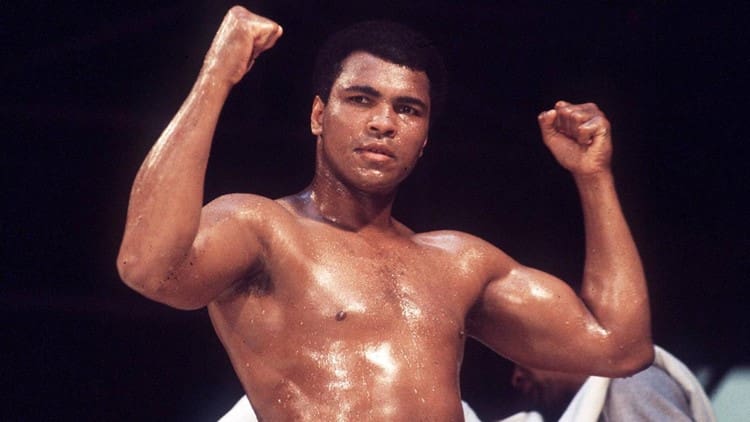
Muhammad Ali was born Cassius Marcellus Clay Jr. in Louisville in 1942 and became far more than a heavyweight champion. The International Olympic Committee’s athlete biography records his 1960 light-heavyweight gold medal, while his public opposition to the Vietnam War and later humanitarian work made his identity commercially durable well beyond boxing. Because Ali died in 2016, this article estimates the value associated with his estate and retained legacy interests, not cash personally available to a living athlete.
Ali learned to box after reporting a stolen bicycle to Louisville police officer and boxing coach Joe Martin. He won national Golden Gloves titles before Rome and turned professional immediately after the Olympics. The Britannica chronology places his early rise, name change and religious affiliation in context. Early purses were small beside his later events, but his unbeaten run and gift for promotion created negotiating power before athletes routinely controlled television economics.
The breakthrough years
The career decisions and defining moments that turned recognition into sustained earning power.
The financial breakthrough came when the 22-year-old stopped Sonny Liston in February 1964. History’s account of the title upset documents the moment Clay became heavyweight champion. His subsequent announcement that he was Muhammad Ali transformed a sports star into a globally recognized public figure. That recognition did not instantly become retained wealth: boxing management, taxes, family support and Ali’s forced absence from the ring all interrupted his prime earning years.
What the work can earn
Reported pay, contracts, royalties and performance income reveal how the fortune was funded.
Ali regained the championship, fought Joe Frazier three times, defeated George Foreman in the 1974 “Rumble in the Jungle,” and retired with a 56-5 record. The ESPN retrospective traces the athletic and cultural sequence rather than reducing it to one fight. Contemporary summaries put his lifetime fight purses in the tens of millions, but those were gross receipts earned under 1960s and 1970s arrangements, not a modern promoter-owned PPV fortune.
During Ali’s life the main inflows were fight purses, appearances, publishing, memorabilia and later licensing. The clearest transaction arrived in 2006, when he sold 80% of GOAT LLC—the vehicle holding important name and likeness rights—to CKX for a reported $50 million. The contemporaneous report confirms both the price and Ali’s retained 20% interest. The calculation treats the $50 million as a historical gross realization, not as money still intact two decades later.
The business beyond the main career
Endorsements, ownership interests and investments can keep compounding long after the initial breakthrough.
Before that sale, the Ali brand was reportedly generating about $7 million annually through partners including Adidas and Electronic Arts. The Guardian’s examination of Ali’s finances also reports that a later rights transaction produced roughly $2 million for the family while the 20% holding continued. Film, books, stamps and licensed apparel broadened the revenue base, although a licensing company’s sales are not the same thing as distributions to Ali’s estate.
Authentic Brands Group eventually became the manager of Ali’s commercial rights, placing the estate within a larger licensing platform. The most defensible business asset is therefore the retained minority interest created by the 2006 transaction, together with contractual royalty participation. Ali did not leave a transparent operating-company empire. His family, the Ali Center and commercial rights managers perform different roles, and charitable or museum activity is not counted as personal property merely because it carries his name.
Notable luxury item
A reported property or major asset offers a tangible glimpse of the wealth behind the public estimate.
Reports after Ali’s death referred to homes in Arizona and Kentucky, memorabilia and an estate divided among his widow and children. ANSA’s 2016 estate report also noted a Pennsylvania-area home sale for $690,000 and annual image-rights income. Probate details, trusts, liabilities and later distributions are not public enough to reconstruct. Those unknowns require a conservative present value rather than simply carrying forward every historical dollar.
Muhammad Ali’s estimated net worth
Public estimates vary because private contracts, investments, taxes and liabilities are not fully disclosed.
How this estimate is calculated
HMW starts with the documented $50 million 2006 realization, applies deductions for federal and state tax, advisers and a decade of family and medical expenditure, and separately recognizes only a restrained value for the retained 20% licensing participation. Property and memorabilia receive modest allowances because no complete inventory is public. Post-2016 royalties are partly offset by estate administration and beneficiary distributions. This produces an estate-and-legacy estimate grounded in the rights transaction rather than Ali’s profession or fame.
Ali remained valuable after Parkinson’s disease ended his career. He lit the Olympic cauldron in Atlanta in 1996, appeared in documentaries and became an international humanitarian symbol. The Muhammad Ali Center’s account of his six core principles explains why commercial users still associate the name with conviction and social purpose. That distinction matters: a recognized likeness can generate licensing revenue, but only the estate’s retained ownership share can be counted as an asset.
The $50 million rights sale and 20% retained stake are stronger evidence than online celebrity-wealth lists. However, the purchase price included intellectual-property expectations, the proceeds were subject to tax and living costs, and the minority interest may have been diluted, transferred or distributed. Estate value also changes after death. This profile therefore uses the transaction as an anchor, cross-checks posthumous licensing activity and refuses to treat Ali’s cultural importance as an additional numerical asset.

JavaScript is off, so all sections are displayed together.