 How Much Are They Worth?
Celebrity fortunes, explained







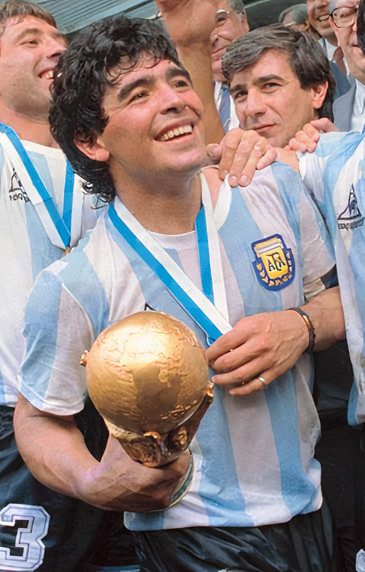
How did Diego Maradona build this fortune?
The answer unfolds through the career, earnings, deals and assets behind the headline estimate.
Diego Maradona before the fame
The background and early turning points that shaped Diego Maradona’s route to prominence.
Diego Armando Maradona was born on 30 October 1960 in Lanús, on the southern edge of Buenos Aires, and grew up in Villa Fiorito, a shanty settlement without running water. He was the fifth of eight children; his father worked in a bone-meal factory.
A neighbour gave him his first football at three. By eight he was playing for Los Cebollitas, the Argentinos Juniors youth side, which won 136 consecutive matches with him in it, and he performed ball tricks at half-time in senior games for coins from the crowd.
He made his first-division debut for Argentinos Juniors on 20 October 1976, ten days before his sixteenth birthday, and scored 115 goals in 167 games for them. Al Jazeera records the sequence that followed: Argentinos Juniors to 1981, then Boca Juniors, Barcelona, Napoli, Sevilla, Newell’s Old Boys and Boca again.
His single season at Boca in 1981-82 brought the Argentine championship and made him the country’s most valuable export. Left out of the 1978 World Cup squad at seventeen, he went to the 1982 tournament in Spain instead.
Diego Maradona’s breakthrough years
The career decisions and defining moments that turned recognition into sustained earning power.
Barcelona signed him from Boca in July 1982. UPI reported the deal at $9.2 million across six years, then a world record, and reported two years later that Barcelona sold him to Napoli for $7.5 million in three instalments. Both sums passed between clubs and formed no part of his income — a distinction that matters especially here, because those two fees are the figures most often quoted about his money.
What he actually earned was a salary, and at Napoli it was the largest in the game. Our estimate, built from his standing as the best-paid player in the world across most of those seven seasons, is $14 million to $19 million in Napoli wages alone, in money of the day — roughly $1.5 million a year at the start rising past $3 million by the end. That is 1980s money: multiply by about 2.7 for United States inflation since 1988 to compare it with today.
Across the whole playing career, from Argentinos Juniors in 1976 to Boca in 1997, our working puts wages and endorsements at $30 million to $43 million in money of the day, or roughly $80 million to $115 million in 2026 terms.

What Diego Maradona’s work can earn
Reported pay, contracts, royalties and performance income reveal how the fortune was funded.
Napoli had never won the Italian championship before he arrived. They won it in 1987 and 1990, took the Coppa Italia in 1987 and the UEFA Cup in 1989, and the turnaround is one of the most complete any single signing has produced.
The 1986 World Cup in Mexico is the tournament by which he is measured. He captained Argentina to a 3-2 win over West Germany in the final and scored, in the quarter-final against England, both the handled goal and the run past half the England side generally held to be the finest individual goal the competition has produced. He led Argentina to the final again in 1990, and in 2001 FIFA named him and Pelé the sport’s two greatest players.
Naples renamed its stadium after him. In Buenos Aires there is a church founded in his name; in Naples, murals of him are a fixture of the Quartieri Spagnoli.
Both Napoli and Boca Juniors retired his shirt number, and his name still carries commercial weight thirty years after he last played — which is why his image rights became the most valuable thing in his estate.
Diego Maradona’s business beyond the main career
Endorsements, ownership interests and investments can keep compounding long after the initial breakthrough.
He endorsed sportswear from his teens and through the 1980s fronted Italian and Argentine consumer campaigns, at a time when the sums involved were a fraction of today’s. Our estimate puts his endorsement income at $5 million to $10 million in money of the day across the playing years, or about $15 million to $27 million in 2026 terms.
The later deals were worth more in real money, because his name outlasted his legs. The Konami licence, the apparel arrangements and appearance fees ran from the late 1990s until 2020, and we put them at $10 million to $20 million in total.
His post-playing income came from coaching and from his own name. He managed Argentina from 2008 to the 2010 World Cup quarter-final, then clubs in the United Arab Emirates, Mexico and Argentina, finishing at Gimnasia y Esgrima de La Plata. The Rio Times catalogued the rest: a licensing contract with the video-game publisher Konami, sportswear and watch deals, football schools in China, a Cuban hotel investment and a 0.5 per cent shareholding in the Belarusian club Dinamo Brest.
The trademarks themselves — Maradona, El 10, Diegol, La Mano de Dios, El Diego — were transferred in 2015 to Sattvica SA, a company chaired by his lawyer, with the heirs taking royalty percentages on their use. On our working that royalty stream is worth $10 million to $30 million capitalised, making it the largest single component of the estate.
Diego Maradona’s notable luxury item
A reported property or major asset offers a tangible glimpse of the wealth behind the public estimate.
The estate inventory reported by The Rio Times lists a house on the corner of Segurola and Habana in Buenos Aires, a second flat, an apartment in the Puerto Madero district, four cars in Argentina, and a Rolls-Royce Ghost valued at €300,000 and a BMW i8 at €145,000 left behind in Dubai.
Also listed are a watch collection, a diamond ring valued at €300,000 and a FIFA platinum ball. Together the tangible assets come to roughly $3 million to $6 million, a small fraction of what the football paid him.
Diego Maradona’s estimated net worth
Public estimates vary because private contracts, investments, taxes and liabilities are not fully disclosed.
How this estimate is calculated
Start by removing what was never his. The $9.2 million Barcelona paid Boca in 1982 and the $7.5 million Napoli paid Barcelona in 1984, both reported by UPI at the time, were club-to-club payments. The €39 million Italian tax claim is a liability rather than an asset, and it was contested rather than settled.
What is left is earnings and assets. Our estimate of playing income, in money of the day, is $14 million to $19 million from Napoli, $3 million to $4 million from Barcelona, about $1 million from Argentinos Juniors and Boca before 1982, $6 million to $9 million from Sevilla, Newell’s and the Boca return, and $5 million to $10 million of endorsements: $30 million to $43 million, or about $80 million to $115 million once converted at 2.7 times for inflation since 1988. Coaching and later licensing from 1997 to 2020 add $20 million to $35 million.
Almost none of that survived as capital. Four decades of spending, two long tax fights, family settlements and long periods out of work consumed it, and the assets catalogued in the estate are the test of what remained: $3 million to $6 million of property, cars, watches and collectibles, plus the trademark royalty stream we value at $10 million to $30 million capitalised, plus residual contract income. The working supports a range of $12 million to $38 million. What we publish is the middle of that range. It treats the brand as an asset of the estate rather than of Sattvica, which is what the litigation has been about, and that is the assumption most likely to move the number.
Confidence: Partly documented — individual estate assets carry reported values and the transfer and tax figures are on the record, but his salaries and the value of the trademarks are our own working.
He gave money away throughout his life, directly and without a foundation behind it: to Villa Fiorito, to hospitals in Naples and Buenos Aires, and to individuals who approached him. He played a long series of charity matches, including a 2001 testimonial at La Bombonera whose proceeds went to children’s causes.
His public image was never managed. He was outspoken about politics, about football’s governing bodies and about his own failings, and the affection he commanded was of a kind no publicist could have built.
He was suspended for fifteen months in 1991 after a positive drugs test in Italy and sent home from the 1994 World Cup after another, and he spoke openly about addiction for the rest of his life.
The longest financial dispute of his career was with the Italian revenue. The Local reported a claim against him of €39 million in unpaid tax relating to his Napoli years from 1984 to 1991, over which his assets in Italy were pursued for more than a decade; a Naples court suspended the collection proceedings in July 2014 on evidence that no violation had occurred, while the collection agency maintained the debt had not been cancelled. He always argued the liability was the club’s. Maradona died on 25 November 2020, aged 60. His estate has since been the subject of protracted litigation between five recognised heirs, with further claims over the handling of the trademarks.