 How Much Are They Worth?
Celebrity fortunes, explained
How Much Are They Worth?
Celebrity fortunes, explained



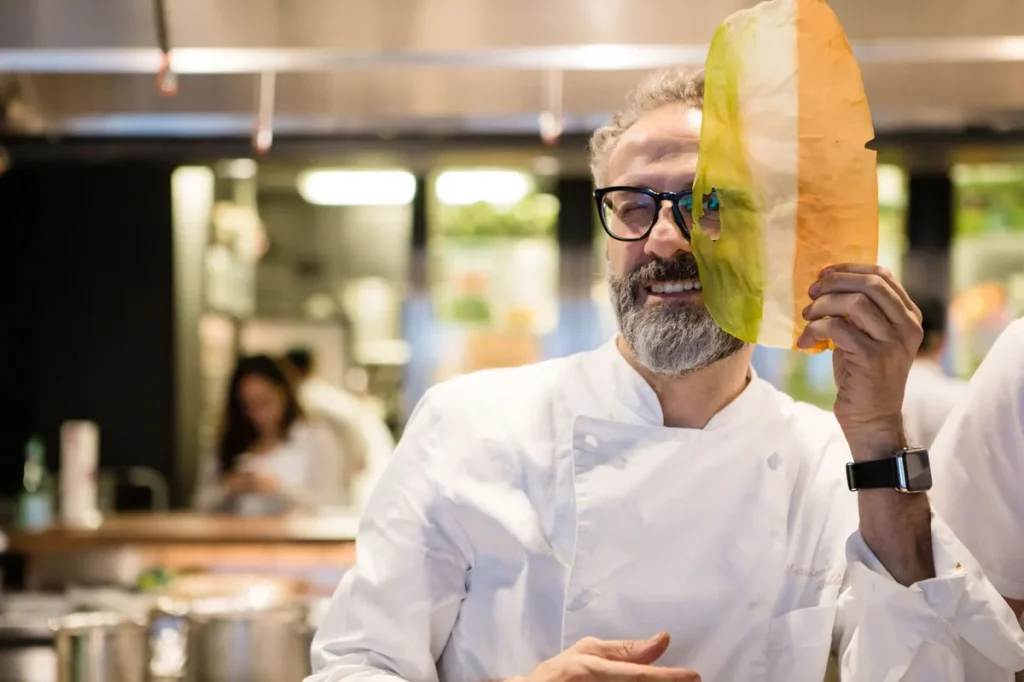
How did Massimo Bottura build this fortune?
The answer unfolds through the career, earnings, deals and assets behind the headline estimate.
Before the fame
The background and early turning points that shaped Massimo Bottura’s route to prominence.
Massimo Bottura is an Italian chef and restaurateur born in Modena, the Emilia-Romagna city that became the centre of his international hospitality group. His wealth is not best assessed from television fame or Michelin stars alone. It rests on almost four decades of restaurant ownership, luxury partnerships, hospitality, books and branded food products, shared in important cases with his wife and business partner Lara Gilmore. Osteria Francescana’s official Bottura biography describes his Modena upbringing and the creative philosophy behind the flagship restaurant.
Bottura abandoned law studies and in 1986 bought Trattoria del Campazzo outside Modena. There he learned regional cooking from rezdora Lidia Cristoni and classical French technique from Georges Coigny. A formative period with Alain Ducasse at Le Louis XV in Monte Carlo followed in 1994. Euro-Toques Italia’s Massimo Bottura profile gives that specific sequence, including Campazzo, Coigny and Ducasse. These years were commercially modest compared with his later work, but they established the technique and ownership experience behind the future restaurant group.
The breakthrough years
The career decisions and defining moments that turned recognition into sustained earning power.
In 1995 Bottura opened Osteria Francescana in Modena. Its reinterpretation of Italian culinary memory was initially controversial locally, then became internationally celebrated. The restaurant ultimately gained three Michelin stars in 2012 and topped The World’s 50 Best Restaurants list in both 2016 and 2018. The World’s 50 Best Restaurants’ Osteria Francescana profile documents its standing. Those honours increased reservation demand and the Bottura brand, but a ranking has no direct balance-sheet value unless it translates into profitable operations.

What the work can earn
Reported pay, contracts, royalties and performance income reveal how the fortune was funded.
Bottura expanded carefully rather than turning Osteria Francescana into a mass-market chain. Franceschetta58 opened as a more casual Modena restaurant, Casa Maria Luigia added rooms and dining in the countryside, and Al Gatto Verde extended that property’s food offering. Ferrari’s official profile of Bottura at Ristorante Cavallino lists the wider Francescana Family, including Cavallino, Gucci Osteria locations and international Torno Subito restaurants. The portfolio shows multiple revenue centres, although ownership structures and partner shares differ from venue to venue.
The principal income sources are restaurant profit, management and licensing arrangements, the Casa Maria Luigia hospitality business, product sales, books and paid media or appearances. Osteria Francescana’s limited seats and premium menu create high revenue per guest, yet fine dining also carries heavy labour, ingredient, property and service costs. Michelin’s Osteria Francescana guide listing confirms the flagship’s three-star status and operating proposition. HMW does not multiply menu price by perpetual full occupancy; closures, staffing, taxes and partner interests make that shortcut unreliable.
The business beyond the main career
Endorsements, ownership interests and investments can keep compounding long after the initial breakthrough.
The Gucci Osteria project placed Bottura’s culinary name inside a global luxury brand. The first restaurant opened in Florence’s Gucci Garden, followed by international locations with local chefs interpreting the concept. Gucci’s official Osteria overview identifies the venues and their connection to Bottura. Ferrari’s revival of Cavallino adds another prestigious partnership. Such collaborations can generate consultancy, management or equity income, but the contracts are private, so this estimate does not assume Bottura owns the host brands or all restaurant turnover.
Casa Maria Luigia may be the most tangible expansion of Bottura and Gilmore’s owned hospitality assets. The restored country estate combines accommodation, art, motor culture and several dining experiences. The family also markets Villa Manodori balsamic vinegar and olive oil, extending the brand into products that can be sold without adding restaurant seats. Villa Manodori’s official company history connects the products with the Francescana Family and records the 2019 opening of Casa Maria Luigia. Exact group revenue, margins, debt and ownership percentages are not publicly filed in a consolidated form.
Notable luxury item
A reported property or major asset offers a tangible glimpse of the wealth behind the public estimate.
The business controls or operates valuable restaurant concepts, intellectual property and hospitality premises, but valuation is difficult. A celebrated restaurant may depend heavily on its founder and therefore deserve a lower multiple than a scalable chain. Casa Maria Luigia includes substantial real estate, yet acquisition costs, renovation financing and co-ownership are unknown. The model also distinguishes Bottura’s personal assets from Food for Soul, the nonprofit he founded with Gilmore. Food for Soul’s official organisation profile describes its social mission; charitable resources are not included in his personal wealth.
Massimo Bottura’s estimated net worth
Public estimates vary because private contracts, investments, taxes and liabilities are not fully disclosed.
How this estimate is calculated
The calculation models attributable cumulative earnings from Osteria Francescana and other restaurant operations at $18 million to $30 million after operating expenses but before personal taxes over the mature career. Hospitality, product, publishing, consulting and media activity contribute a further estimated $10 million to $18 million on the same basis. After allowing 40% to 50% for personal tax, reinvestment and consumption, approximately $15 million to $29 million may have been retained. The model then adds $12 million to $24 million for Bottura’s attributable equity in hospitality property, restaurant businesses, intellectual property, products, cash and investments, while reserving $5 million to $10 million for debt, partner shares, illiquidity and overlap. The resulting range is approximately $22 million to $43 million, supporting a midpoint that reflects genuine ownership without valuing the Francescana name like a global franchise.
Books, documentaries, speaking appearances and television have made Bottura recognisable far beyond the small dining room in Via Stella. His episode of Netflix’s Chef’s Table introduced the stories behind dishes such as “Oops! I Dropped the Lemon Tart” to a mass audience. He has published Never Trust a Skinny Italian Chef, Bread Is Gold and, with Gilmore, Slow Food, Fast Cars. Phaidon’s page for his first major book confirms the publisher and scope. Royalties contribute income but are unlikely to rival hospitality operations.
There is strong evidence for the breadth and durability of Bottura’s operating platform but very little public financial disclosure. The United Nations Office for Partnerships profile identifies him as chef-patron, entrepreneur, Food for Soul founder and UNEP goodwill ambassador, and lists the major venues. It does not publish profit or equity. Consequently, this estimate uses restaurant-industry ranges, discounts partnership venues, excludes charitable assets and avoids treating Michelin stars, honorary degrees or social influence as cash.