 How Much Are They Worth?
Celebrity fortunes, explained
How Much Are They Worth?
Celebrity fortunes, explained










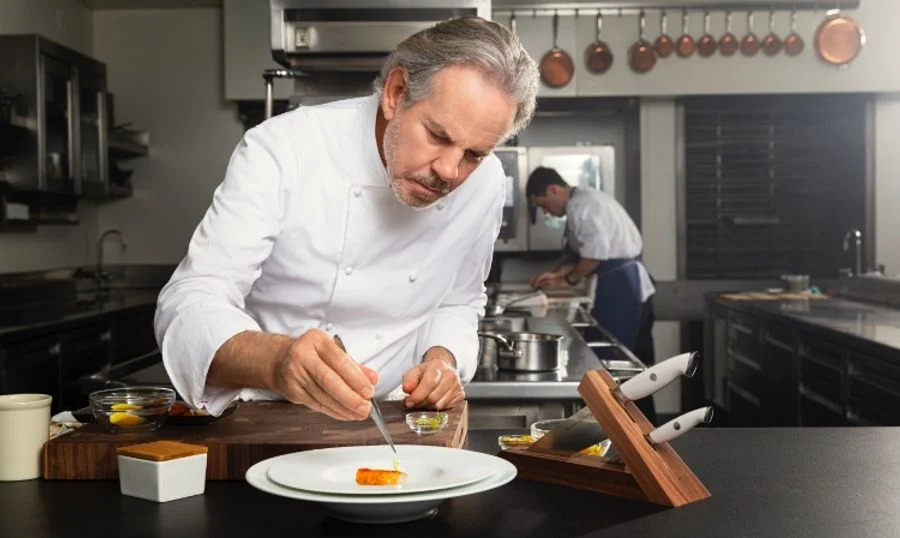
How did Thomas Keller build this fortune?
The answer unfolds through the career, earnings, deals and assets behind the headline estimate.
Before the fame
The background and early turning points that shaped Thomas Keller’s route to prominence.
Thomas Keller is an American chef, restaurateur and cookbook author best known for The French Laundry in California and Per Se in New York. His financial position is rooted in ownership and decades of restaurant operations rather than celebrity endorsements alone. The Thomas Keller Restaurant Group spans fine dining, bistros, bakeries and more casual concepts, giving the founder several income streams with very different margins. The Thomas Keller Restaurant Group’s official biography records his restaurant portfolio and notes that more than 1.5 million copies of his cookbooks are in print.
Keller’s first restaurant job was as a dishwasher in a Palm Beach operation managed by his mother. He progressed through American kitchens, worked for Roland Henin and travelled to France in 1983 to apprentice in Michelin-starred restaurants. Back in New York, he opened Rakel in 1986, but the venture did not provide lasting security. The American Academy of Achievement’s Thomas Keller interview and biography details the dishwasher-to-chef progression and the setbacks preceding Napa Valley. That chronology matters because his later wealth arose after years of financial risk rather than from early television fame.
The breakthrough years
The career decisions and defining moments that turned recognition into sustained earning power.
In 1994 Keller purchased The French Laundry, a stone building in Yountville, after raising money from investors. Its daily changing tasting menus and exacting service turned the small property into an international destination. The French Laundry’s official restaurant history confirms Keller’s 1994 purchase and the building’s origins. The acquisition created both an operating business and potential real-estate value, although outside investment and subsequent financing mean HMW cannot treat the entire property value as unencumbered personal equity.

What the work can earn
Reported pay, contracts, royalties and performance income reveal how the fortune was funded.
Keller opened Per Se at Columbus Circle in 2004 and became the first American-born chef to hold simultaneous three-star Michelin ratings at two restaurants. Bouchon, Bouchon Bakery, Ad Hoc and The Surf Club Restaurant broadened the group beyond two flagships. Per Se’s official history identifies it as Keller’s New York interpretation of The French Laundry and describes its nine-course menus. The Michelin achievements support demand and brand value, but restaurant stars and menu prices are not counted directly as Keller’s cash.
Keller’s core income comes from restaurant profits, salary or management compensation, bakery and retail operations, books, licensing and special projects. The French Laundry and Per Se charge premium prices but also employ unusually large kitchen and service teams, purchase expensive ingredients and maintain extensive wine inventories. The Michelin Guide’s French Laundry listing verifies the current three-star operation. HMW models profit margins rather than multiplying every seat by the menu price and calling the result personal income.

The business beyond the main career
Endorsements, ownership interests and investments can keep compounding long after the initial breakthrough.
Consumer products and partnerships provide income without requiring Keller personally to serve another table. The group has sold cookware, knives, pantry products and branded gifts, while Keller has advised films including Ratatouille. His longstanding relationship with luxury suppliers also reinforces the group’s position. Disney’s official Ratatouille page confirms the production associated with Keller’s widely reported culinary consulting, though the fee was not disclosed. These activities are included as supplemental earnings, not assigned blockbuster-film economics.
The restaurant group includes The French Laundry, Per Se, Bouchon Bistro, Bouchon Bakery, Ad Hoc + Addendum and The Surf Club Restaurant. Some are closely held operating businesses; others occupy hotel or landlord premises under agreements whose economics are private. Thomas Keller Restaurant Group’s restaurant directory provides the current portfolio used in this assessment. Keller’s name and systems constitute valuable intellectual property, but the estimate discounts founder dependence and does not value the group like a scalable fast-food franchisor.

Notable luxury item
A reported property or major asset offers a tangible glimpse of the wealth behind the public estimate.
The French Laundry property is a tangible asset, and the group also invested in a major kitchen renovation and owns or leases other sites. The exact division between Keller, investors and corporate entities is not public. Wine inventories, equipment and working capital have value but are required to operate the restaurants. Personal real estate, securities, mortgages, partner stakes and succession arrangements are likewise undisclosed. The National Park Service record for The French Laundry building confirms the historic Yountville property, but historic designation does not supply a current appraisal.
Thomas Keller’s estimated net worth
Public estimates vary because private contracts, investments, taxes and liabilities are not fully disclosed.
How this estimate is calculated
The model assigns $35 million to $55 million of cumulative pre-tax compensation and distributions to Keller from three decades of mature restaurant operations, with another $8 million to $15 million from books, consulting, products and appearances. After tax, reinvestment and personal spending, approximately $20 million to $36 million may remain as accumulated cash and investments. His attributable interests in restaurants, intellectual property, inventory and real estate are valued at $35 million to $60 million, then reduced by $10 million to $20 million for investor shares, debt, illiquidity and overlap. The resulting range is approximately $45 million to $75 million. Its midpoint recognises ownership of elite businesses while respecting the thin margins and capital demands of fine dining.
Keller has achieved substantial influence without building his career primarily around weekly television. His cookbooks—among them The French Laundry Cookbook, Bouchon, Ad Hoc at Home and The French Laundry, Per Se—extend his methods into home kitchens and professional training. The Artisan Books author page for Thomas Keller identifies his published catalogue. More than 1.5 million books in print indicates meaningful royalties, though author splits, advances and production costs remain private and are valued below the restaurant group.
The evidence strongly supports a valuable, durable hospitality group, but private-company finances prevent a precise appraisal. The restaurant portfolio and book circulation are verifiable; ownership percentages, debt and annual distributions are not. The James Beard Foundation’s Thomas Keller award record corroborates his long professional standing. Awards are used only as evidence that premium demand persisted. Failed or closed concepts are excluded from current enterprise value, and gross restaurant sales are reduced for operating costs before attribution.