
 How Much Are They Worth?
Celebrity fortunes, explained
How Much Are They Worth?
Celebrity fortunes, explained

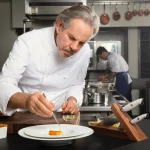




Victor Arguinzoniz (Spain) – Asador Etxebarri
Net worth revealed after 6 slides
Begin the countdown ↓How did Victor Arguinzoniz build this fortune?
The answer unfolds through the career, earnings, deals and assets behind the headline estimate.
Victor Arguinzoniz before the fame
The background and early turning points that shaped Victor Arguinzoniz (Spain) – Asador Etxebarri’s route to prominence.
Victor “Bittor” Arguinzoniz was born in 1960 in the small village of Axpe, in the Atxondo valley of Spain’s Basque Country, and has lived in that valley his entire life, according to Fine Dining Lovers. He grew up in a household without electricity or gas, where his mother and grandmothers cooked over an open hearth both to prepare food and to heat the house, per The World’s 50 Best Restaurants. Before turning to food, he worked for years in a flag factory rather than in a professional kitchen, according to Wikipedia. In 1989, he bought a derelict, roughly 200-year-old stone building on Axpe’s main square jointly with his father and uncle, a purchase that would become the foundation of his career, per The World’s 50 Best Restaurants.
Arguinzoniz has no formal culinary training of any kind; he never attended cooking school and never staged in a professional restaurant kitchen, according to The Best Chef Awards. He opened Asador Etxebarri in the building he had bought with his family on April 27, 1990, and taught himself to cook through trial and error and an intuitive read of how fire behaves, per Fine Dining Lovers. Rather than buying commercial kitchen equipment, he built his own grilling apparatus from scratch, and he spent years learning how different woods, including holm oak and vine cuttings, change heat, smoke and timing, according to the same source. He kept an obsessive daily schedule from the start, arriving early to light the braziers and staying late to prepare dough for the following day, per Fine Dining Lovers.
Victor Arguinzoniz’s breakthrough years
The career decisions and defining moments that turned recognition into sustained earning power.
Arguinzoniz’s breakthrough came from the tools he invented rather than any single dish. He developed latticed pans shaped like colanders, metal mesh grates fine enough to hold caviar without it falling through, a pot with a hole in the center for cooking seafood over wood steam, and a laser-perforated pan for grilling risotto that lets smoke in while keeping liquid inside, according to Wikipedia and The World’s 50 Best Restaurants. That equipment let him put ingredients over an open fire that grill cooks had never attempted, including caviar cooked at low temperature until it just begins to sweat oil, baby eels, octopus, and smoked milk ice cream made by letting buckets of milk absorb wood smoke in an oven, per the same sources. The restaurant earned its Michelin star and began drawing chefs and critics from across the world to a village that Wikipedia describes as sitting immediately next to where Arguinzoniz himself was born.

What Victor Arguinzoniz’s work can earn
Reported pay, contracts, royalties and performance income reveal how the fortune was funded.
Asador Etxebarri has appeared on The World’s 50 Best Restaurants list in almost every year since 2009, missing only once, and currently ranks No. 2 in the world and Best Restaurant in Europe for 2025, according to The World’s 50 Best Restaurants. Its ranking has climbed over the years, from 6th in 2015 to 3rd in both 2019 and 2021, 4th in 2023, and 2nd in both 2024 and 2025, per Wikipedia. The restaurant holds one Michelin star in the 2025 Spain guide, according to The Best Chef Awards. In 2016, Spain’s Real Academia de Gastronomia named Arguinzoniz winner of the National Gastronomy Award for Best Head Chef, per Gastronomia.com. In October 2021, his peers voted him the winner of the Estrella Damm Chefs’ Choice Award, the only peer-voted prize in The World’s 50 Best program, at a ceremony in Antwerp, according to The World’s 50 Best Restaurants.
Arguinzoniz is recognized by international publications, including Restaurant magazine and The New York Times, for reinventing barbecue-driven cuisine while preserving Basque regional tradition, according to Reporter Gourmet, which also describes him as a reserved, media-shy figure who prefers working behind the scenes to the celebrity-chef circuit that surrounds many of his peers. His profile grew substantially after Anthony Bourdain featured Asador Etxebarri, which helped push the restaurant to what one review calls “legendary status,” per Steak Society. He is also a reference point for other elite chefs: Lennox Hastie, the Australian chef profiled in Netflix’s “Chef’s Table: BBQ,” trained under Arguinzoniz at Etxebarri before opening his own Sydney restaurant, Firedoor, an experience that became a focal point of Hastie’s episode, according to Hospitality Magazine. His global reach is underscored by industry profile site Underseasoned, which ranks him among its list of the most influential figures in food for redefining grilling and live-fire cuisine worldwide.

Victor Arguinzoniz’s business beyond the main career
Endorsements, ownership interests and investments can keep compounding long after the initial breakthrough.
No reviewed source documents a conventional third-party brand endorsement or sponsorship deal, such as a cookware, appliance or drinks brand ambassadorship, of the kind common among television-facing chefs. Arguinzoniz’s public presence is built almost entirely around his own restaurant and technique rather than paid outside partnerships, consistent with his description in Fine Dining Lovers as someone who insists there is “no secret recipe,” only daily discipline. His highest-profile recognition, the 2021 Chefs’ Choice Award, was peer-voted by fellow chefs rather than commercially sponsored promotion, according to The World’s 50 Best Restaurants.
Unlike many chefs of his stature, Arguinzoniz has not built a restaurant group; Asador Etxebarri remains his only restaurant more than three decades after he opened it, and no reviewed source documents a second location, a consulting arm, or a spinoff concept bearing his name. His one clear venture outside the restaurant itself is a cookbook, “Etxebarri,” published in 2018 by Grub Street and written with journalists Juan Pablo Cardenal and Jon Sarabia, documenting his techniques and recipes for a wider audience, according to Amazon’s listing for the book. The restaurant’s wine program is run in partnership with sommelier Mohamed Benabdallah, formerly of Mugaritz, per Wikipedia, but that is an operating collaboration inside his single restaurant rather than a separate commercial venture.
Victor Arguinzoniz’s notable luxury item
A reported property or major asset offers a tangible glimpse of the wealth behind the public estimate.
Arguinzoniz’s clearest documented asset is the roughly 200-year-old stone building on Axpe’s main square that he bought jointly with his father and uncle in 1989 and later converted into Asador Etxebarri, according to The World’s 50 Best Restaurants. He reportedly still lives about one kilometer from the restaurant in the same valley where he was born, per Fine Dining Lovers, but no reviewed source discloses the value of that home or identifies any other real estate, vehicles, or investment holdings in his name. There is no reliable public record of a broader property portfolio, which is consistent with a chef who has kept his business to a single, family-owned rural building for his entire career.
Victor Arguinzoniz’s estimated net worth
Public estimates vary because private contracts, investments, taxes and liabilities are not fully disclosed.
How this estimate is calculated
Victor Arguinzoniz does not publicly disclose his personal finances, and no celebrity net worth aggregator or financial outlet reviewed for this profile carries a well-sourced published estimate for him, so this figure is built from indirect business signals rather than adjusted from an existing public number. Those signals include sole ownership, with his father and uncle, of the roughly 200-year-old building that houses his restaurant, purchased outright in 1989 and therefore free of the debt load a newer venue would carry after 35 years of operation; a tasting menu priced around 175 euros that has run at effective full capacity for years given a 90-day booking window that sells out within seconds; a restaurant that has held a top-six global ranking on The World’s 50 Best list for roughly a decade and reached No. 2 in 2024 and 2025; and modest supplementary income from the 2018 book “Etxebarri.” Working against a higher figure is the fact that, unlike many peers profiled on this site, he has never opened a second restaurant, licensed his name to other properties, signed a brand endorsement deal, or expanded beyond one small, remote dining room with limited covers per service. Weighed together, these signals point to a comfortably wealthy chef-owner whose fortune rests entirely on one long-running, high-demand, debt-free restaurant rather than a diversified hospitality business.
No dedicated charitable foundation or major publicized philanthropic campaign under Arguinzoniz’s name turned up among the sources reviewed for this profile. His public image instead centers on humility and workmanlike dedication despite his global fame; The World’s 50 Best Restaurants describes him as someone who, even after decades of top rankings, “remains humble,” per The World’s 50 Best Restaurants. Accepting the Chefs’ Choice Award in 2021, he told the audience it was “a great compliment and honour, a surprise that made me very happy,” and urged younger cooks to “fight for their dreams and work hard to achieve them,” according to The World’s 50 Best Restaurants. He has summed up his own philosophy more plainly elsewhere: “It’s just a daily job, nothing more,” per Fine Dining Lovers.
Arguinzoniz has not been linked to any personal scandal, and the scrutiny directed at his restaurant centers on how hard it is for ordinary diners to get a table rather than on his conduct. Reservations for Asador Etxebarri open exactly 90 days in advance and routinely sell out within seconds, with a required deposit of 100 euros per person credited toward the final bill, according to Steak Society, whose reviewer called securing a table “painfully hard” even after repeated attempts over several months. The roughly 175 euro tasting menu, before wine, has drawn some criticism as steep for a rural grill restaurant, though reviewers generally conclude the multi-hour, multi-course experience justifies the price, per the same source. The underlying tension is less about the food than about scarcity: demand for one of the world’s most acclaimed restaurants has for years vastly outstripped the seats available in a converted stable in a village of about one hundred people.