 How Much Are They Worth?
Celebrity fortunes, explained









How did Prince William build this fortune?
The answer unfolds through the career, earnings, deals and assets behind the headline estimate.
Prince William before the fame
The background and early turning points that shaped Prince William’s route to prominence.
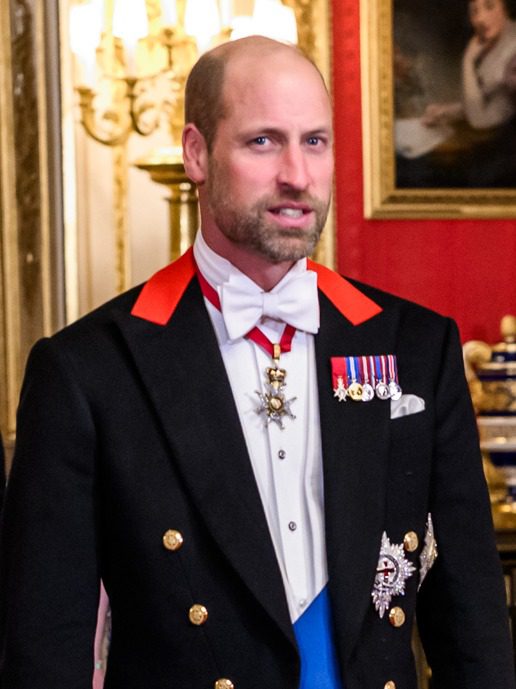
William Arthur Philip Louis was born on 21 June 1982 at St Mary’s Hospital, Paddington (The Royal Family). On the accession of his father in September 2022 he became Duke of Cornwall and Prince of Wales, and with the title came the Duchy of Cornwall – an estate created by Edward III in 1337 to fund the heir to the throne (CNN Business).
He has no salary and no net worth in the sense the phrase is usually used. What he has is the annual distributable surplus of a landed estate he holds for the office rather than for himself, and that surplus is published every year.
He was educated at Eton and read geography at the University of St Andrews, then took a commission and trained as a military pilot, serving as a search-and-rescue helicopter pilot with the Royal Air Force (The Royal Family).
After leaving the RAF he flew for the East Anglian Air Ambulance, a civilian charity, between 2015 and 2017, and donated his salary from that role to the charity.
Prince William’s breakthrough years
The career decisions and defining moments that turned recognition into sustained earning power.
The financial turning point was not a job but an inheritance of office. Before September 2022 his household costs were met from his father’s Duchy income; afterwards he became the beneficiary of the estate itself.
What the office has actually paid him. Two conventional wages come first, because they are the only ones he has drawn. A Flight Lieutenant’s pay puts his seven years of military service between 2006 and 2013 at roughly £30,000 to £40,000 a year, or about £250,000 in total – our estimate, built from published service pay scales rather than from his pay slip. The air ambulance job paid a comparable civilian pilot’s salary of around £40,000 a year for two years, and he gave every penny of it away. Then comes the Duchy. For the year ended 31 March 2025 its distributable surplus was £22.9 million, after £23.6 million the year before and £24 million in 2022-23 (Duchy of Cornwall Integrated Impact Report 2025). Counting a part year to March 2023 at roughly seven twelfths, he has received on the order of £60 million gross in three years as Duke of Cornwall – out of which come the offices, the staff, the official travel, the charitable work and income tax on the remainder.
Reporting at the time of his accession to the title described a billion-pound inheritance (CNN Business), which is accurate about the estate’s capital value and misleading about his position, for reasons the sections below set out.

What Prince William’s work can earn
Reported pay, contracts, royalties and performance income reveal how the fortune was funded.
His principal independent project is the Earthshot Prize, launched in 2020 as a fifty million pound commitment to fund environmental solutions over a decade, awarding five one million pound prizes a year (The Earthshot Prize, The Royal Foundation).
The second is Homewards, a five-year programme run through the Royal Foundation across several UK locations to demonstrate that homelessness can be ended locally (The Royal Family). Both are financed by the Foundation’s donors and partners rather than from the Duchy surplus.
Recognition, for an heir, is constitutional rather than earned, and it does not convert into money. The Earthshot ceremonies have been staged in London, Boston and Singapore and carried on international broadcast (The Royal Family) – the kind of profile a commercial figure would monetise and he cannot. Fame that would be worth a fortune to anybody else is, in his case, unsellable, and that is the single most important thing to grasp about a royal net worth figure.

Prince William’s business beyond the main career
Endorsements, ownership interests and investments can keep compounding long after the initial breakthrough.
Nil, by constitutional convention. No working member of the royal family endorses a commercial product, and no brand has ever paid for his name. That is structural rather than a gap in the research, and it removes the stream that would otherwise be the largest private earner for someone with his recognition.
He has none, and is not permitted any in the ordinary sense: no company, no investment vehicle, no commercial directorship in his name.
The Duchy itself is a commercial operation – roughly 130,000 acres across more than twenty counties in England and Wales, with a substantial commercial property portfolio – but he is its beneficiary, not its owner. Its capital cannot be spent, and he cannot sell it (CNN Business).

Prince William’s notable luxury item
A reported property or major asset offers a tangible glimpse of the wealth behind the public estimate.
This is where most published figures go wrong. The Duchy’s land and buildings are held for the office of the Duke of Cornwall in perpetuity; counting them as his personal assets overstates his position substantially.
His own housing is rented. The family lived at Adelaide Cottage in the Windsor Castle grounds from August 2022 and moved to Forest Lodge in Windsor Great Park in 2025, a move Kensington Palace confirmed would be funded privately with market rent paid (ITV News, CNN). Highgrove belongs to the Duchy and Anmer Hall sits on the King’s private Sandringham estate, so neither is his either.
Prince William’s estimated net worth
Public estimates vary because private contracts, investments, taxes and liabilities are not fully disclosed.
How this estimate is calculated
What it is not. Two separate pots are routinely confused with his income. The Sovereign Grant funds the monarch’s official duties, not the heir’s: it was set at £132.1 million for 2025-26, calculated as a percentage of Crown Estate profits, and that percentage was cut from 25 to 12 per cent after the 2023 Royal Trustees’ review (Institute for Government). The Crown Estate is a third thing again, returning about £1.1 billion in net profit in 2024, and that money goes to the Treasury.
What he owns personally. Three things, and the Duchy is not one of them. Diana’s estate was held in trust for her two sons and William took his share on turning 30 in 2012, reported at about $14 million (ABC News); Harry’s equivalent share had been put at roughly £10 million (CNN). The Queen Mother left about £14 million to her great-grandsons in 2002, with Harry understood to have received the larger part (TIME). And the houses are rented or borrowed.
The arithmetic. Start with the Diana trust at about £10 million when it came to him in 2012; ordinary growth over the fourteen years since puts it in the mid teens of millions. Add a share of the Queen Mother’s bequest, on the smaller side, at £1 million to £4 million. Then add whatever has been retained from three years of Duchy surplus: household costs and tax come out of that £60 million first, so we assume he keeps a tenth to a fifth once both are met, which is £6 million to £12 million. That gives roughly £20 million to £35 million. The assumption doing the most work is that retention rate, and it is ours rather than anyone’s disclosure.
Kept apart. The Duchy’s £1 billion of land and property sits outside that total and always should. He holds it in trust for the next duke, cannot sell it and cannot keep its capital, which is why the headline figures putting him above a billion are measuring a medieval endowment and calling it a man.
Confidence: Indicative — our estimate, built from the Diana trust he received in 2012, a share of the Queen Mother’s bequest and three years of retained Duchy surplus; the Duchy’s own £1 billion is held in trust and is not counted.
Think you know Prince William? Take the quiz: Easy · Medium · Legendary
The air ambulance salary he gave away in 2015-17 remains the clearest example of personal rather than institutional giving.
He has also pushed change inside the estate that funds him. After criticism of the Duchy’s commercial arrangements, it announced in 2025 that some grassroots tenants would have their rents waived altogether and that local charities would see reductions of up to half, with the estate’s new secretary describing it as an era of deep change (ITV News).
The Duchy’s tenancies drew sustained scrutiny after reporting in late 2024 revealed the scale of its rental agreements with public bodies – the armed forces, the NHS, state schools, and a long-running lease of Dartmoor Prison to the Ministry of Justice. The 2025 response changed the treatment of charitable and grassroots tenants but left the commercial relationships with government departments untouched (ITV News).
Separately, how the estate is taxed and reported is a live constitutional question: the Duchy pays no corporation tax, and the Duke pays income tax on what he receives after official expenditure (Institute for Government).