 How Much Are They Worth?
Celebrity fortunes, explained
How Much Are They Worth?
Celebrity fortunes, explained



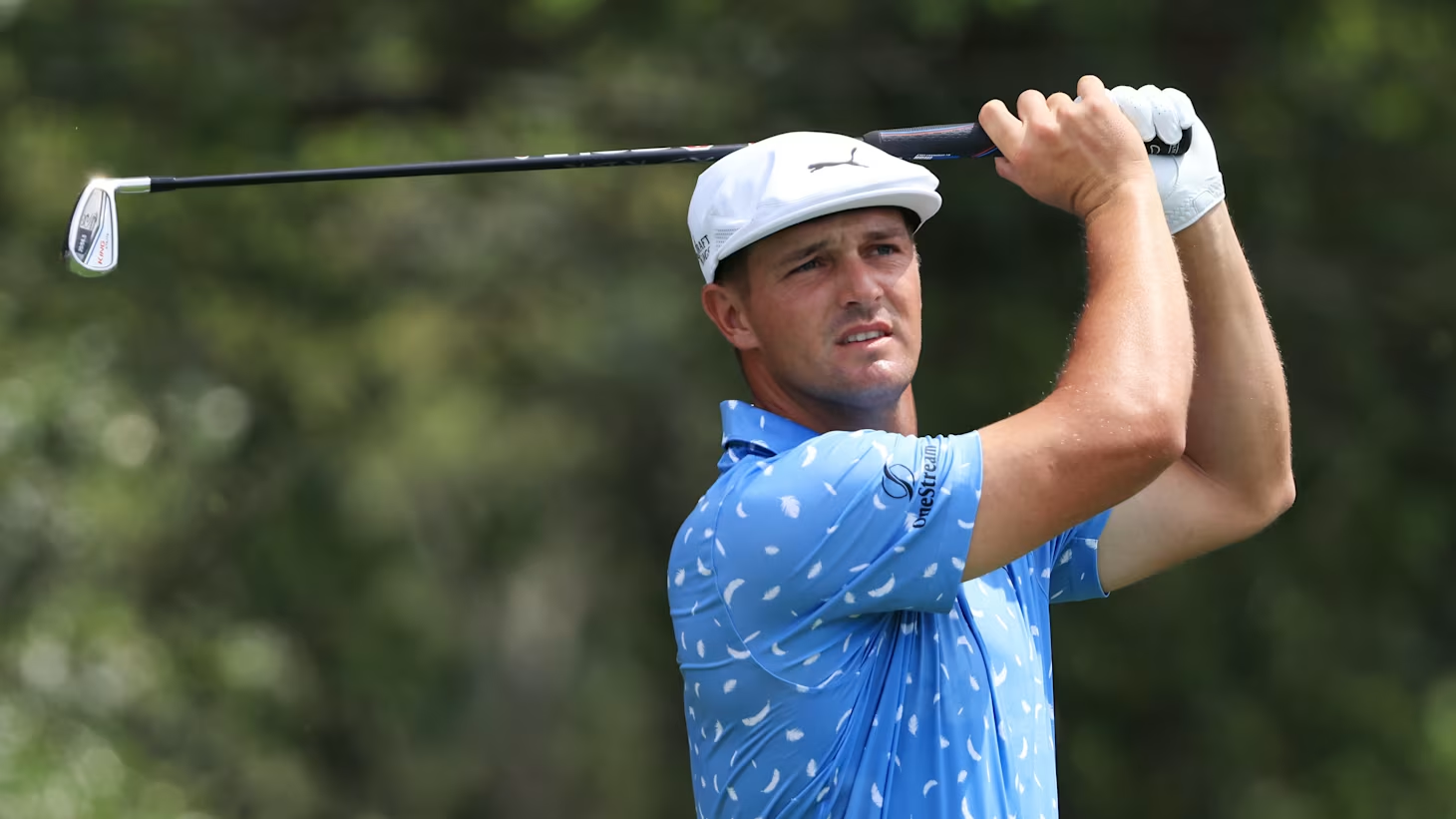

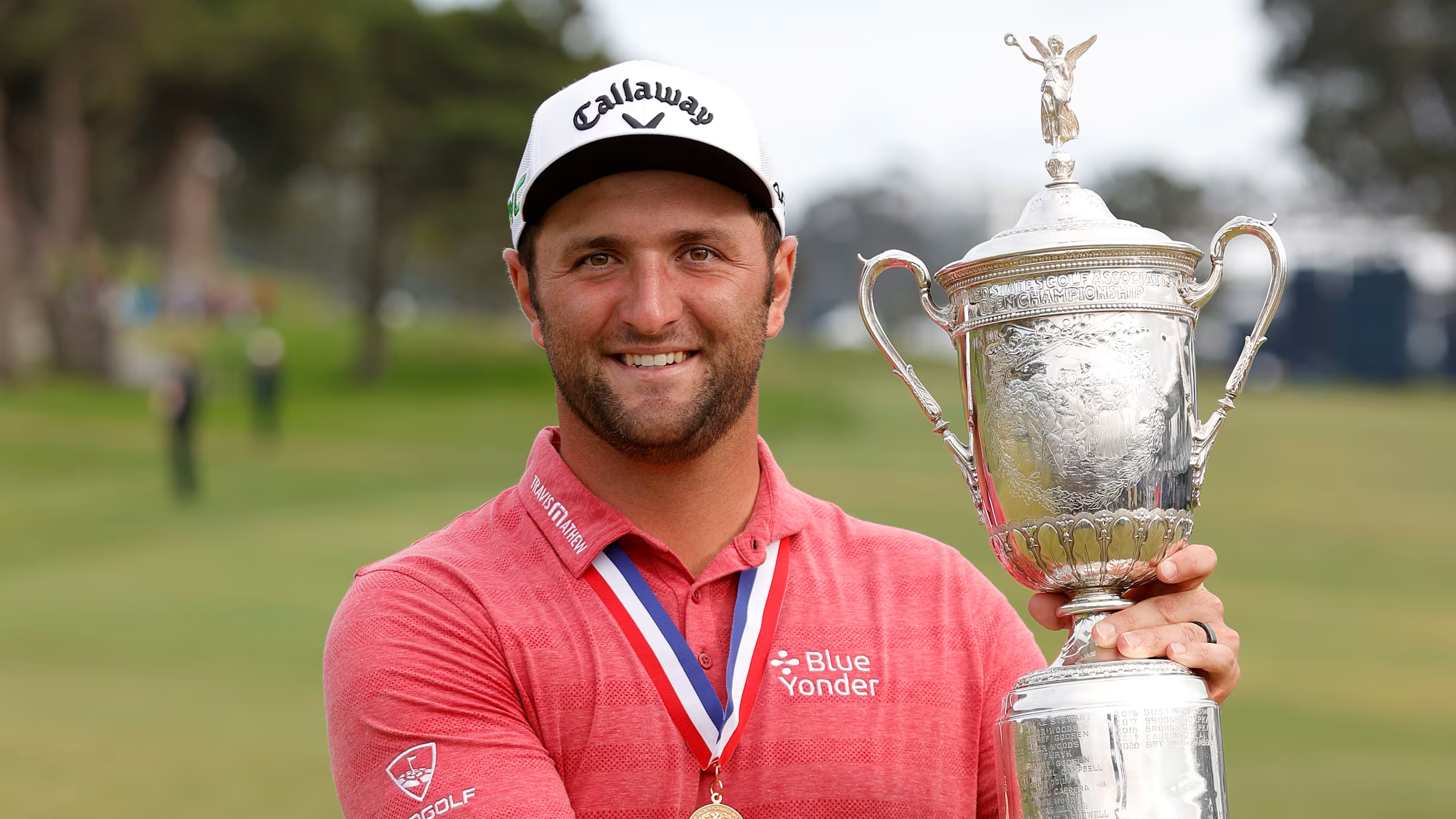
How did Tom Watson build this fortune?
The answer unfolds through the career, earnings, deals and assets behind the headline estimate.
Before the fame
The background and early turning points that shaped Tom Watson’s route to prominence.
Thomas Sturges Watson was born on September 4, 1949, in Kansas City, Missouri, the son of an insurance broker who introduced him to golf as a boy. He grew up playing at the Kansas City Country Club under longtime instructor Stan Thirsk, then attended Stanford University on an academic track, graduating in 1971 with a degree in psychology while competing for the Stanford golf team. (Wikipedia)
Watson turned professional in 1971 and joined the PGA Tour that same year, though his early results were modest and he was initially better known for talent than for closing out tournaments under pressure. That changed in 1975, when he won his first PGA Tour event at the Western Open and then, in his very first appearance in the Open Championship, beat Jack Newton in a playoff at Carnoustie to claim the first of his eight major titles. (PGA Tour)
The breakthrough years
The career decisions and defining moments that turned recognition into sustained earning power.
Watson’s defining moment came at the 1977 Open Championship at Turnberry, where he and Jack Nicklaus pulled clear of the rest of the field and traded birdies over the final two rounds in what became known as the “Duel in the Sun.” Watson closed with a five under par 65 to beat Nicklaus by a single stroke, a result that established him as Nicklaus’s chief rival and the dominant player of the sport for the next several years. (The Open)

What the work can earn
Reported pay, contracts, royalties and performance income reveal how the fortune was funded.
Over his career Watson won eight major championships: five Open Championships (1975, 1977, 1980, 1982 and 1983), two Masters titles (1977 and 1981) and the 1982 U.S. Open at Pebble Beach, sealed by a famous chip in from the rough on the 17th hole. He was PGA Tour Player of the Year six times, led the PGA Tour money list five times, finished with 39 PGA Tour victories, and was inducted into the World Golf Hall of Fame in 1988. (Kansas Golf Foundation)
Watson’s profile extended well past his playing peak in the 1970s and 1980s. In 2009, at age 59 and less than a year after hip replacement surgery, he came within a par putt of winning a sixth Open Championship at Turnberry before losing a four hole playoff to Stewart Cink, a performance widely regarded as one of the most remarkable near misses in major championship history. He also played on four Ryder Cup teams and was chosen to captain the United States side in 1993 and again in 2014. (The Open)

The business beyond the main career
Endorsements, ownership interests and investments can keep compounding long after the initial breakthrough.
For much of his playing career Watson was closely associated with Ram Golf, whose clubs he used through his dominant run in the late 1970s and early 1980s alongside contemporaries such as Gary Player and Raymond Floyd. In 2011 he joined the Rolex family of golf ambassadors, a relationship the watchmaker has maintained with him for well over a decade, and he has also carried associations with Titleist and Callaway equipment later in his career. (TomWatson.com)
After stepping back from full time competition, Watson built a second career in golf course architecture, working first alongside Robert Trent Jones Jr. and Sandy Tatum on the Links at Spanish Bay before founding Tom Watson Golf Course Design. His firm has designed or renovated more than a dozen courses on three continents, including the National Golf Club of Kansas City and the renovated Old Course at Ballybunion in Ireland. (American Society of Golf Course Architects)
Notable luxury item
A reported property or major asset offers a tangible glimpse of the wealth behind the public estimate.
Watson has never marketed himself as a real estate collector, and detailed public records of his personal holdings are limited. What is documented is that he has remained rooted in the Kansas City area throughout his adult life, living in the Overland Park-Stilwell area of the metro rather than relocating to golf-industry hubs such as Florida, a choice local profiles have tied directly to his deep, decades-long involvement with Kansas City civic and charitable life. (Kansas City Magazine)
Tom Watson’s estimated net worth
Public estimates vary because private contracts, investments, taxes and liabilities are not fully disclosed.
How this estimate is calculated
Watson’s wealth traces primarily to more than five decades of tournament earnings, from a PGA Tour career that generated well over 11 million dollars in official prize money through the peak of his playing days, supplemented by several million more won on the PGA Tour Champions after he turned 50. (Spotrac) That base has been built on over the decades by long-running endorsement income, fees from his golf course design business, speaking engagements and broadcast work. Public trackers such as Celebrity Net Worth, used here only as a secondary, supplementary source rather than a primary one, put his current net worth at around 25 million dollars, though other published estimates run somewhat higher given his combined tournament, design and endorsement income over a fifty-year career. (Celebrity Net Worth)
Watson has long been one of golf’s more visible philanthropic figures. He is the founder of Watson Links, a nonprofit mentoring program that pairs junior golfers aged 10 to 18 with trained adult volunteers for free rounds, which has grown from its Kansas City roots to 17 locations nationwide. (First Tee Greater Kansas City) He also co-founded the Bruce Edwards Foundation for ALS Research in 2005 after his longtime caddie was diagnosed with the disease, and in 1990 he resigned his membership at the Kansas City Country Club after the club’s board failed to approve the application of a prominent Jewish businessman, a stand that drew national attention and helped push the club to reverse course within days. (UPI)
Watson’s most public controversy came off the course, during his second stint as U.S. Ryder Cup captain at Gleneagles in 2014, when the American team lost badly and Phil Mickelson used the post-match press conference to openly criticize Watson’s captaincy and communication style in front of the media. The episode was unusual for how publicly a player broke with a losing captain, and Watson later wrote an open letter to his team accepting responsibility for the defeat, saying any mistakes made were his own. (Bleacher Report)