
 How Much Are They Worth?
Celebrity fortunes, explained
How Much Are They Worth?
Celebrity fortunes, explained

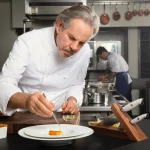



How did Mauro Colagreco build this fortune?
The answer unfolds through the career, earnings, deals and assets behind the headline estimate.
Mauro Colagreco before the fame
The background and early turning points that shaped Mauro Colagreco’s route to prominence.
Mauro Colagreco was born on October 5, 1976, in La Plata, Argentina, into a family shaped by both Argentine and Italian influences. He studied economics before committing to hospitality, training at the Gato Dumas culinary school in Buenos Aires. In 2001 he moved to France, a decisive step for a chef who would later become one of the most acclaimed figures in French gastronomy despite being born abroad. His cooking identity developed from migration, Mediterranean produce and an instinctive relationship with gardens rather than a single national tradition.
The principal dates in his journey are recorded on Mirazur’s official chef biography and UNESCO’s appointment profile.
After arriving in France, Colagreco trained in some of the country’s most demanding kitchens. He worked with Bernard Loiseau, then with Alain Passard at L’Arpège, Alain Ducasse at Hôtel Plaza Athénée and Guy Martin at Le Grand Véfour. The sequence gave him exposure to classical discipline, vegetable-led cuisine and luxury hotel operations. Instead of copying a mentor, he combined those lessons with the flavours and emotional references of Argentina, Italy and the French Riviera.
UNESCO lists the chefs under whom he worked in its exact biographical announcement, while Mirazur’s official timeline records his 2001 arrival.
Mauro Colagreco’s breakthrough years
The career decisions and defining moments that turned recognition into sustained earning power.
Colagreco opened Mirazur in Menton in 2006, overlooking the Mediterranean near the French-Italian border. The restaurant earned its first Michelin star within a year and its second in 2012. Its gardens and proximity to small producers became central to the food, with menus responding to the rhythms of fruit, vegetables, flowers and the sea. Colagreco’s breakthrough was not merely a star: it was establishing an independent restaurant and recognisable philosophy in a country where he had arrived as an outsider.
The opening and awards timeline appears on Mirazur’s chef page. The restaurant’s setting and garden-led approach are described on the official Mirazur homepage.

What Mauro Colagreco’s work can earn
Reported pay, contracts, royalties and performance income reveal how the fortune was funded.
In 2019 Mirazur received its third Michelin star and was ranked number one in The World’s 50 Best Restaurants. Colagreco became the first chef not born in France to receive three stars in the French guide and the first Latin American chef to lead the global 50 Best ranking. Mirazur subsequently earned a Michelin Green Star, Plastic Free certification and B Corp certification. Colagreco has also written books and developed a network of restaurants spanning multiple countries.
The 2019 double achievement is reported by La Nación; the sustainability milestones are listed on Mirazur’s official timeline.
France appointed Colagreco a Knight of Arts and Letters in 2012, a Knight of the National Order of Merit in 2017 and a Knight of the Legion of Honour in 2023. In 2022 UNESCO appointed him its first Goodwill Ambassador for Biodiversity who was a chef. He later became vice-president of Relais & Châteaux, giving him a platform to influence hundreds of hospitality properties rather than only guests at Mirazur.
His French honours are recorded by Mirazur’s French-language official biography. His UNESCO remit appears on the exact Goodwill Ambassador page.
Mauro Colagreco’s business beyond the main career
Endorsements, ownership interests and investments can keep compounding long after the initial breakthrough.
Colagreco’s strongest commercial partnerships sit within luxury hospitality and sustainability. Restaurants in hotels and resorts use his name and culinary systems to add prestige, while Relais & Châteaux and UNESCO amplify his biodiversity agenda. These relationships make his brand valuable beyond the Menton dining room, although contract values are private. His public work increasingly links fine dining with measurable environmental commitments rather than conventional consumer-product endorsement.
The UNESCO and Relais & Châteaux partnership, reaching a network of 580 properties and 800 restaurants, is detailed in the exact partnership announcement.
Mirazur is the flagship of a much larger enterprise led by Mauro and Julia Colagreco. The group operates or provides culinary direction to more than 30 dining establishments worldwide, using formats from fine dining to hotel restaurants and more accessible concepts. Partner venues allow international expansion without requiring the family to own every building. Revenue may include Mirazur profits, management fees, royalties, consulting and brand licensing, alongside books and appearances.
The scale of more than 30 establishments is stated on Mirazur’s official site, and Julia Colagreco’s role in directing Mirazur and the group is described on the official chef page.
Mauro Colagreco’s notable luxury item
A reported property or major asset offers a tangible glimpse of the wealth behind the public estimate.
Colagreco is identified as Mirazur’s owner and founder. The restaurant’s business assets include its globally recognised name, recipes, three-star reputation and gardens. Mirazur describes 12 acres of biodynamic and permaculture cultivation supporting its seed-to-plate system. The wider group also controls intellectual property attached to Colagreco-branded concepts. Public sources do not establish that he personally owns every hotel property housing one of his restaurants, nor do they disclose his private real estate or group debt.
The ownership, gardens and certifications are presented on Mirazur’s exact official homepage.
Mauro Colagreco’s estimated net worth
Public estimates vary because private contracts, investments, taxes and liabilities are not fully disclosed.
How this estimate is calculated
The estimate considers nearly two decades of ownership in a three-star flagship, Colagreco’s interest in a group linked to more than 30 establishments, hotel management and licensing agreements, publishing and international appearances. It applies significant value to the Mirazur brand and its sustained global recognition, while recognising high labour, garden, property and ingredient costs and the fact that partner-hotel revenue is not automatically personal income.
No public consolidated balance sheet reveals his ownership percentages, liabilities or individual contract fees. The calculation is therefore deliberately broad and does not value UNESCO work as commercial wealth. Its main anchors are the ownership and network claims on Mirazur’s official website, the group leadership described on the official biography and the documented luxury-hospitality network.
Colagreco uses his UNESCO role to advocate for biodiversity, regenerative agriculture, sustainable fishing, lower food waste and food education. At COP16 he promoted protection of the Amazon and responsible gastronomy. With Daniel Humm he co-organised a public dinner at Eleven Madison Park, and he has proposed “Seeds for the Future,” an educational programme intended to help children understand agricultural diversity and seasonal food.
His education plans and joint work with Humm are covered by UNESCO’s exact interview; his COP16 activity is documented on UNESCO’s sustainable-food page.
Colagreco has avoided major personal scandal, but the gap between sustainability language and luxury dining invites scrutiny. International restaurants, guest travel and elaborate tasting menus have environmental costs, while certifications require continuous proof rather than slogans. Mirazur’s response has included Plastic Free and B Corp certification, its gardens and work with local producers. The pandemic also forced Mirazur to rethink its service, illustrating the financial vulnerability of even a globally famous restaurant.
UNESCO examines how his sourcing operates in practice in its “gardener in a chef’s jacket” interview, while Mirazur lists the third-party certifications on its official site.