
 How Much Are They Worth?
Celebrity fortunes, explained









How did Elvis Presley build this fortune?
The answer unfolds through the career, earnings, deals and assets behind the headline estimate.
Elvis Presley before the fame
The background and early turning points that shaped Elvis Presley’s route to prominence.
Elvis Aaron Presley was born on 8 January 1935 in a two-room house in Tupelo, Mississippi. His twin brother Jesse was stillborn. The family moved to Memphis in 1948, where he absorbed the gospel, country and rhythm and blues that would collide in his music.
That poverty matters to the money story: he never stopped behaving like a man who had once had nothing, and it is why the best-paid entertainer of his era left a modest estate.
Presley recorded at Sun Studio in 1953, paying for the session himself, and was called back by Sam Phillips the following year. That’s All Right, cut in July 1954, is generally treated as the starting point. Colonel Tom Parker took over his management in 1955 and sold his contract to RCA Victor for 35,000 dollars – the beginning of a management relationship that defined and ultimately damaged his finances, as Parker’s commission rose from a quarter to fifty per cent (Britannica).
Ed Sullivan, who had said he would never book him, paid 50,000 dollars for three appearances in 1956 and 1957, the largest fee the programme had paid a performer (History).
Elvis Presley’s breakthrough years
The career decisions and defining moments that turned recognition into sustained earning power.
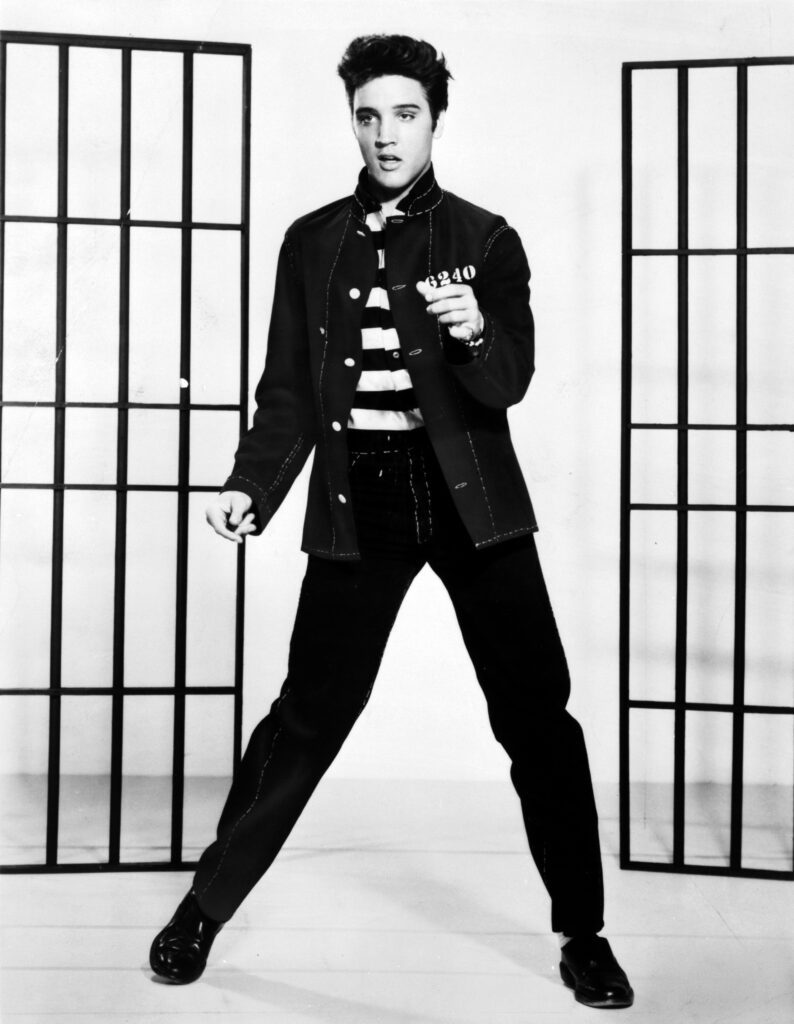
Between 1956 and 1958 Presley became the most commercially significant performer in the world, with Heartbreak Hotel, Hound Dog, Don’t Be Cruel and Jailhouse Rock in rapid succession. He has sold in the region of a billion records worldwide, more than any other solo artist.
What that paid him is the question most profiles skip. Our estimate of his gross career earnings from the craft itself – records, films, television and the stage – is 100 to 150 million dollars across 1956 to 1977, before Parker’s commission and tax. The films account for about a fifth: by the mid-1960s Hollywood paid him a million dollars a picture plus a share of the profits, and he made 31 films in thirteen years in which the soundtrack sold the film and the film sold the album (The Conversation).

What Elvis Presley’s work can earn
Reported pay, contracts, royalties and performance income reveal how the fortune was funded.
The 1968 television special remains one of the most effective comebacks in popular music, and the Las Vegas residency that followed reshaped how the city sold live entertainment. The International Hotel signed him in August 1969 and he played 636 further sold-out shows in that one room over seven years (Fox 5 Vegas), at a fee of 100,000 to 130,000 dollars a week from which the band, the orchestra and the costumes had to be paid (Management Today).
The road was bigger still: from 1970 until his last show in June 1977 he played roughly a thousand arena dates, and that touring engine, not the films, is where most of the career gross was earned.
Presley won three Grammy awards, all for gospel recordings, and the Grammy Lifetime Achievement Award in 1971 at the age of 36. He was in the first group inducted into the Rock and Roll Hall of Fame in 1986 and has since entered the Country, Gospel and Rockabilly halls too. The Postal Service put him on a stamp in 1993 after a public vote on the portrait.
He died at Graceland on 16 August 1977, aged 42. The anniversary is still marked every August by a candlelight vigil at the gates.

Elvis Presley’s business beyond the main career
Endorsements, ownership interests and investments can keep compounding long after the initial breakthrough.
Presley never endorsed a product in the modern sense; Parker’s merchandising was the substitute. Within months of the RCA signing there were Elvis lipsticks, charm bracelets, jeans and record players, licensed through Special Products Inc, with Parker taking a large share. Whatever it earned him is folded into the estimate above rather than counted twice.
Presley ran no businesses; Parker did. His publishing companies, Elvis Presley Music and Gladys Music, took a share of every song he recorded, which is why Dolly Parton famously refused him I Will Always Love You.
The business that carries his name today is not his. Elvis Presley Enterprises was built after his death, and in 2005 Lisa Marie Presley’s trust sold 85 per cent of it to CKX for about 50 million dollars in cash plus stock, a package worth roughly 100 million (CKX’s SEC filing). The rights changed hands again in 2013 when Authentic Brands Group bought them in a deal reported at 145 million dollars (Billboard).

Elvis Presley’s notable luxury item
A reported property or major asset offers a tangible glimpse of the wealth behind the public estimate.
Presley bought Graceland in 1957 for around 100,000 dollars. It is now a National Historic Landmark receiving hundreds of thousands of visitors a year, operated by the Elvis Presley Trust (the Elvis Presley Trust) and owned by his granddaughter Riley Keough, who became sole trustee after Lisa Marie Presley’s death in 2023 (the BBC). An attempted auction of the property in 2024 was blocked in court after Keough alleged the loan documents were forged.
He also owned a fleet of aircraft, including the Lisa Marie Convair 880, and a large collection of cars.
Elvis Presley’s estimated net worth
Public estimates vary because private contracts, investments, taxes and liabilities are not fully disclosed.
How this estimate is calculated
Three documented figures anchor this, and the third explains everything. Parker sold the Sun contract to RCA for 35,000 dollars in 1955. Parker’s commission rose to fifty per cent. And in 1973 Parker sold Presley’s entire back catalogue – more than 700 master recordings – to RCA for 5.4 million dollars, of which Parker took half. Presley received about 2.7 million dollars and surrendered all future royalties on his 1950s and 1960s hits; after his death the estate separately settled with RCA out of court (UPI).
The career gross is our estimate, built from the fees above. Films: 31 pictures, the later ones at a million dollars plus profit share and the earlier ones at a fraction of that, about 20 to 25 million dollars. Las Vegas: roughly fifteen four-week engagements at 100,000 to 130,000 dollars a week, 7 to 8 million. Touring: around a thousand arena shows from 1970 to 1977 at an artist share we put at 50,000 to 75,000 dollars a night, 50 to 75 million. Record royalties, television and merchandising across the career: 20 to 40 million. That sums to roughly 100 to 150 million dollars gross, assuming the concert share matches what top acts of the period took from the gate.
From that gross, Parker removed a quarter and later half, income tax took up to 70 per cent of what remained because Parker never let him shelter it, and the household spent much of the rest. The result is an estate commonly assessed at roughly five million dollars in 1977, with less than a million of it in cash (Management Today), startlingly little for the best-selling solo artist in history. Adjusted for inflation that is in the region of 25 million dollars, and the range below is that inflation-adjusted value of what he personally left, not what the Elvis name earns now.
Whatever the 700 masters would fetch today, the man who sang them was paid 2.7 million dollars for them once, and that single afternoon’s arithmetic is why the King’s estate was smaller than a mid-sized car dealership.
The working supports a range of $20 million to $30 million. The figure we publish is its midpoint.
Confidence: Partly documented — the catalogue sale, commission structure and Vegas fees are on the record; the career gross and the 1977 estate composition are modelled.
Think you know Elvis Presley? Take the quiz: Easy · Medium · Legendary
His giving was personal rather than institutional: every Christmas he spread donations across dozens of Memphis charities in a single afternoon, and the Cadillacs he handed to friends and occasionally strangers became part of the legend. In 1961 he played a Honolulu benefit that raised the money to finish the USS Arizona Memorial, for which he took nothing.
The generosity was real and expensive: a household staff, an entourage on salary and relatives on the payroll consumed a large share of what he earned.
The scrutiny falls into three areas. The first is his appropriation of Black American musical forms and what he owed the artists who created them, a debate that has outlived him. The second is his relationship with Priscilla Beaulieu, who was fourteen when they met in Germany in 1959 and whom he married in 1967. The third is Parker’s management: a Memphis probate investigation in 1980 found his fifty per cent commission and side arrangements extraordinary by any standard, and the estate sued him for fraud and mismanagement before settling (UPI).