
 How Much Are They Worth?
Celebrity fortunes, explained




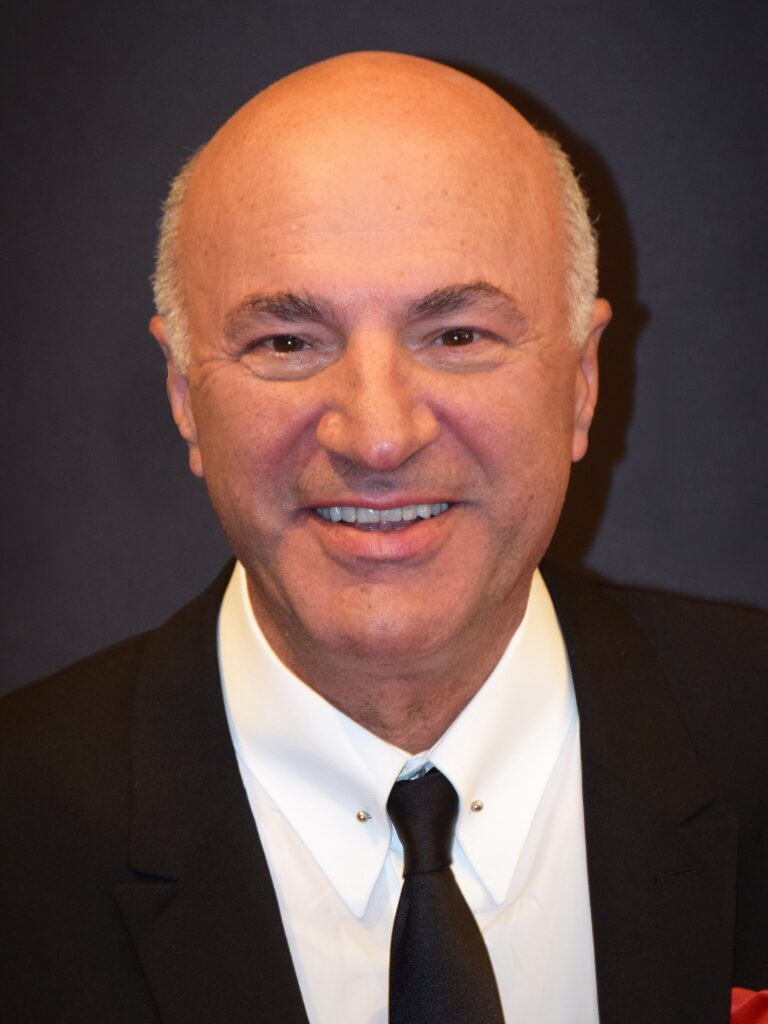
How did Kevin O’Leary build this fortune?
The answer unfolds through the career, earnings, deals and assets behind the headline estimate.
Kevin O’Leary before the fame
The background and early turning points that shaped Kevin O’Leary’s route to prominence.
Kevin O’Leary was born in Montreal on 9 July 1954. His father died when he was young and his mother remarried an economist whose international work took the family abroad, which is why a man identified with North American business television spent part of his schooling elsewhere.
The story he tells most often about money is his mother’s: a retailer who quietly put a third of every pay cheque into dividend-paying stocks and bonds. It is the foundation of his public position on investing, and by his own account why he thinks about wealth as accumulation rather than an event.
He took a degree at the University of Waterloo and an MBA at the Ivey Business School, and after a short period in television production started SoftKey Software Products in the mid-1980s with a partner and a small amount of family capital. The company published consumer software: reference titles, educational discs, boxes sold next to the tills.
SoftKey was publicly traded by 1993, as The Globe and Mail records, and grew by acquisition rather than invention. The decisive move was a hostile bid for The Learning Company; the merged business took the TLC name, ran 3,000 employees and about $800 million of annual revenue, and lost money through 1996, 1997 and 1998.
Kevin O’Leary’s breakthrough years
The career decisions and defining moments that turned recognition into sustained earning power.
In 1999 Mattel bought The Learning Company for roughly $4 billion in stock. It became one of the most criticised acquisitions of the era, and within six months O’Leary was out of a three-year contract as the losses mounted.
This is the event his wealth rests on, and the figure is documented. The Globe and Mail established that he netted $11.2 million from the deal, through his severance package and the sale of his Mattel stock — not the hundreds of millions the headline price invites people to assume. The $4 billion was the company’s price, paid mostly to institutional shareholders; the $11.2 million was his, and everything since started from it.

What Kevin O’Leary’s work can earn
Reported pay, contracts, royalties and performance income reveal how the fortune was funded.
Television is where the second fortune came from. He joined the CBC’s Dragons’ Den in 2006 and ABC’s Shark Tank in 2009. On an episodic fee we put at around $50,000, rising towards six figures for a long-serving panellist, and roughly four hundred episodes across both shows, his gross television earnings come to about $25 million — our estimate, and far more than the 1999 sale paid him.
The platform then monetised itself twice over. A business speaker of his profile commands $50,000 to $100,000 an engagement, and he has published a series of bestselling personal finance books; together we carry speaking and publishing income at roughly $20 million gross across two decades. O’Leary Funds, launched in 2008, reached $1 billion under management within two years and was sold to Canoe Financial in 2015 with $800 million; he held 45 per cent of it.
He is known as Mr Wonderful, the panellist who tells founders their business is worthless and then offers a royalty deal. The character is a commercial asset in itself: it is why the speaking fees are what they are and why financial firms pay to put his name on a product.
In 2017 he entered the race to lead Canada’s Conservative Party and led several polls before withdrawing on 26 April, endorsing Maxime Bernier and saying he did not believe he could win in Quebec, as CBC reported. It lasted four months.

Kevin O’Leary’s business beyond the main career
Endorsements, ownership interests and investments can keep compounding long after the initial breakthrough.
Endorsement income is a major part of his finances, and one episode of it is on the public record in unusual detail. He was paid to act as a spokesman for the cryptocurrency exchange FTX, and after its collapse he told a United States Senate committee in December 2022 that the fee had been $15 million, of which roughly $9.7 million went back into crypto and was lost, the rest to tax and agents, as CNBC reported.
That single arrangement shows the scale of what his name earns. Our estimate is that other brand and spokesman work has contributed a further $15 million to $25 million gross over the past fifteen years.
The venture portfolio is where most of the uncertainty about his wealth lives. O’Leary Ventures makes direct investments; O’Leary Fine Wines sells under his name; he has backed investing apps, bitcoin-mining capacity and dozens of companies from Shark Tank, where the sharks invest their own money rather than the network’s.
A portfolio of that shape is mostly illiquid. He has said he holds stakes in more than fifty private companies, and such a book is worth whatever a buyer pays: a few exits could be worth $80 million, or the same holdings could return a fraction of the capital. We carry it at $30 million to $80 million, the widest band in the arithmetic.

Kevin O’Leary’s notable luxury item
A reported property or major asset offers a tangible glimpse of the wealth behind the public estimate.
His property is spread across the places his work takes him: Toronto, Boston, Florida and a long-held family place in Ontario cottage country. Given his stated preference for income-producing assets over trophies, we carry $20 million to $30 million of real estate.
Alongside it sits the thing he is most credible about: a dividend-focused public-markets portfolio run on the principles he has sold in every book for twenty years. We put the liquid position at $50 million to $80 million, the largest single line in the estimate.
Kevin O’Leary’s estimated net worth
Public estimates vary because private contracts, investments, taxes and liabilities are not fully disclosed.
How this estimate is calculated
Two figures are documented: the $11.2 million of personal proceeds from the 1999 Mattel deal established by The Globe and Mail, and $15 million from FTX of which he says almost all was lost. Around those we build the rest as estimates: about $25 million gross from Dragons’ Den and Shark Tank, about $20 million from speaking and publishing, $15 million to $25 million from other endorsement work, and perhaps $5 million for his 45 per cent of a fund manager sold with $800 million under management. That is $90 million to $100 million of gross lifetime income before investment returns.
Tax at an effective 45 per cent and the FTX loss leave roughly $40 million of net savings, accumulated mostly after 2009 and compounded through the markets he follows. That supports a liquid position of $50 million to $80 million, to which we add real estate at $20 million to $30 million and the private venture book at $30 million to $80 million. The working supports a range of $90 million to $190 million, and the published figure is its centre. Figures several times larger circulate; they require a return on the 1999 proceeds and on his private holdings that his documented pay and the $800 million fund sale do not support, so we have not adopted them.
The private venture book is what makes this band so wide, and only an exit will narrow it. A single liquidity event in O’Leary Ventures or in one of the larger Shark Tank holdings could add tens of millions at a stroke; equally, a book of fifty small private stakes held by a seventy-something investor can quietly mark down to very little. Until one of those companies sells or files, O’Leary’s own balance sheet is the only place the answer exists.
Confidence: Partly documented — the 1999 proceeds, the FTX fee and the campaign debt are published figures, while the television, speaking, property and private-venture lines are our estimates.
His giving is concentrated in business and financial education: support for the Ivey Business School, where his name is attached to teaching facilities, and a long run of student entrepreneurship competitions and scholarships.
The public image is abrasive by design. He is one of the few business figures to have made being disliked on camera into a durable earning asset: the character sells the message, and the message sells the books and the appearances.
The most substantial scrutiny has concerned the gap between his reputation and his record. The 2017 Globe and Mail investigation set out that TLC was loss-making when Mattel bought it, that he left within six months, and that his proceeds were $11.2 million rather than a share of billions; it also found several O’Leary Funds products down more than 20 per cent by late 2012, against a $5 billion target never approached.
The FTX endorsement brought litigation: he was among the public figures sued by investors over the promotion of the exchange. And his political campaign left a small, awkward debt. Global News reported that his leadership campaign owed $529,184 and that he could not simply write the cheque, because Elections Canada caps a contestant’s own contributions and loans at $25,000, so the money had to be raised from donors.