
 How Much Are They Worth?
Celebrity fortunes, explained








How did Kimi Antonelli build this fortune?
The answer unfolds through the career, earnings, deals and assets behind the headline estimate.
Kimi Antonelli before the fame
The background and early turning points that shaped Kimi Antonelli’s route to prominence.
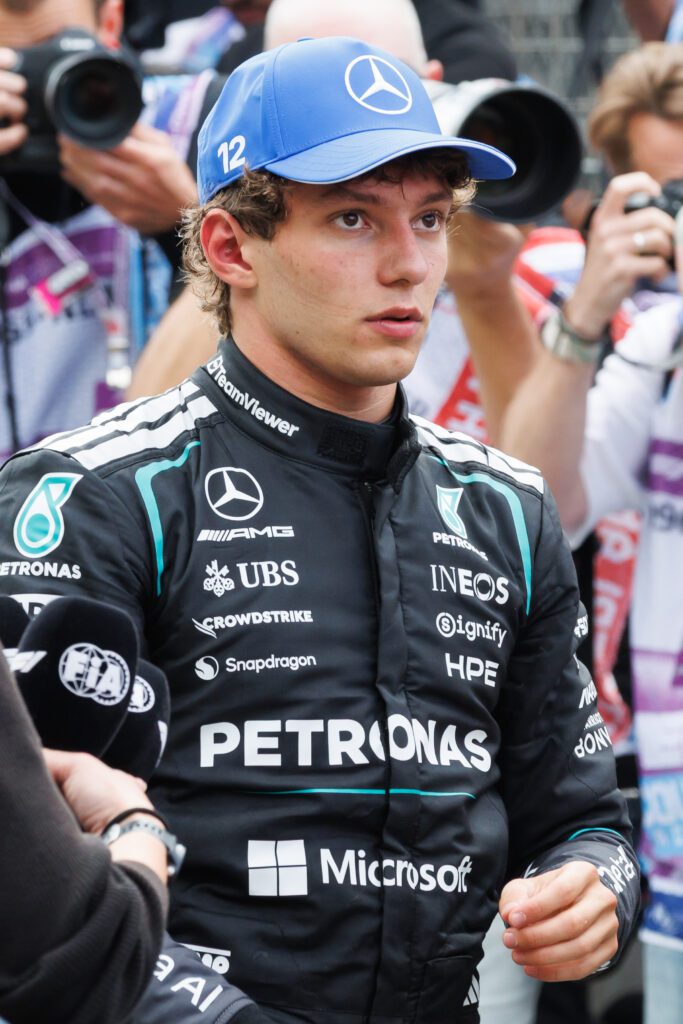
Andrea Kimi Antonelli leads the 2026 Formula 1 world championship by 123 points and is still paid
on the rookie scale he started on. The National put him joint seventeenth on its 2026
salary list at $2 million, thirteen places below his own Mercedes team-mate on $34 million. That gap
is the money story of his career so far.
He was born in Bologna on 25 August 2006. LaPresse records that his father, Marco Antonelli, is a
former sportscar driver who runs the AKM Motorsport team, and that his son has been in the Mercedes
junior programme since 2019.
The years that paid nothing
He started karting at five in Forlì, and LaPresse lists what followed: the WSK Champions Cup
in 60 Mini in 2018, the Euro Series and Final Cup in OKJ in 2019, the OK Euro Series in 2020. Then the
Italian and German Formula 4 titles in 2022, Formula Regional titles in 2023, and Formula 2 with Prema
in 2024, sixth with two wins.
None of it was income. A junior career of that length is a cost carried by a family and a
manufacturer programme, and his was carried by a father who owned a racing team and by Mercedes. The
earnings here start in March 2025.
Kimi Antonelli’s breakthrough years
The career decisions and defining moments that turned recognition into sustained earning power.
He replaced Lewis Hamilton at Mercedes for 2025 and finished fourth in his first race, aged
eighteen. Formula1points has him seventh in that championship on 150 points, six behind Hamilton, with
podiums in Canada, São Paulo and Las Vegas.
The pay has not kept up. The reported bases disagree: $2 million on The National‘s 2026 list, compiled
from specialist salary trackers, against €3 million from Gazzetta dello Sport, which F1 Oversteer
cited while calling him the most underpaid driver on the grid. Milano Finanza put the bonus-inclusive Mercedes
package at up to $14 million for a season like this one, and sponsorship at $1.5 million more.
What has actually been paid is smaller, and that is what this page uses: about
$14 million gross from the craft across two seasons, our estimate, being roughly $3.3
million in 2025 and $10.5 million in 2026 up to the United States Grand Prix, most of it race bonuses.
F1 Oversteer reverse-engineered the per-result rates from a part-season total at just under £15,000 a
point, around £500,000 a win and £370,000 a podium; 365 points at that rate is about $7.3
million. The five rounds still to run, any end-of-season championship bonus and the contracted 2027
season have not been paid, so they are upside and stay out of both this total and the figure.

What Kimi Antonelli’s work can earn
Reported pay, contracts, royalties and performance income reveal how the fortune was funded.
The 2026 season in dates, which is also the season that generated most of the money above:
- 8 June, Monaco. Sofascore records him turning pole into a win, leading all 78
laps, Hamilton second at 6.271 seconds and Isack Hadjar third. - 25 October, Austin. The Sunday Guardian records the United States Grand Prix won in
1:35:16.650 ahead of Charles Leclerc and Max Verstappen, worth 25 points. - After Austin. Crash has him on 365 points with nine wins, 123 clear of George
Russell, 125 points left across five rounds. - Still to come. Two points settle it: ninth or better at the Mexico City Grand Prix
would make him champion, whatever Russell does.
In 2025 he outscored every other rookie on those 150 points, which is the comparison that earned
him a second year.
Leading a championship ahead of a team-mate on seventeen times the salary is its own kind of
recognition, and PitDebrief quoted him on the season behind it: “I’ve learnt so much in my
first season in F1, both in the good moments and the more challenging ones.” Toto Wolff, in the
same announcement, called him and Russell “a strong pairing”.

Kimi Antonelli’s business beyond the main career
Endorsements, ownership interests and investments can keep compounding long after the initial breakthrough.
Milano Finanza estimated his personal sponsorship income at around $1.5 million for 2026, inside a total
of roughly $15.5 million once the Mercedes bonuses were counted. Our working takes $1.2 million
of that as earned by the end of October and $0.3 million for 2025, assuming a driver’s own
commercial deals scale with his results and that his results arrived in 2026.
This is the softest line on the page: a single outlet’s estimate, labelled as one, and a
championship would move it sharply in his favour.
AKM Motorsport, which runs cars in GT and Formula 4 championships, is his father’s team and
his father’s business; LaPresse describes Marco Antonelli as the man at the top of it, and it
arranged his son’s first single-seater test at the Red Bull Ring in 2021. It is a family company
rather than a holding of his, so the working carries no value for it.

Kimi Antonelli’s notable luxury item
A reported property or major asset offers a tangible glimpse of the wealth behind the public estimate.
At twenty, two seasons into a professional income, what he holds is retained cash, and that is
all the working credits him with. The karting and GT equipment that carried him here
belongs to AKM Motorsport, and the Mercedes seat that produces the bonuses is a source of income
rather than an asset he could sell.
This is why the figure at the end of this page is small beside the headline numbers attached to his
name. A $15.5 million earnings estimate is a forecast; a 123-point championship lead is a sporting
fact. Neither is a bank balance.
Kimi Antonelli’s estimated net worth
Public estimates vary because private contracts, investments, taxes and liabilities are not fully disclosed.
How this estimate is calculated
Only money already paid is counted. Everything contracted and unplayed is upside, excluded from
the craft total and the figure.
- 2025, our estimate: $3.3 million gross. A rookie base of about $1.5 million,
some $1.5 million of bonuses on 150 points, $0.3 million of sponsorship. - 2026 to 25 October, our estimate: $10.5 million gross. $2.0 million, four-fifths
of a $2.5 million base (the midpoint of the two reports); $7.3 million of race bonuses, from 365 points
at just under £15,000 a point converted at $1.34 to the pound on the European Central Bank cross rate of 23
October 2026; $1.2 million of sponsorship. - Gross craft earnings to date: $13.8 million.
- Less management at 10 per cent of gross: $1.4 million, leaving $12.4 million.
- Less tax at a blended 40 per cent: $5.0 million, leaving $7.4 million net. The
assumption: Italy’s top rate plus regional and municipal surcharges sits in the mid-forties and
drivers often sit lighter, so 40 per cent is the middle of that. - Less living and spending at 20 per cent of net: $1.5 million, low because he
is twenty. - Retained: about $5.9 million.
The working supports $4.5 million to $7.5 million, and we publish its midpoint. The grade is
Indicative because nothing here is a disclosure about his own money: the base is a press
reconstruction, the bonus rates an outlet’s reverse-engineering from a part-season total, the
sponsorship a single estimate. The input that moves it most is that bonus rate — at
£10,000 a point the figure falls below $4 million, at £20,000 it passes $8 million — so
the number that settles this page is the per-result rate inside the Mercedes contract, not the
trophy.
Confidence: Indicative — two seasons of earnings reconstructed from press salary figures and
reverse-engineered bonus rates, with contracted future money excluded.
His public standing in Italy is built on composure rather than on causes: the Monaco drive, in
which he led every lap of a circuit that punishes one error, did more for it than anything he has said.
He arrived through a manufacturer junior programme that has carried him since 2019, and PitDebrief has
him describing the harder moments of 2025 as the ones that made him stronger as a team-mate.
The scrutiny has been about his pay rather than his driving. F1 Oversteer reported that Mercedes
activated an extension clause in his contract for 2026 instead of negotiating a fresh deal, that the
team left his second season unconfirmed until October 2025, and that a race winner was therefore still
on a rookie-scale wage.
The reported figures are a second kind of scrutiny. The National compiled its list from specialist
salary trackers and said plainly that bonuses were excluded, and Milano Finanza attributed its figures to the
same kind of source. They are press reconstructions, and this page treats them as
that.