
 How Much Are They Worth?
Celebrity fortunes, explained
How Much Are They Worth?
Celebrity fortunes, explained








How did Jensen Huang build this fortune?
The answer unfolds through the career, earnings, deals and assets behind the headline estimate.

Before the fame
The background and early turning points that shaped Jensen Huang’s route to prominence.
Huang was born on February 17, 1963, in Taiwan, to Huang Hsing-tai, a chemical engineer, and Lo Tsai-hsiu, a schoolteacher. When he was five, his father took an engineering job in Thailand and moved the family there; amid regional unrest, nine-year-old Huang and his older brother were sent ahead to the United States to live with relatives and were enrolled at a boarding school in rural Kentucky that turned out to be a strict reform school rather than the elite institution his parents believed they were sending him to. The family later reunited and settled in Oregon, where Huang finished high school. He went on to earn a bachelor’s degree in electrical engineering from Oregon State University in 1984 and a master’s degree in electrical engineering from Stanford University in 1992, working as a chip designer at LSI Logic and later AMD in between.
In 1993, Huang co-founded Nvidia with fellow engineers Chris Malachowsky and Curtis Priem, an idea reportedly hashed out over meetings at a Denny’s restaurant in San Jose, California. The company set out to build graphics processing chips for the video game industry, starting with roughly $40,000 in seed capital before securing venture backing from Sequoia Capital and Sutter Hill Ventures. Nvidia went public on Nasdaq in January 1999, giving outside investors their first opportunity to buy into the company Huang had built.
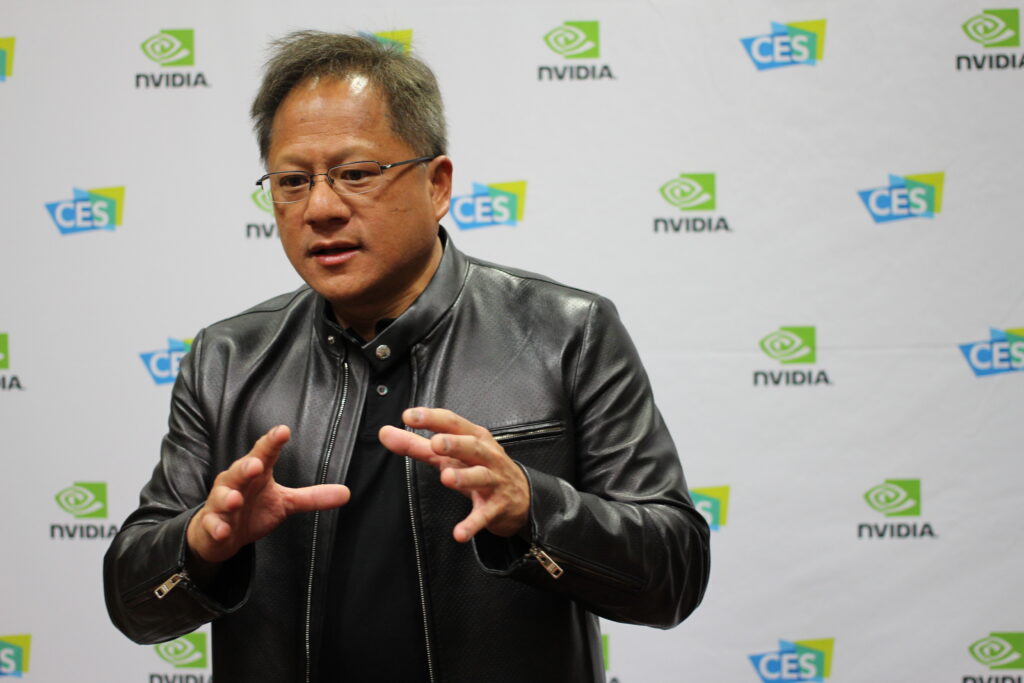
Photo: Anderseidesvik via Wikimedia Commons (CC BY-SA 4.0)
The breakthrough years
The career decisions and defining moments that turned recognition into sustained earning power.
Nvidia spent its first two decades primarily known as a gaming graphics card maker, competing with ATI and later AMD for dominance in PC hardware. Under Huang’s continued leadership, Nvidia’s CUDA software platform, introduced in 2006, gradually turned the company’s chips into the standard computing backbone for machine learning and artificial intelligence research. When the AI boom accelerated in the early 2020s, demand for Nvidia’s data-center GPUs surged, pushing the company’s market capitalization past $1 trillion in 2023 and past $5 trillion by 2026, at times making Nvidia the most valuable public company in the world. Huang remains founder, president, and CEO, a position he has now held for more than three decades without interruption — a rarity among major technology companies.

What the work can earn
Reported pay, contracts, royalties and performance income reveal how the fortune was funded.
As a public company executive rather than an athlete or entertainer, Huang’s reported earnings combine a modest base salary with much larger stock-based compensation, on top of the paper gains on his personal shareholding. Nvidia’s own disclosures show his total reported pay package was about $49.9 million for fiscal year 2025, including roughly $38.8 million in stock awards, and around $36.3 million for fiscal year 2026, after the value of new stock awards declined. These disclosed figures are dwarfed by swings in the value of his existing Nvidia stake, which can rise or fall by billions of dollars in a single trading session.
Huang’s base salary from Nvidia was raised to roughly $1.5 million per year in fiscal 2026, following the company’s first meaningful salary increase for him in about a decade. The bulk of his compensation package continues to come in the form of stock awards and performance-linked equity grants tied to Nvidia’s results, rather than cash. Regulatory filings show Huang has periodically sold Nvidia shares under pre-scheduled 10b5-1 trading plans, reportedly around six million shares for a combined $700-925 million between 2024 and 2025, while retaining the large majority of his overall holding.

The business beyond the main career
Endorsements, ownership interests and investments can keep compounding long after the initial breakthrough.
Unlike athletes or entertainers, Huang does not maintain a portfolio of paid personal endorsement deals. His public profile instead functions largely as an extension of Nvidia’s own brand: his keynote appearances at events such as CES and Nvidia’s GTC conference draw global tech-industry attention, and his signature black leather jacket has become an unofficial personal trademark recognized well outside the semiconductor industry. He has appeared on lists including Time’s 100 Most Influential People and been named a top global business leader by outlets such as Fortune, reflecting a brand value tied closely to his personal reputation rather than any single sponsorship contract.
The overwhelming majority of Huang’s wealth is concentrated in his ownership stake in Nvidia, which regulatory filings place at roughly 3.5% of the company’s outstanding shares, making him Nvidia’s largest individual shareholder by a wide margin. Outside of Nvidia, Huang has not built the kind of separate business empire seen among some other technology billionaires; his public financial activity centers mainly on his continued Nvidia holdings, alongside philanthropic commitments that include sizeable personal donations to Oregon State University and Stanford University for engineering and computing research facilities.

Notable luxury item
A reported property or major asset offers a tangible glimpse of the wealth behind the public estimate.
Huang and his wife, Lori, own a home in the Los Altos Hills area of California’s Silicon Valley, among the most expensive residential markets in the United States. Reporting on Huang’s lifestyle notes he has generally avoided the more visible trappings of extreme wealth common among some other billionaires, though he has access to corporate aircraft through Nvidia in connection with his executive duties. As with many billionaires whose wealth is concentrated in a single company’s stock, the value of his overall estate is closely tied to Nvidia’s share price rather than a diversified portfolio of separate physical assets.
Jensen Huang’s estimated net worth
Public estimates vary because private contracts, investments, taxes and liabilities are not fully disclosed.
| 1993 | Co-founds Nvidia with Chris Malachowsky and Curtis Priem |
| 1999 | Nvidia goes public on Nasdaq |
| 2006 | Launches the CUDA platform, laying the groundwork for Nvidia’s AI computing dominance |
| 2023 | Nvidia’s market capitalization surpasses $1 trillion amid the AI boom |
| 2024-2025 | Huang sells roughly six million Nvidia shares worth an estimated $700-925 million under scheduled trading plans |
| 2026 | Nvidia’s market capitalization tops $5 trillion; Huang’s net worth estimated in the $165 billion-$200 billion range |
Among technology executives, Huang is most often compared to Tesla and SpaceX’s Elon Musk and Meta’s Mark Zuckerberg, whose fortunes — like Huang’s — are concentrated heavily in the stock of the companies they lead, making all three net worth figures highly sensitive to short-term stock market movements. Compared with Amazon founder Jeff Bezos and Microsoft co-founder Bill Gates, whose fortunes have diversified over time into other assets, Huang’s wealth remains unusually concentrated: the vast majority of his net worth is still Nvidia stock, more than three decades after he founded the company.
Sources and references
Sources referenced for this article include reporting from Forbes, the Bloomberg Billionaires Index, Nvidia SEC filings and proxy statements, and coverage from Reuters and Fortune on Nvidia’s stock performance and executive compensation. Net worth figures are estimates compiled from public financial reporting and are subject to change with Nvidia’s share price. Last updated: August 2026.
From a childhood shaped by an ocean crossing and a rough start at a Kentucky boarding school to the helm of the company powering the artificial intelligence era, Jensen Huang’s fortune has become one of the most direct real-time gauges of the AI boom itself — rising and falling by billions of dollars alongside Nvidia’s stock price.
Answer 5 questions about Jensen Huang and get a free offer
Take the Quiz