
 How Much Are They Worth?
Celebrity fortunes, explained
How Much Are They Worth?
Celebrity fortunes, explained




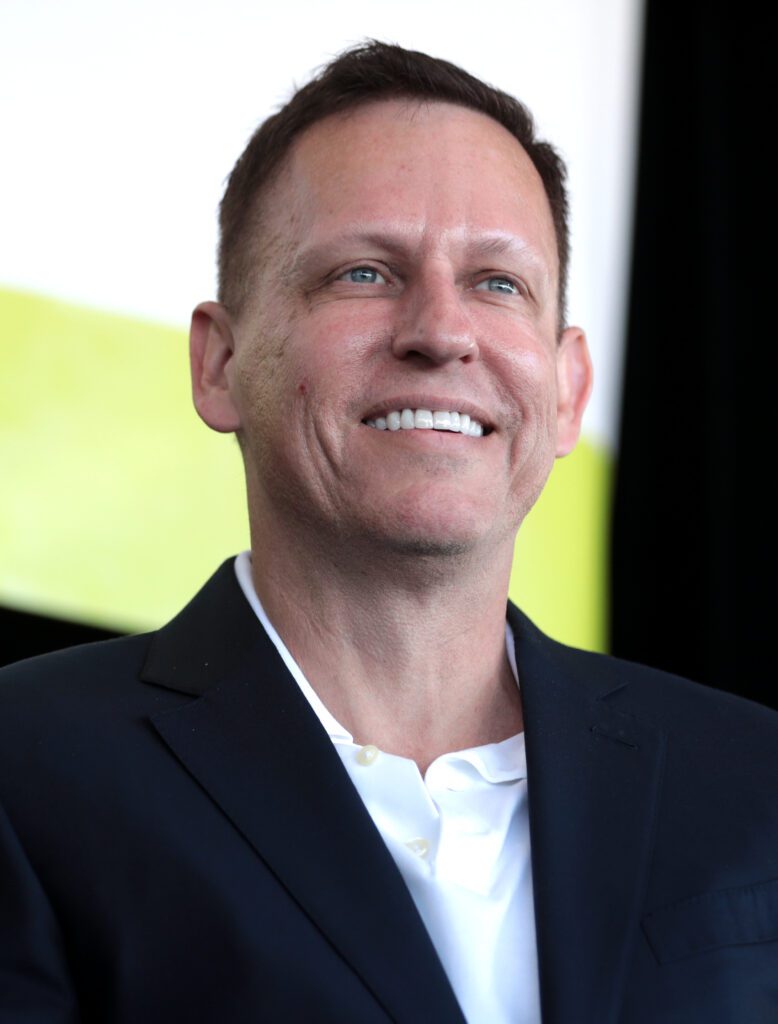
How did Peter Thiel build this fortune?
The answer unfolds through the career, earnings, deals and assets behind the headline estimate.
Peter Thiel before the fame
The background and early turning points that shaped Peter Thiel’s route to prominence.
Peter Andreas Thiel was born on 11 October 1967 in Frankfurt and moved to the United States as a small child. He read philosophy at Stanford, where he founded the conservative Stanford Review, and stayed on for a law degree. A clerkship, months at the law firm Sullivan & Cromwell and a spell trading derivatives at Credit Suisse followed; he has described leaving law as the moment he stopped competing on a track other people had laid out. The money he is famous for came from the decision to stop.
In 1996 Thiel returned to California and raised a small fund, Thiel Capital Management, from family and friends – roughly a million dollars, a figure he has cited himself as the starting capital for everything that followed. In 1998 he used it to co-found Confinity with Max Levchin, which merged with Elon Musk’s X.com in 2000 and took the PayPal name. Thiel served as chief executive through the merger and the flotation.
Peter Thiel’s breakthrough years
The career decisions and defining moments that turned recognition into sustained earning power.
eBay bought PayPal in July 2002 for 1.5 billion dollars. Thiel’s own stake in the company he had co-founded and run converted into a reported 55 million dollars – the seed capital for everything after.
Two years later he wrote a 500,000 dollar cheque to a Harvard undergraduate’s website in exchange for roughly ten per cent of it, becoming the first outside investor in Facebook. When the lock-up expired after the 2012 flotation he sold the great majority of the holding: about 16.8 million shares at the offering, then 20.1 million more in August 2012 at an average of 19.73 dollars, raising a further 395.8 million (Forbes, CNBC). Taken together, the Facebook position returned him more than a billion dollars on half a million invested – better than two thousand to one.

What Peter Thiel’s work can earn
Reported pay, contracts, royalties and performance income reveal how the fortune was funded.
Thiel co-founded Palantir Technologies in 2003 and chaired it through a long private period before it listed in 2020. That shareholding is by a wide margin the largest single component of his wealth, and because he is a corporate insider every sale is filed publicly (Palantir insider filings with the SEC). Those filings show sustained, pre-planned selling – some 50 million shares sold since 2021 for around 1.8 billion dollars, including two million shares in March 2026 for close to 290 million – leaving a position of roughly 69 million shares, about three per cent of the company and worth in the region of 12 to 13 billion dollars at 2026 prices.
He also founded Founders Fund, with early positions in SpaceX, Airbnb, Stripe, Anduril and Palantir itself. The firm closed a 4.6 billion dollar growth fund in April 2025 against a three billion target (CNBC), and raised six billion dollars in its largest-ever haul in May 2026, 1.5 billion of it from its own partners and staff (Bloomberg). On standard venture economics a firm of that size generates hundreds of millions a year in fees before any carried interest, and carry on funds holding SpaceX and Stripe runs to many multiples of that; Thiel’s share is modelled below.
Thiel is recognised less as a financier than as an ideologist. Zero to One became a standard text in start-up circles. The Thiel Fellowship, which pays young people to leave or skip university, drew attention out of all proportion to its budget. The ‘PayPal Mafia’ – the founders who left the company and built Tesla, SpaceX, LinkedIn, YouTube and Palantir – made him a reference point for how concentrated technology wealth became.
Peter Thiel’s business beyond the main career
Endorsements, ownership interests and investments can keep compounding long after the initial breakthrough.
There is effectively nothing here, and that is itself informative. Thiel has no consumer endorsement business, no branded products and no sponsorship income. His public profile earns through speaking fees, book royalties and the deal flow that reputation brings to a venture firm – second-order effects rather than a revenue line.
Beyond Palantir and Founders Fund, Thiel has run Clarium Capital, a global macro hedge fund that grew to several billion dollars before heavy losses shrank it, and Mithril Capital, a growth fund of a few billion. He was an early and large holder of Bitcoin, and has backed defence, biotechnology and political ventures directly. The pattern across all of it is the one that produced the Facebook cheque: a small number of very concentrated positions. Concentration is the method, and volatility is its price.

Peter Thiel’s notable luxury item
A reported property or major asset offers a tangible glimpse of the wealth behind the public estimate.
Thiel has held homes in San Francisco, Los Angeles, Miami and Maui, and a well-documented estate at Wanaka in New Zealand’s South Island. Our estimate for the personal property portfolio is 150 to 300 million dollars, derived from the sale prices reported for comparable trophy assets in those markets. Against a fortune measured in billions it is a rounding item.
Peter Thiel’s estimated net worth
Public estimates vary because private contracts, investments, taxes and liabilities are not fully disclosed.
How this estimate is calculated
Start with what can be counted. The Palantir stake is the anchor: roughly 69 million shares, worth 12 to 13 billion dollars at 2026 prices and verifiable through insider filings (Palantir insider filings with the SEC). Add realised proceeds that have been banked and reinvested for a decade or more – 55 million dollars from PayPal in 2002, over a billion from Facebook in 2012 (CNBC) and around 1.8 billion from Palantir sales since 2021 – which we carry at 3 to 5 billion dollars after tax and growth. The Roth account reported at around five billion dollars (ProPublica) is a wrapper around some of those same holdings rather than a separate pile, so it changes the tax on the total, not the total itself.
Then model the rest. Founders Fund is a general partner in SpaceX, Stripe and Anduril at valuations that have multiplied since its early cheques, and its 2026 raise took 1.5 billion dollars from its own partners; our estimate of Thiel’s personal share of accumulated carry, fund stakes and co-investments is 8 to 20 billion dollars, assuming founder’s economics on a firm of that size and marks consistent with the public ones. Mithril, Bitcoin and a long tail of private positions add an amount we model at one to three billion rather than assert. The result is a range because Palantir and SpaceX are the dominant terms, and both have moved by factors rather than percentages within single years. Forbes’ billionaires profile puts him at around 37 billion dollars in September 2026 and sits at the top of our range; our lower bound is what the same holdings were worth at the marks of a year earlier. The honest way to read any figure for Thiel is as a snapshot of a stock quote attached to a man, taken on a particular afternoon.
The working supports a range of $25 billion to $38 billion. The figure we publish is its midpoint.
Confidence: Partly documented — the Palantir holding and the PayPal, Facebook and Palantir sale proceeds are filed or reported, while the venture-fund carry and private positions behind the upper bound are modelled on standard partnership economics.
Think you know Peter Thiel? Take the quiz: Easy · Medium · Legendary
Thiel has funded the Thiel Foundation, the Methuselah Foundation and the Machine Intelligence Research Institute, and channelled money into longevity research, seasteading and anti-ageing biotechnology – projects that reflect a specific view of what progress requires, rather than endowments and hospital wings. His public image has shifted accordingly, from contrarian investor to political actor, and he is the figure most often cited when people describe Silicon Valley wealth as a force in American government rather than merely adjacent to it.
Thiel secretly funded Hulk Hogan’s invasion-of-privacy litigation against Gawker Media, which produced a 140 million dollar verdict and the publication’s bankruptcy. He acknowledged the funding afterwards and described it as deterrence; critics described it as a billionaire closing a publication that had written about him. He obtained New Zealand citizenship in 2011 after spending twelve days in the country, a grant that prompted a later government review. Palantir’s contracts with immigration and intelligence agencies have drawn sustained criticism from civil-liberties organisations and some of its own staff.
And ProPublica reported that Thiel had built a Roth individual retirement account – a vehicle designed for middle-class savers, with annual contributions capped at a few thousand dollars – into a fund worth around five billion dollars, from which withdrawals are tax-free. That structure sits outside conventional wealth accounting altogether.